



Ask “how many push button switch types are there?” and every source gives a different number: two, three, five, a dozen. All are describing the same devices, and all are incomplete, because each list cuts the subject along a different axis. This guide gives you one framework that explains every list you will meet, then shows how to use it when you choose, replace, or order a button for an industrial panel.
What Is a Push Button Switch, and What Isn’t One?
A push button switch is a manually operated control device: you press the operator, an internal mechanism moves a set of contacts, and a circuit opens or closes. Release it and a spring returns the operator to rest, which is what gives push buttons their defining trait: the device acts only while a human hand is acting on it.
Its contacts have two possible rest states. A normally open (NO) contact is open at rest, so the circuit is off until you press and it closes. A normally closed (NC) contact is closed at rest, so the circuit is on until you press and it opens. Every push button type you meet later is built from one of these two behaviors.
Equally useful is knowing what a push button is not. It belongs to the “operated by a person” family of switches. Limit switches and micro switches are triggered by machine motion, not by a hand: a separate product family, so do not ask for a push button when a cam will do the pressing. Inside the hand-operated family, the neighbors have clear boundaries too. Tactile switches are miniature, PCB-mounted, almost always momentary, and live inside electronics: a different product class, not a small push button. Rocker and toggle switches latch mechanically and sell as their own families. Selector switches share the mounting hole and panel system of industrial push buttons, but they are rotary: you turn a knob for “manual / auto / remote”, you do not press it.
Why “How Many Types” Has No Single Answer
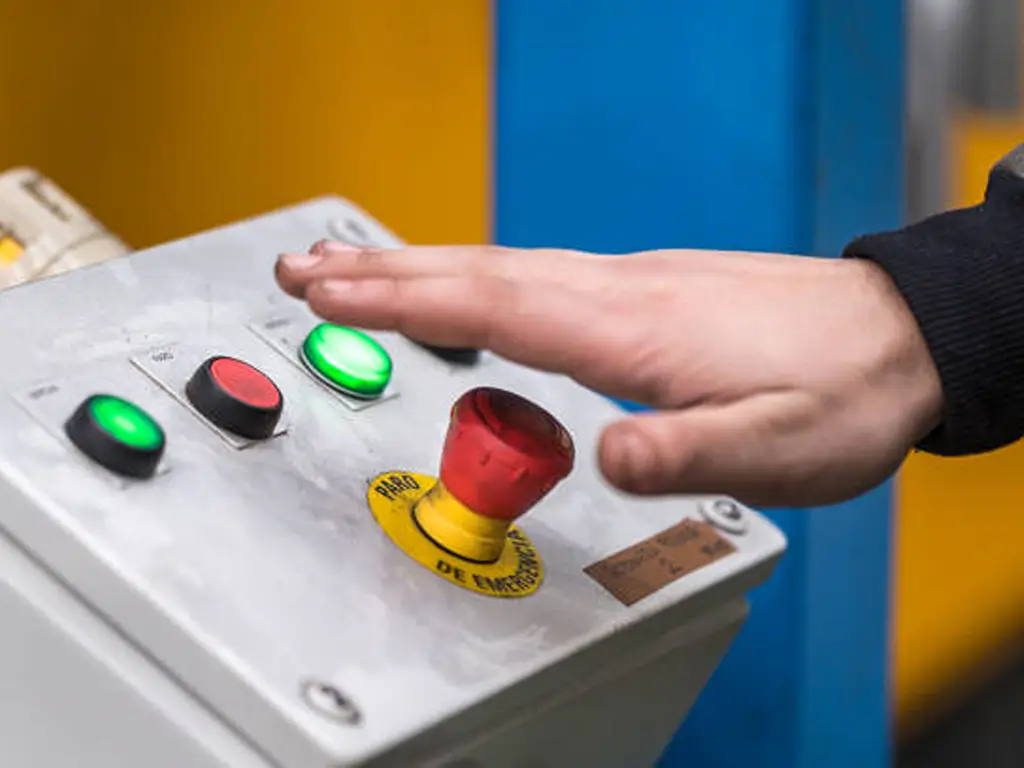
Compare a doorbell button, an arcade button, a start button on a lathe, and a red mushroom emergency stop. All four are called push buttons, yet nobody would swap one for another. A “type” is not one attribute: every push button carries at least three independent sets of decisions, and each list you read counts the branches of just one.
Here is the mental model to keep for the whole guide:
Every industrial push button is three independent choices in one housing: the operator you press, the contact circuit behind it, and the mounting and environment package that fits it to your panel. The segments combine freely, which is why counts never agree: the “two types” answer counts operator behavior, the “three classifications” answer counts function, and none is the whole picture. A “latching illuminated 22 mm button with a 1NO1NC block” is one operator choice, one lamp choice, one mounting choice, and one contact choice stacked into a single line item.
One Push Button, Three Independent Choices
Segment 1 · Operator
What you press: momentary, maintained, or e-stop latching; shape and colour.
Segment 2 · Contact circuit
What carries the load: NO/NC block, poles, rating, silver vs gold.
Segment 3 · Mounting & environment
What fits the panel: hole size, IP rating, destination standard.
The model also explains why industrial push buttons are sold as modules while small electronic ones are not. A PCB-mount push button is one integral piece: press the whole switch, replace the whole switch. An industrial panel button is modular: catalogs list operators, contact blocks, lamps and legend plates as separate lines that assemble on one mounting base, so a worn contact block comes out while the operator stays and the wiring never moves.
Momentary, Maintained, E-Stop: Behavior Decides the Type
The operator segment carries what most articles mean by “push button switch types”: how the button behaves after release, and what it looks like. Behavior comes first, because the circuit decides it, not taste.
The Three Behavioral Families
Every operator is momentary, maintained, or emergency-stop latching, and two of the three are easy to confuse because they share a word.
A momentary operator returns to rest when released; it is also called spring-return. Press to act, release to stop acting. A maintained operator stays in the position you pushed it into until you push it again; catalogs call the same behavior maintained, latching, alternate operation, or self-holding. Four labels for one behavior: exactly the naming sprawl behind the disagreement on “types” lists.
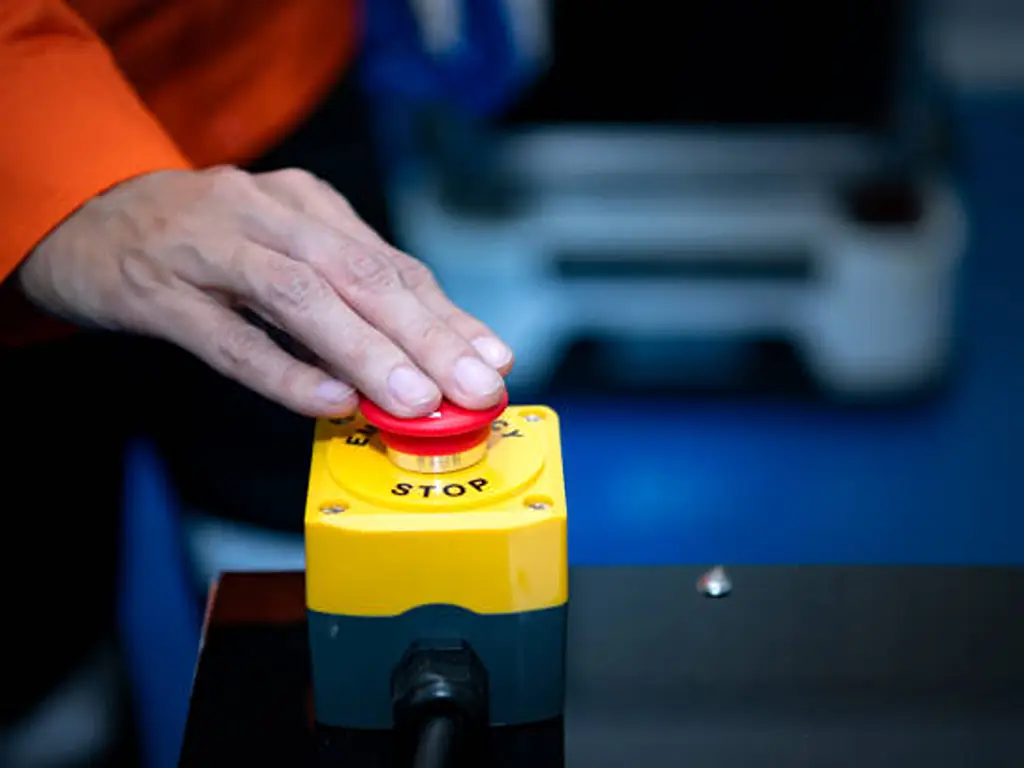
The third family, the emergency stop, is mechanically maintained too, but it is a product class of its own, governed by its own standards. It must latch mechanically when actuated, its NC contacts must open by direct mechanical action rather than spring force, and it may be reset only by an intentional human action: twisting, pulling, or key release in older designs. Latching keeps a stopped machine stopped while you find out why, and reset must never restart the machine: a deliberate start command is required afterward. ISO 13850:2015 sets these rules for the emergency stop function, and IEC 60947-5-5 covers the device itself (its scope is limited to devices with mechanical latching). The safety-related parts of the control circuit must also reach at least performance level c (PL c) or SIL 1.
Behavior Boundaries: What Each Type May Never Do
Now the part that matters on a real machine: each family has a hard boundary, and crossing it is how machines restart on their own, keep moving unattended, or fail to stop in an emergency.
Start commands are momentary-only. If a machine must not restart by itself after a power failure and restoration, its start input must be a momentary button, with the run state held by a seal-in circuit or the PLC program. A maintained start button that stays closed through a power dip can make the machine come alive when power returns; experienced controls people state the rule flatly: momentary for start. Jog and inch functions follow the same logic and must never be maintained or latched: a jog must stop the instant the operator lets go, and latched jog inputs are a classic source of “the machine kept moving while I turned around” incidents.
The emergency stop is the boundary where momentary is illegal. A machine whose “emergency stop” is a momentary push button does not stop, it interrupts: release it and the machine resumes. That failure has produced real incidents, and it violates ISO 13850 and IEC 60204-1. A button marked as an emergency stop must be a latching red mushroom operator, hard-wired through its NC contacts into the safety circuit. Mushroom shape alone is not enough: a mushroom operator on an ordinary maintained function is not an emergency stop.
An emergency stop is not momentary
An emergency stop must latch and must be reset by hand. A momentary e-stop “works” only until someone lets go; then the machine starts again on its own.
Maintained operators do have legitimate homes: mode selection, state-holding functions, and on-off control where a visible, persistent state is wanted. But many “it must stay on” cases are better solved by a momentary button plus electrical seal-in, because a mechanically maintained contact cannot be released from another station or by the control system. That circuit logic and its wiring deserve their own treatment; see the companion guide on push button wiring and the start-stop seal-in circuit.
| Family | Behavior | Typical jobs | Red line |
|---|---|---|---|
| Momentary (spring-return) | Acts only while pressed | Start; jog and inch; signals | Never an emergency stop. |
| Maintained (latching / alternate) | Stays in the last pushed position | Mode selection; on-off state | Never for start (auto-restart risk) or jog (runaway risk). |
| E-stop (latching release) | Latches pressed; twist / pull / key to reset | Emergency stop only | Latching red mushroom, NC into the safety circuit |
Shapes and Colours: the Visible Side of the Operator
Operator shape is where catalog photos live. Flush operators sit nearly level with the panel and resist accidental presses; extended operators rise above it for gloved hands; mushroom operators give a large palm-sized target, which is why emergency stops use them; key-operated operators lock out unauthorized use. The remaining variants, long-head, guarded, double, refine the same four ideas: prevent accidental presses, enable gloved presses, make the emergency target big, or restrict who presses.
Colour is regulation, not decoration. Under IEC 60204-1, start actuators should be white, grey, black or green (white preferred), stop actuators black, grey or white, and red is reserved for the emergency stop; green must never be used for stop. The red-on-yellow emergency stop combination is so standardized that IEC 60204-1 and NFPA 79 both reserve it exclusively for emergency stop devices. ISO 13850:2015 also advises against printing text on the actuator or its background, allowing only the IEC 60417-5638 symbol where a mark is needed. Text is not required; the colour combination is the signal.
Contact Blocks and Lamps: What Actually Carries the Load
The second segment does the electrical work, and it is where specification errors happen, because it sits out of sight behind the panel. The operator is what you see; the contact block is what you order.
Contacts are described by rest state and count. A single block commonly carries one NO contact, one NC contact, or both as a 1NO1NC changeover. The pole notation maps straight across: SPST is one circuit, SPDT one changeover, DPST and DPDT double each for two isolated circuits. For panel buttons the practical unit is the block: one 1NO1NC covers most start-stop needs, and two stacked give 2NO2NC when one button must signal two things at once.
| Code | Meaning | Panel use |
|---|---|---|
| SPST | One circuit (NO or NC) | Simple signal. |
| SPDT | One changeover | Stop + start contacts on one block. |
| DPST | Two independent circuits | Switch two loads together. |
| DPDT | Two changeovers | Two isolated circuits switched together. |
| 1NO1NC | The common panel block | Start + stop behind one button |
Ratings follow the load, not the button. Inductive loads arc harder on opening, and IEC 60947-5-1 classifies them by utilization category: AC-15 covers switching electromagnetic loads such as contactor coils, DC-13 covers switching electromagnets in DC circuits. When the load is a coil, the AC-15 or DC-13 figure on the block is the one to compare.
Contact material is the silent cause of mysterious failures. Power-level contacts use silver alloy, which withstands the arc of real current. But silver tarnishes in air, and tarnish is an insulator at the tiny voltages and currents of dry circuits: PLC inputs and logic signals. A silver contact on a dry circuit works for a while, then fails intermittently; the “new” button that tests fine with a meter but fails in the machine is the classic signature. Dry circuits need gold-plated contacts, and gold contacts on power loads are equally wrong: they erode quickly under real current.
The lamp has one rule worth framing: lamp voltage is not contact voltage. A 24 V lamp on a button whose contacts switch 230 V is normal: the lamp feeds from the panel’s 24 V control supply while the contacts switch the machine load. Ordering a 220 V lamp for a 24 V panel is not normal: it barely glows, and the reverse burns out instantly.
Mounting, Environment and Export Rules: Sizing a Replacement Correctly
The third segment decides whether the operator and contact block you chose will fit, survive the environment, and pass inspection in the country the machine ends up in. It turns a type discussion into an order, and it is the one that burns replacement buyers most often.
The Mounting Hole Is the Lock
Industrial push buttons are defined by the diameter of the hole they mount in. Ranges are organized around standard hole sizes: 16 mm and 22 mm are the modern panel sizes, 22 mm has become the default across most industrial ranges, and 30 mm survives in heavy-duty and older US-influenced panels, alongside the imperial 30.5 mm (1-3/16 in) openings of legacy American equipment. The first question for any replacement is therefore: measure the hole before you ask about the brand.
Modular buttons make the payoff concrete: a broken operator is replaced with a matching operator, a worn block with a compatible block, and the wiring never moves. But the hole is a compatibility lock, not a universal key: two buttons with the same hole diameter are not automatically interchangeable, because operator, block and lamp must match within one system. The professional answer to a replacement request is a request, not a guess: confirm the hole, then confirm the segments.
The Three Hole Sizes You Will Actually Meet
Compact control stations
Small machines and tight panel layouts
The industrial default
Most modern ranges build around it
Heavy-duty and US legacy
Older panels may carry imperial 30.5 mm (1-3/16 in) openings
Same hole size is not same button: operator, block and lamp must match within one system.
Environments: Where Ordinary Buttons Are Not Allowed
The IP code covers solids and water: IP40 for basic indoor panels, IP65 for dust-tight and hose-down-resistant, IP67 for temporary immersion, and washdown-duty machines go further. Match the rating to the environment’s worst moment: a panel that gets hosed down weekly needs the hose-down rating every week. The hard line is the hazardous area: an explosive atmosphere does not need a “stronger” button but certified explosion-proof or intrinsically safe equipment built to ATEX or IECEx rules, selected as part of a full hazardous-area design. An ordinary industrial button, whatever its IP rating, is not allowed there.
Destination Rules: Same Button, Different Markets
Export machinery and its spare parts are built to the standards of the market they will serve: European-bound machines under IEC 60204-1, with emergency stops per ISO 13850 and IEC 60947-5-5 and CE marking; US-bound machines under NFPA 79; China-market equipment under CCC. The practical consequence is blunt: when a trader or OEM asks which button fits, the correct first question is not the brand but the destination. A compliant button is defined by the standard its machine must meet.
| Choice | Right scene | Boundary to respect |
|---|---|---|
| Momentary | Start; jog; signals | Never an emergency stop. |
| Maintained | Mode select; on-off state | Not for start; never for jog. |
| E-stop latching | Machine safety | Latching red mushroom; NC into safety circuit; manual reset. |
| 22 mm modular | Standard IEC-style panels | Will not fill a 30 mm legacy hole. |
| 30 mm heavy-duty | Gloved heavy industry; US legacy panels | Measure the hole before ordering. |
| Gold contacts | Dry logic-level circuits | Erode under power loads. |
| Silver contacts | Power and coil loads | Fail intermittently on dry circuits. |
| 24 V lamp | 24 V control panels | A 220 V lamp burns out instantly. |
| Hazardous-area certified | Explosive atmospheres | Ordinary buttons are forbidden there |
Five questions close a button order cleanly, whether you are buying one piece or a hundred:
Five Questions That Specify Any Push Button
- What mounting hole size?
- What operator behavior: momentary, maintained, or latching emergency stop?
- What contact combination and rating, and what load does it switch?
- What lamp voltage, if illuminated?
- What standard must the machine meet, meaning where does it ship?
Answer those five and the “type” is fully specified, whichever catalog you are holding.
What This Means If You Stock and Sell Push Buttons
Everything above is more than a buying guide; for a distributor serving repair and maintenance customers, it is the shape of a stock list. Return to the three-segment model and the numbers behave differently. A row of complete, one-piece buttons is a wall of slow-moving SKUs: each one is a single customer’s exact configuration, and none is the next customer’s. A small matrix of modular segments covers the same customers with far fewer line items: a 22 mm operator family in momentary, maintained and latching emergency-stop versions; 1NO1NC and 2NO2NC snap-action blocks in silver for power loads and gold for dry circuits; lamps in 24 V and 220 V. Any segment combines with any other, which is precisely what makes the stock efficient.
The model also makes the counter conversation reliable. When a customer asks for “an emergency stop button”, the profitable response is not to reach for the shelf but to ask the five questions above, starting with the hole size and ending with the destination standard. Every answer narrows the matrix one step; every skipped question is a return or a site visit later. Selling the matching service, not just the piece, is where the margin lives: customers pay for “this will fit and comply”.
One honest boundary: the matrix covers the daily bulk of panel work. Project-sized orders, hazardous-area certified devices, and extreme-duty specifications should still be handled as inquiries against the full range.
If you have panel details and drawings on hand, OMCH’s spec-based product selection support matches your request across a range spanning 30+ categories of industrial automation components. Operators, contact blocks and lamp choices come back as one order, alongside the switches, relays and power supplies in the same cabinet.
Send the Panel Specs, Get the Button Match Confirmed
Answer the five questions from the checklist, or send photos and markings of the old unit. We match operator, contact block and lamp across 30+ categories of industrial automation components, so the replacement and the rest of the cabinet order arrive together.
Send My Spec ListReferences
- Control Engineering. “Machine Safety: My Main Disconnect E-Stop Isn’t Red With a Yellow Background.” 2026. https://www.controleng.com/machine-safety-my-main-disconnect-e-stop-isnt-red-with-a-yellow-background/
- r/PLC practitioner discussion. “Momentary vs Maintained Contact: Does It Matter?” 2021. https://www.reddit.com/r/PLC/comments/qvjv9w/momentary_vs_maintained_contact_does_it_matter/
- r/PLC practitioner discussion. “E-Stop Button: ISO 13850 and Performance Level Requirements.” 2025. https://www.reddit.com/r/PLC/comments/1hw26vk/estop_button/
- OMCH. “Push Button Switch Category.” 2026. https://www.omch.com/push-button-switch/
- OMCH. “Product Selection Support.” 2026. https://www.omch.com/product-selection/
- OMCH. “Home.” 2026. https://www.omch.com/


 English
  Arabic
  Turkish
  Russian
  Spanish
  French
  Indonesian
  Portuguese
  Thai
Thai  Vietnamese