




Why Every Electrical Distributor Needs a Systematic Category Framework
Picture this: a customer in Southeast Asia sends you an RFQ with 15 line items — proximity sensors, MCBs, DIN-rail power supplies, terminal blocks, a couple of contactors, and a temperature controller. Each product comes from a different factory. Each factory has its own MOQ, lead time, and shipping schedule. Your job? Consolidate all of this into one shipment, at a workable margin, without missing a single part number.
This is daily reality for small-to-medium electrical wholesalers and distributors serving overseas markets. The electrical components landscape spans dozens of product categories and thousands of SKU variations. Without a systematic mental map of what exists in each category — and why certain items belong together from a procurement standpoint — you run into three problems: ballooning supplier count, missed cross-selling opportunities, and quote delays that lose deals.
A structured category framework gives you three concrete advantages. First, it cuts the number of factories you need to manage. When you know which product families naturally cluster together, you can consolidate sourcing. Second, it prevents RFQ blind spots: when a customer asks for “electrical items” generically, you can proactively suggest complementary categories they may have overlooked. Third, it speeds up your response time. Instead of searching “what’s an SPD?” mid-quote, you already know where it sits in the taxonomy and which supplier carries it.
This guide organizes industrial electrical components by procurement logic — grouping products the way a distributor stocks shelves and builds shipments, not the way an engineer designs a schematic. It covers the full electrical items list across seven major category clusters, from circuit protection to field devices to physical infrastructure. At the end, you will find a supplier evaluation framework and a practical procurement strategy for multi-category sourcing.
Circuit Protection and Power Distribution Components
Circuit protection and power distribution form the foundation of virtually every electrical installation. Whether your customer is building a control panel, upgrading a facility’s switchgear, or stocking replacement parts for maintenance contracts, these products are the high-turnover, high-repeat backbone of any electrical items list. The procurement logic here is different from other categories: you are not comparing feature sets — you are matching electrical parameters. Get the rated current, breaking capacity, and trip characteristics right, and the sale is straightforward.
Miniature Circuit Breakers (MCB), Molded Case Circuit Breakers (MCCB), and Air Circuit Breakers
Circuit breakers follow a clear size-and-capacity hierarchy that maps directly to where they sit in a power distribution system. Understanding this hierarchy is the first step toward accurate quoting.
Miniature Circuit Breakers (MCBs) are the workhorses of terminal distribution. Rated from 6A to 63A, they protect individual circuits in residential, commercial, and light industrial panels. The key procurement parameters are pole count (1P through 4P), rated current, and trip curve. Trip curves follow IEC 60898: Type B (trips at 3–5 times rated current, for resistive loads like lighting), Type C (5–10× In, for general-purpose inductive loads like motors), and Type D (10–20× In, for high-inrush equipment like transformers and X-ray machines). A common distributor mistake is shipping Type B breakers for motor circuits — which will nuisance-trip on startup. When in doubt for industrial applications, default to Type C.
Molded Case Circuit Breakers (MCCBs) handle the mid-level: 100A to 1,600A, installed in distribution boards and sub-main panels. Governed by IEC 60947-2, MCCBs offer adjustable trip settings — you can dial in the long-time delay, short-time pickup, and instantaneous thresholds. The critical procurement parameter beyond current rating is the breaking capacity (Icu), expressed in kA. A 25kA MCCB might suffice for a downstream panel, but the main incomer might need 65kA or higher depending on the prospective short-circuit current at that point in the network. Also verify Ics (service breaking capacity) — the breaker’s ability to interrupt a fault and remain operational afterward, typically expressed as a percentage of Icu.
Air Circuit Breakers (ACBs) sit at the top of the hierarchy: 630A to 6,300A, installed as main incomers in large switchboards. They come in two form factors — draw-out (mounted on a carriage that slides out for maintenance) and fixed (bolted directly to busbars). ACBs almost always include electronic trip units with communication capabilities (Modbus, Profibus) for integration into building management systems. For a distributor, ACBs represent high-value but lower-volume items — worth stocking if you have confirmed demand from panel builders or facility contractors.
Procurement tip: For MCBs, stock the 1P and 3P variants of Type C in 6A, 10A, 16A, 20A, 32A, and 63A as your core range — these cover 80% of typical orders.
Fuses, Surge Protective Devices (SPD), and Isolation Switches
These three sub-categories are circuit protection’s supporting cast. They rarely headline an RFQ but frequently appear as add-on line items that increase average order value.
Fuses break down by application speed. General-purpose gG fuses (IEC 60269) protect against both overload and short circuit. For semiconductor protection — think VFD input stages or rectifier circuits — you need ultra-fast aR types that clear a fault in milliseconds before the silicon junction overheats. NH (刀型) fuse links, with their square ceramic bodies and blade contacts, are the dominant form factor in industrial panels across European and Asian markets. If your customers are in North America, check whether they expect Class J or Class CC fuses per UL/CSA standards instead.
Surge Protective Devices (SPDs) follow a three-tier protection architecture defined by IEC 61643-11. Type 1 SPDs install at the main service entrance and handle direct lightning currents with a 10/350 μs waveform. Type 2 SPDs go into sub-distribution boards and handle switching-induced surges (8/20 μs waveform). Type 3 SPDs protect individual sensitive equipment at the point of use. The key specification is Up (voltage protection level) — the lower, the better the protection — and Uc (maximum continuous operating voltage), which must exceed the system’s nominal voltage with margin.
Isolation switches provide visible break confirmation for safe maintenance. Rated under IEC 60947-3, they are classified by utilization category: AC-21 for resistive loads, AC-22 for mixed loads, and AC-23 for motor and other high-inductive loads. The procurement checkpoint: does the switch need to break under load (in which case AC-23 rating is mandatory) or only in no-load condition after downstream breakers have tripped?
| Type | Current Range | Standard | Key Procurement Parameter | Typical Application |
|---|---|---|---|---|
| MCB | 6A–63A | IEC 60898 | Trip curve (B/C/D) | Terminal distribution |
| MCCB | 100A–1,600A | IEC 60947-2 | Breaking capacity Icu (kA) | Sub-main distribution |
| ACB | 630A–6,300A | IEC 60947-2 | Draw-out vs. fixed | Main incomer switchboards |
Power Supplies, Transformers, and Busbar Systems
Power conversion and distribution hardware forms the electrical backbone inside every control cabinet. The procurement logic flows from high voltage to low: transformers step down the incoming supply, switch-mode power supplies convert AC to regulated DC for control circuits, and busbar systems distribute power with minimal voltage drop.
Control transformers (IEC 61558) take a 380V or 220V AC input and deliver 110V or 24V for control circuits. The key parameter is VA rating — size the transformer based on the total burden of all contactor coils, relay coils, and indicator lamps it will supply, plus 20% headroom. Current transformers (CTs) are specified by their ratio (e.g., 100:5A) and accuracy class (Class 0.5 for metering, Class 5P for protection).
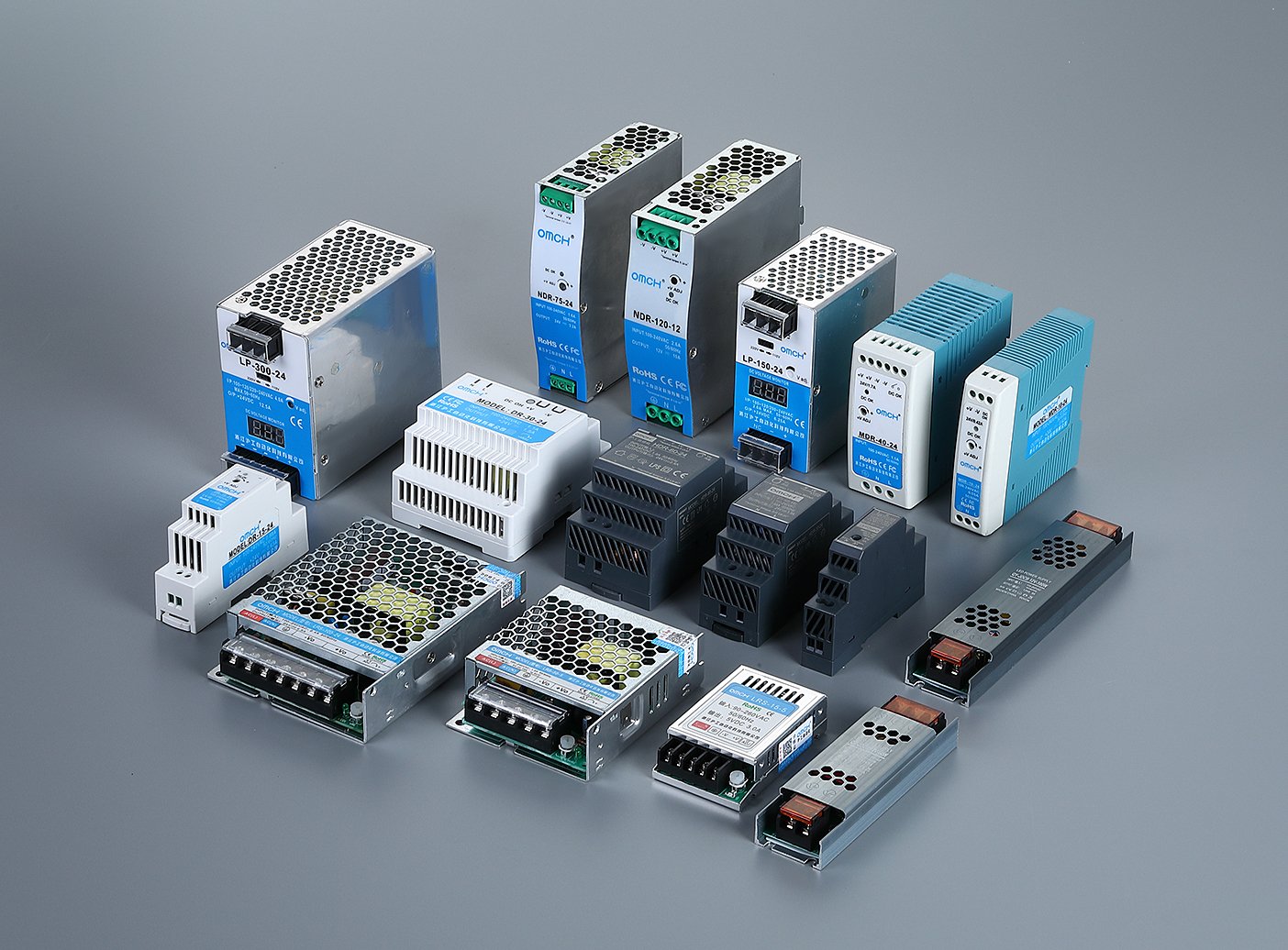
Switch-mode power supplies (SMPS) are the industry standard for control voltage — compact, efficient, and DIN-rail mountable. Common output voltages include 5V (logic circuits), 12V (sensors), 24V (industrial control — the de facto standard), and 48V (PoE and telecom). Power ratings typically span 15W to 960W in the DIN-rail form factor. An important procurement filter: whether the supply includes active Power Factor Correction (PFC). Without PFC, a 240W supply draws disproportionately high input current, which can cause nuisance tripping on upstream breakers in large installations.
Busbar systems distribute power inside switchboards and panelboards. The 60mm center-to-center spacing is the IEC standard, with copper bars rated by cross-sectional area. Procurement considerations include plating — tin-plated copper is standard for most environments; silver-plated offers lower contact resistance but at higher cost; bare copper requires periodic maintenance to prevent oxidation.
Industrial Control, Switching, and Automation Devices
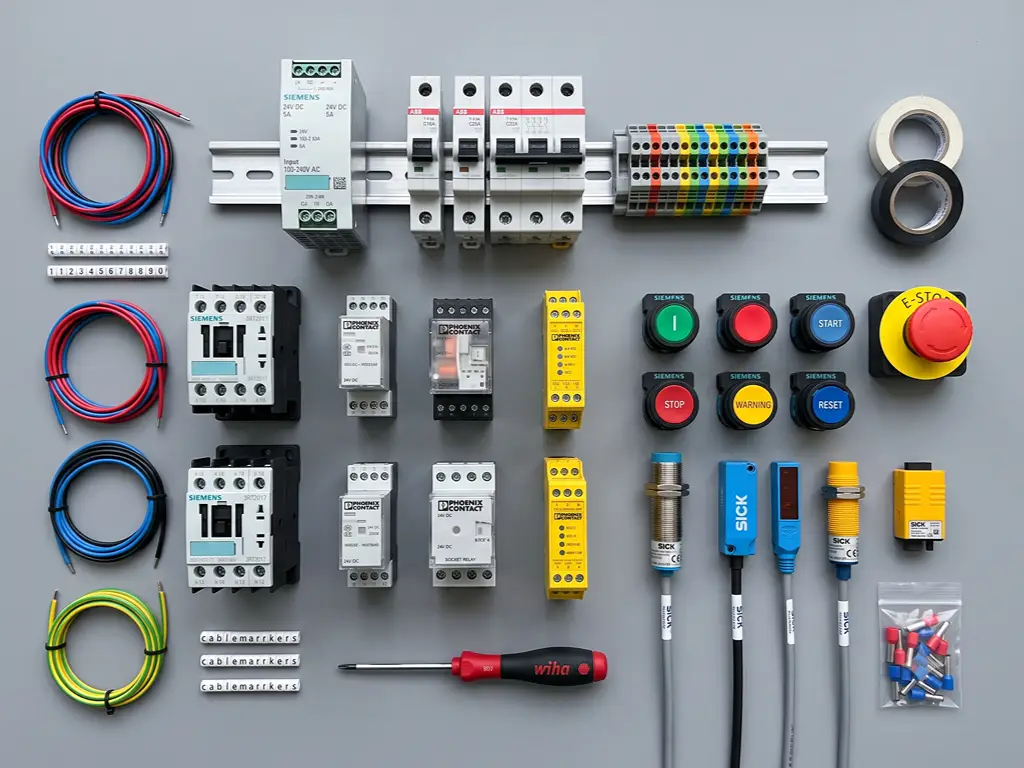
Industrial control represents the intelligence layer of any automated system. For distributors, this category group offers a sweet spot: higher per-unit value than passive components, significant repeat business on accessories and consumables, and a natural entry point for technical consultative selling.
Think of the industrial control complexity ladder: Relays handle point-level on/off decisions, contactors switch power-level loads, PLCs execute programmed logic sequences, and VFDs manage precision motor motion. Knowing which rung your customer operates on tells you which catalog section to open first.
Relays, Contactors, and Overload Relays
Relays are the fundamental switching unit — low-power control signals commanding higher-power circuits. The electromagnetic relay (EMR) remains dominant for general-purpose applications: coil voltages of 12V DC, 24V DC, or 220V AC; contact ratings from 5A to 16A; configurations from SPDT to 4PDT. The miniaturized “ice cube” relays (MY/LY series format) are universally interchangeable across brands — your customer can almost certainly use whatever brand you carry. That makes them ideal stock items.
Solid-state relays (SSRs) replace mechanical contacts with semiconductor switching — zero arcing, silent operation, and lifetimes measured in millions of cycles rather than hundreds of thousands. They cost more but excel in high-frequency switching applications. A temperature controller cycling heaters every few seconds would destroy an EMR within weeks. The procurement parameter to check: zero-cross vs. random-turn-on. Zero-cross SSRs reduce EMI but only work with AC loads; random-turn-on types are required for phase-angle control.
Contactors (IEC 60947-4-1) are essentially heavy-duty relays designed to switch motors and other power loads. The utilization category tells you what the contactor is rated to handle: AC-1 for resistive or slightly inductive loads, AC-3 for squirrel-cage motor starting and switching off during running, and AC-4 for plugging and inching duty (frequent starting with high current inrush). A contactor rated 25A AC-3 might only handle 10A under AC-4 conditions — always match the utilization category to the actual load.
Thermal overload relays protect motors from sustained overcurrent by simulating the motor’s thermal behavior with a bimetallic strip. Trip classes (IEC 60947-4-1) define how quickly the relay trips at 7.2× rated current: Class 10 (2–10 seconds, for standard motors), Class 20 (6–20 seconds, for high-inertia loads), and Class 30 (9–30 seconds, for very heavy starting). Electronic overload relays offer wider adjustment ranges, phase-loss sensitivity, and communication options — increasingly worth the premium as panel builders move toward smart systems.
Pushbutton Switches, Selector Switches, and Indicator Lights
Standardization in this category is so complete that brand loyalty is minimal. That means a distributor with reliable stock and competitive pricing can win business from incumbents here. Every control panel door needs at least a start button, a stop button, and a power indicator.
Pushbutton switch procurement follows the IEC 60947-5-1 framework. The standard mounting hole is Φ22mm (IEC) — not to be confused with the Φ30.5mm NEMA standard common in North America. Confirm which market your customer serves before ordering. Operators come in flush, extended, and mushroom-head profiles; mushroom heads are mandatory for emergency stop functions. Contact blocks (1NC, 1NO, or combinations) are typically sold separately from the operator — this modularity lets you stock fewer SKUs while covering more configurations.
Indicator light color coding follows IEC 60073: Red for emergency/stop/fault, Green for normal/run/safe, Yellow for warning/abnormal condition, Blue for mandatory action, and White for neutral status or confirmation. LED illumination has all but replaced incandescent and neon — the power consumption is negligible and the 50,000-hour lifespan means your customer’s panel will likely be obsolete before the indicator burns out.
Procurement tip: Button operators, contact blocks, and LED lamp cartridges should be stocked as separate line items. This lets you assemble any configuration on demand with one-third the inventory investment of pre-assembled units.
PLCs, HMIs, and Industrial Networking
Programmable Logic Controllers (PLCs) and Human-Machine Interfaces (HMIs) sit at the higher-value, higher-technical-support end of the industrial control spectrum. For a distributor, they carry a steeper learning curve but significantly better margins than commodity components.
The IEC 61131-3 standard defines the programming languages for PLCs, but the practical procurement distinction is simpler: compact PLCs (like the LOGO! or Zelio class, 10–40 I/O points) handle small standalone machines and simple automation; modular PLCs (S7-1200/FX5 class, 40–256 I/O) scale to production lines and can add I/O, communication, and specialty modules as needed; high-end PLCs (S7-1500 class) serve plant-wide automation with redundancy and advanced motion control. Once a customer commits to a PLC platform, they are locked into that ecosystem for I/O modules, programming software, cables, and communication cards. That recurring revenue stream is what makes the initial sale worthwhile for distributors.
HMI selection hinges on screen size — 4.3″ for simple operator panels, 7″ as the most common sweet spot, 10″–15″ for process visualization — and communication protocol support. Most modern HMIs support at least Ethernet/IP and Modbus TCP; Profinet, EtherCAT, and OPC-UA are progressively more common at the higher end.
Industrial networking deserves its own line on the electrical items list. Unmanaged switches are plug-and-play at the machine level; managed switches support VLANs, QoS, and redundancy protocols (RSTP, MRP) for plant-wide networks. The distinction matters because a network outage in a production line can cost thousands per minute — managed switches with ring redundancy are cheap insurance.
Variable Frequency Drives (VFD), Soft Starters, and Motor Controls
Motors account for approximately 45% of global industrial electricity consumption, according to the International Energy Agency. A VFD can reduce a motor’s energy consumption by 20–50% by matching speed to actual load demand rather than running at full speed with a throttled output. That makes it one of the easiest energy-efficiency arguments for your customers.
VFDs (IEC 61800-5-1) range from micro-drives (0.4kW, single-phase input) to large industrial drives (630kW+, three-phase). The control mode determines precision: V/F (volts-per-hertz) control is simplest and works for general-purpose speed adjustment; sensorless vector control (SVC) provides tighter speed regulation down to low speeds without needing a feedback encoder; closed-loop vector control (FOC) uses an encoder feedback signal to achieve servo-like precision. The EMC filter category — C1 (residential), C2 (commercial/light industrial), C3 (industrial) — determines where the drive can legally be installed under EU EMC Directive requirements.
Soft starters are the economical alternative when you only need to manage motor starting current, not vary running speed. By ramping voltage via thyristor control, a soft starter limits inrush to 2–4× rated current instead of the 6–8× spike of direct-on-line (DOL) starting. The bypass contactor — which shorts out the thyristors once the motor reaches full speed — eliminates ongoing semiconductor losses and heat.
| Criterion | Direct-On-Line (DOL) | Soft Starter | VFD |
|---|---|---|---|
| Starting current | 6–8× In | 2–4× In | 1.5× In |
| Speed control | None | None | 0–100% |
| Energy saving | None | None during run | 20–50% possible |
| Relative cost | 1× | 3–5× | 5–15× |
| Best for | Small pumps, simple machines | Conveyors, compressors, fixed-speed pumps | Pumps, fans, mixers, extruders (variable speed) |
Sensors, Switches, and Field Measurement Devices
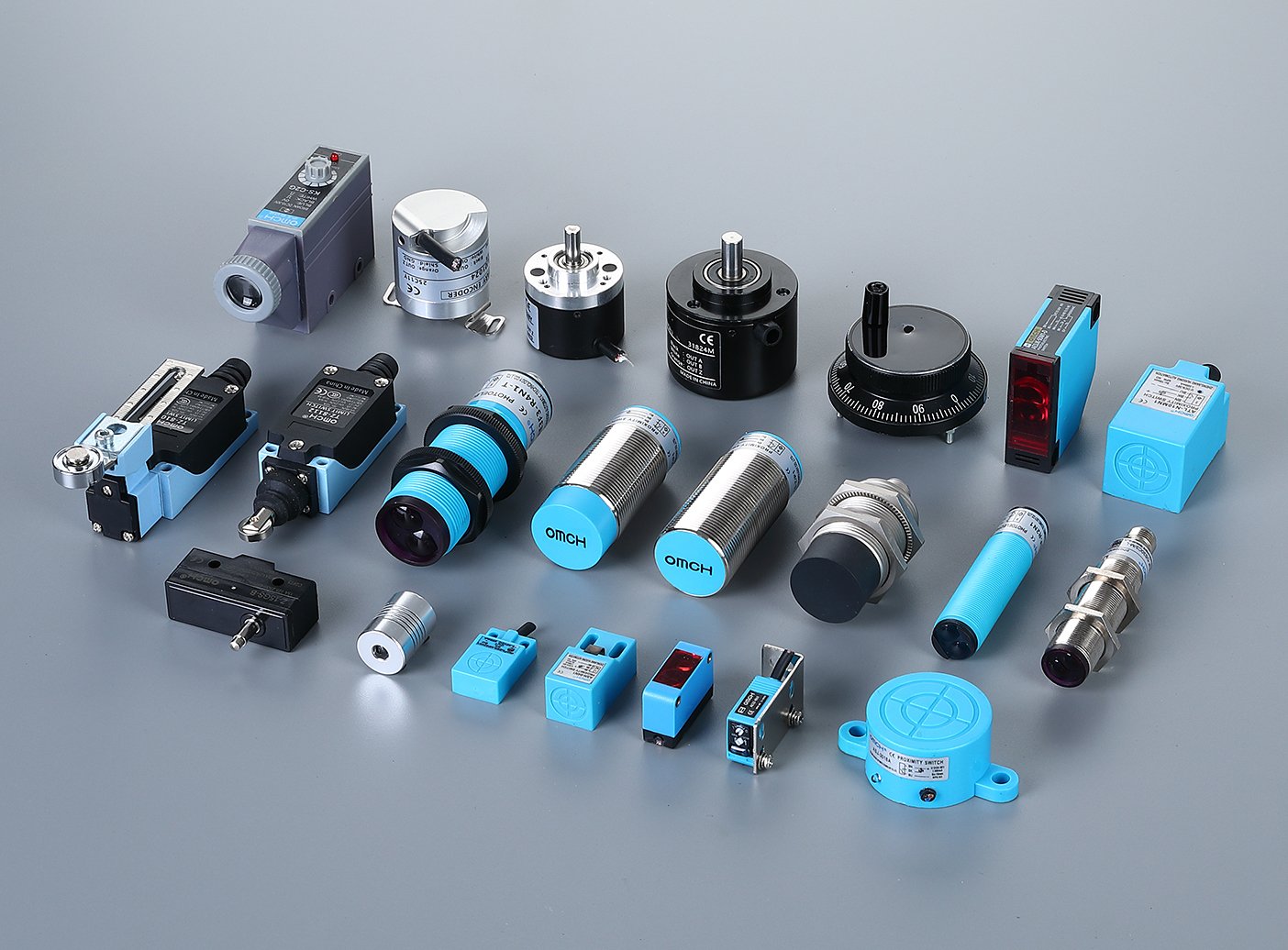
Sensors and detection switches are the sensory organs of automation — and the most fragmented category in any electrical items list. A single factory floor might have 50 different sensor models installed across its machines. For a distributor, this fragmentation is an opportunity: consolidate the long tail of sensor SKUs that would otherwise require your customer to manage a dozen niche suppliers.
Proximity Sensors, Photoelectric Sensors, and Ultrasonic Sensors
These three technologies cover the majority of non-contact detection applications. The choice between them comes down to three questions: What are you detecting? How far away is it? What kind of environment is it in?
| Parameter | Inductive | Photoelectric (Through-Beam) | Photoelectric (Diffuse) | Ultrasonic |
|---|---|---|---|---|
| Detection target | Metal only | Any solid object | Any solid object | Any material (incl. transparent, liquid) |
| Maximum range | 1–60mm | Up to 50m | Up to 2m | 30mm–8m |
| Dust/dirt tolerance | Excellent | Poor (lens blockage) | Poor | Excellent |
| Response speed | Fast (500Hz–5kHz) | Very fast | Fast | Slow (10–100Hz) |
| Typical relative cost | Low | Medium | Low | Medium–High |
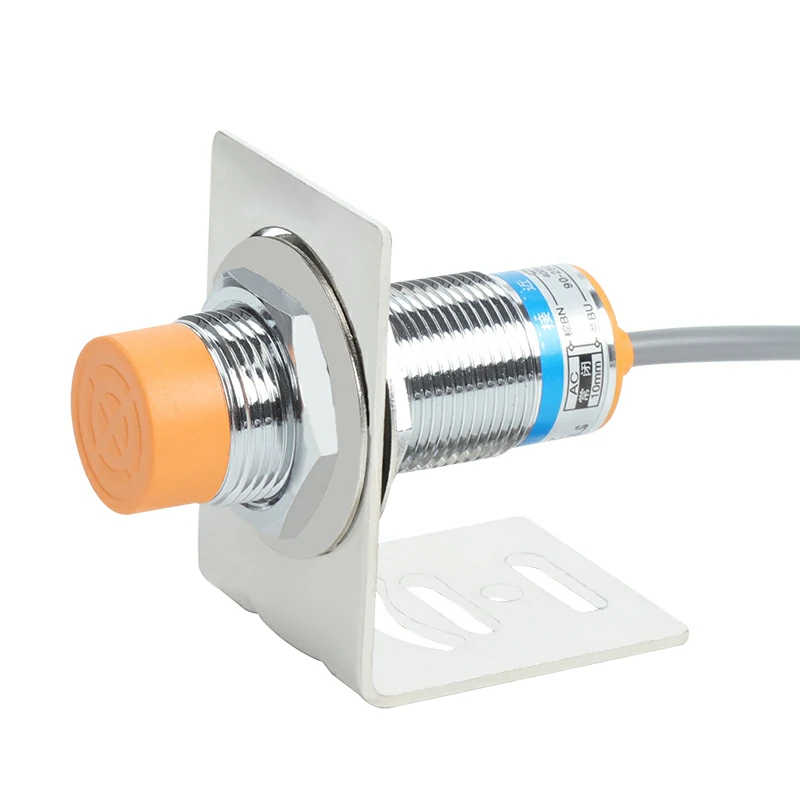
Inductive proximity sensors (IEC 60947-5-2) detect metal targets at short range. The three output wiring schemes are universal but region-specific in practice: NPN (sinking, current flows into the sensor) is standard in Asian markets; PNP (sourcing, current flows out of the sensor) is preferred in Europe. The NAMUR output variant is intrinsically safe — designed for hazardous-area installations where spark energy must be limited. Mechanical installation comes in shielded (flush-mountable in metal, detection field is contained to the sensing face) and unshielded (non-flush, the sensing field extends beyond the face — must have a metal-free zone around it).
Photoelectric sensors use three optical configurations. Through-beam pairs (separate emitter and receiver, up to 50m range) provide the highest reliability — if the beam breaks, the output changes, period. Retro-reflective sensors bounce the beam off a prismatic reflector (up to 10m), making wiring simpler at the cost of potential false triggers from shiny objects. Diffuse sensors detect light reflected off the target itself (up to 2m) — convenient but sensitive to target color and surface finish. For applications where the target varies in color, look for sensors with background suppression (BGS) that triangulate distance rather than relying on reflected intensity.
Ultrasonic sensors are the go-to when nothing else works: transparent targets (glass bottles, clear film), dusty or steamy environments, level detection of liquids and powders. The trade-off is slower response (10–100Hz vs. kilohertz for optical) and a minimum sensing distance — the “blind zone” close to the sensor face where echoes return too fast to measure.
Limit Switches and Micro Switches
In an age of non-contact sensors, the humble mechanical limit switch remains irreplaceable for one reason: physical force. When you need to physically stop a moving machine element at a defined position, a cam riding against a roller-lever limit switch is more reliable than any electronic sensor that can fail silently.
Limit switches (IEC 60947-5-1) are specified by three choices. The body type — standard industrial, compact (space-constrained), or safety-rated (with positive-opening NC contacts that are mechanically forced apart even if the contacts weld). The actuator head — roller plunger for linear end-stop detection, roller lever for cam-driven sequencing, rod lever for coarse position sensing, and whisker/spring-rod for omni-directional contact. The contact configuration — 1NC+1NO is standard; 2NC+2NO provides redundancy for safety circuits. Housing material matters for environment: metal (zinc alloy or aluminum) for mechanical robustness, plastic for corrosive or washdown environments.
Micro switches are the limit switch’s smaller sibling — operating forces from 0.1N to 4N, making them suitable for detecting lightweight mechanisms, door interlocks, and consumer-grade appliances. The three critical travel parameters are pre-travel (distance from free position to operating point), over-travel (additional travel beyond operating point — provides safety margin), and differential travel (hysteresis between operate and release points — prevents chatter at threshold positions).
Encoders, Counters, and Timing Relays
When “roughly in position” is not good enough, encoders provide precision feedback. Incremental encoders output A/B/Z phase pulse trains — the A and B channels are offset by 90° electrical, allowing the controller to determine both position (by counting pulses) and direction (by comparing which channel leads). Resolution is specified in PPR (Pulses Per Revolution), with 1,000–10,000 PPR covering most industrial applications. The Z (index) channel fires once per revolution and serves as a home reference. Note that the effective resolution after 4× quadrature decoding is 4× the PPR rating.
Absolute encoders output a unique digital code for every angular position — they know exactly where they are at power-up without needing a homing sequence. Single-turn absolute encoders wrap around every revolution; multi-turn variants track total revolutions via an internal gear train or battery-backed counter. The output interface matters for procurement: SSI (Synchronous Serial Interface) is the simplest and most universal; BiSS offers bidirectional communication at higher speeds; Profinet and EtherCAT variants integrate directly into industrial networks without a separate gateway.
Counters and timing relays round out the measurement sub-category: preset counters for batch counting and cut-to-length applications, tachometers for rotational speed display, and multi-function timing relays with selectable modes (on-delay, off-delay, interval, cyclic, star-delta) for sequential control without a PLC.
Temperature Controllers, Thermocouples, and Process Instruments
Temperature measurement follows a clear precision hierarchy that maps to price: thermocouples are robust and wide-ranging (±0.5–2°C typical accuracy), RTDs (PT100/PT1000) are precise and stable (±0.1–0.5°C), and the controller quality determines whether that accuracy translates into actual process performance.
Thermocouple types are identified by letter codes defined in IEC 60584: Type K (chromel-alumel, −200 to +1,260°C) is the universal industrial workhorse — wide range, affordable, and compatible with most controllers. Type J (iron-constantan) offers higher sensitivity but narrower range and rusts in humid environments. Type T (copper-constantan) excels at sub-zero measurements. For high temperatures, Type R/S (platinum-rhodium, up to 1,760°C) and Type B (up to 1,820°C) serve furnaces and kilns but at significantly higher cost. A quick field test: Type K positive leg is magnetic — touch it with a magnet to verify you have the right type before wiring.
Resistance Temperature Detectors (RTDs) (IEC 60751) use platinum’s predictable resistance change with temperature. PT100 = 100Ω at 0°C; PT1000 = 1,000Ω at 0°C (higher resistance = less sensitive to lead-wire error). Accuracy classes: Class B (±0.3°C at 0°C) is standard industrial grade; Class A (±0.15°C) for tighter process control; Class AA (±0.1°C) for laboratory and calibration applications. Wiring configuration matters: 2-wire is simplest but includes lead resistance in the measurement; 3-wire compensates for lead resistance (standard industrial practice); 4-wire eliminates lead resistance entirely (high-precision applications).
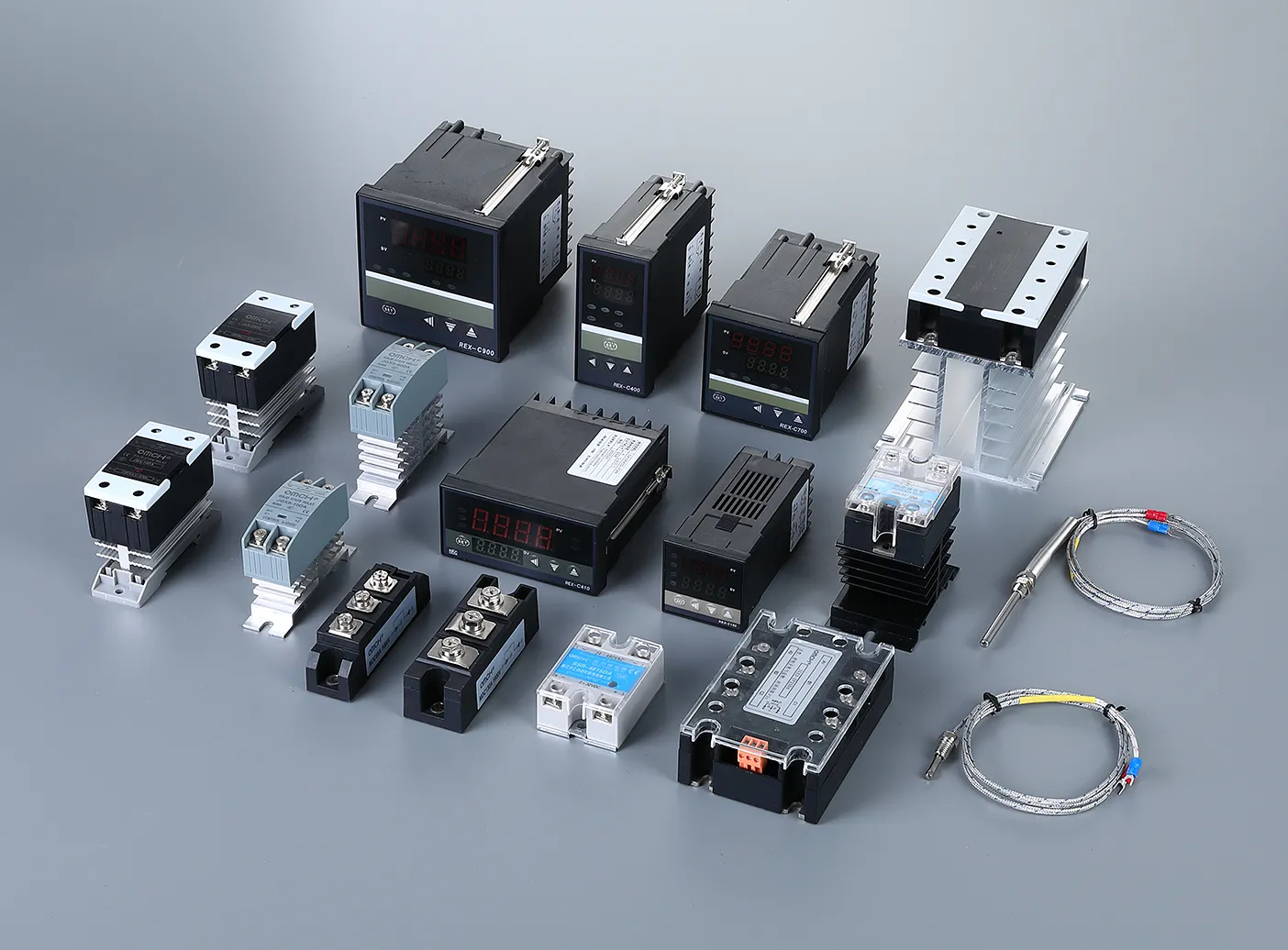
Temperature controllers bridge the sensor and the actuator. ON/OFF control (simple thermostat logic) causes inevitable temperature oscillation around the setpoint. PID control (Proportional-Integral-Derivative) continuously modulates the output to maintain a stable temperature — controllers with auto-tuning can self-optimize the P, I, and D parameters by analyzing the system’s response to a test pulse. The output type must match the actuator: relay output for contactors, SSR drive output (DC pulse) for solid-state relays, and 4–20mA analog output for proportional valves and thyristor power controllers.
Wiring, Connectivity, and Physical Infrastructure Components
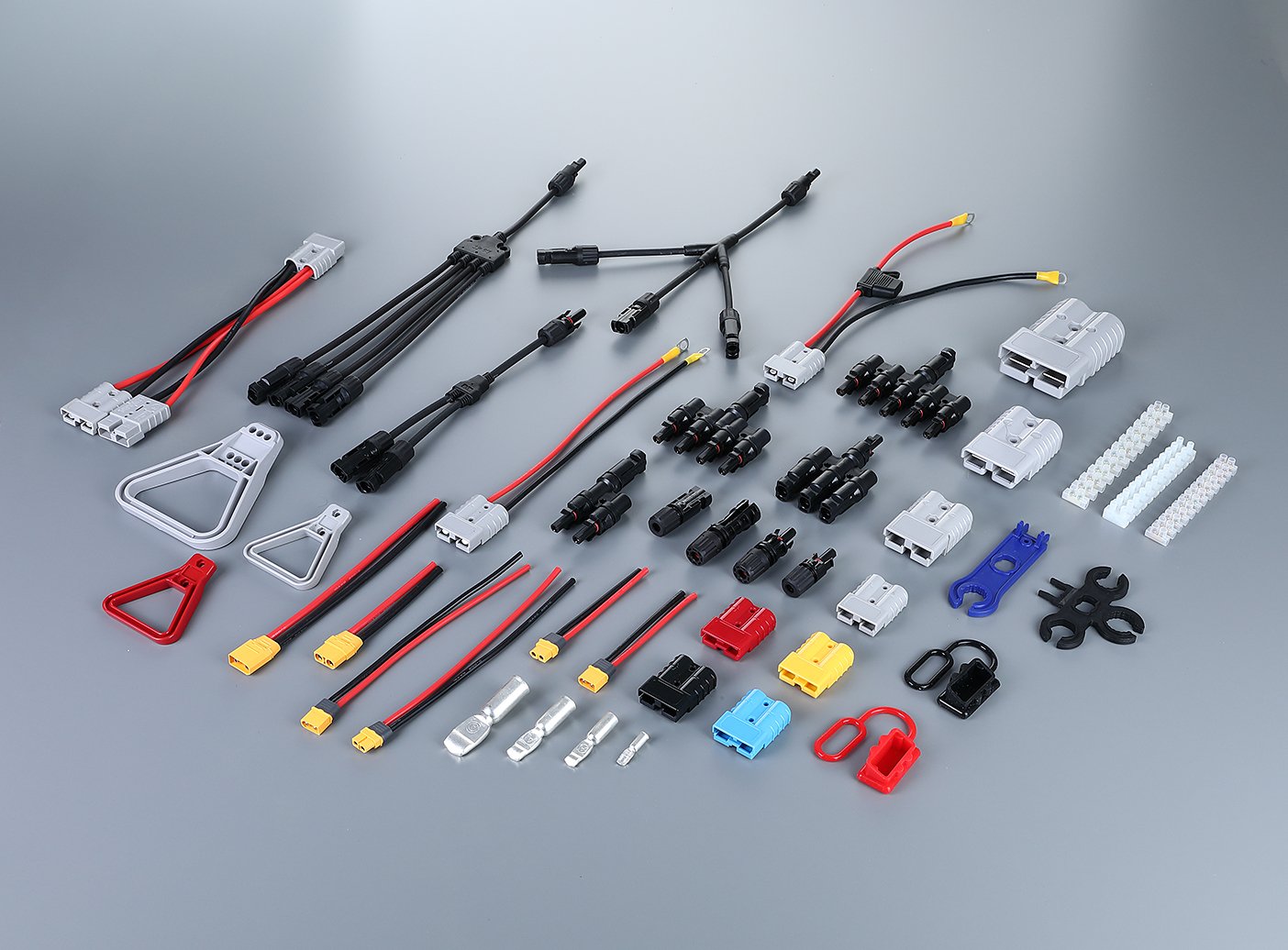
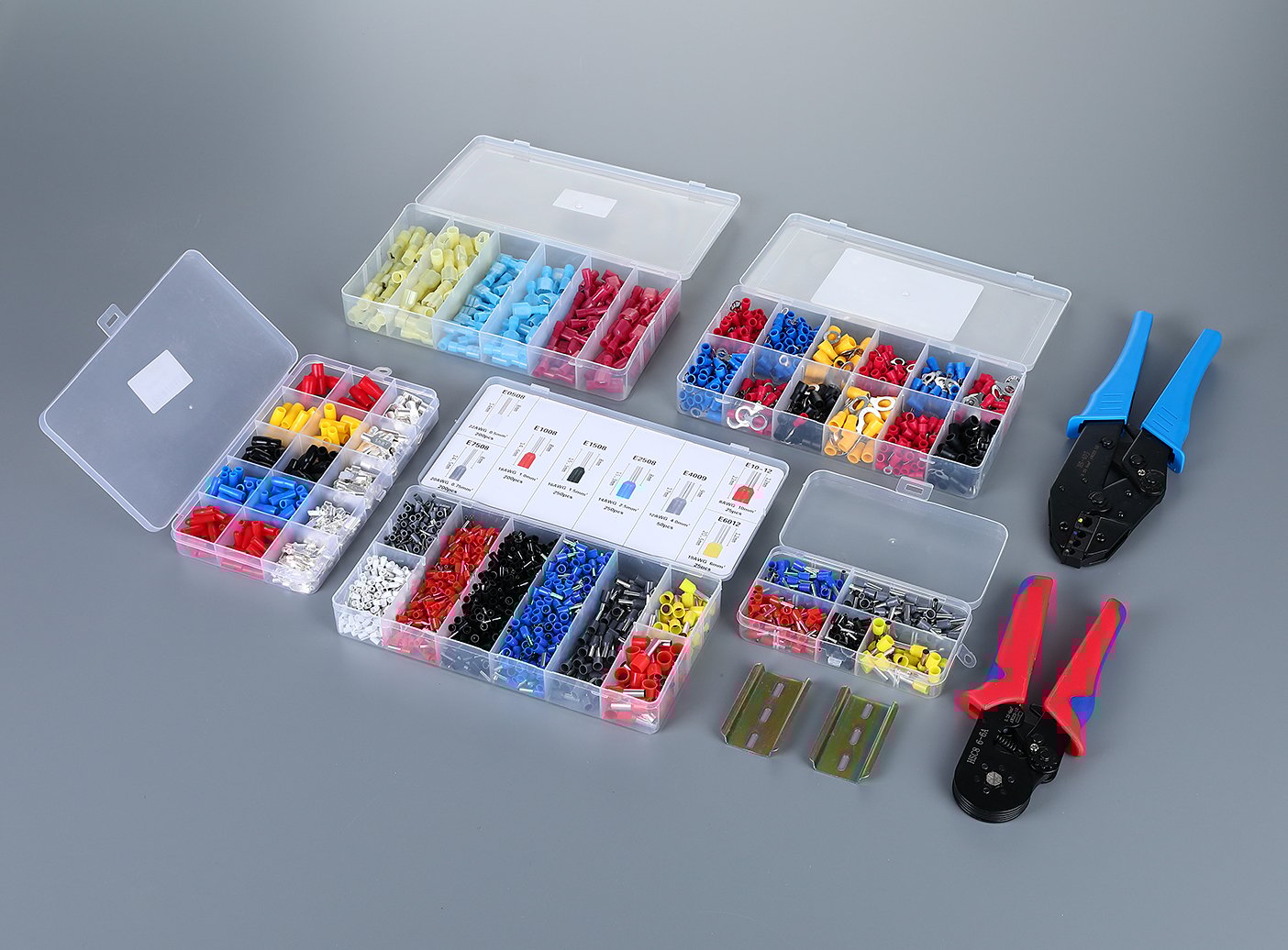
These are the “every-order” items — rarely the reason a customer calls, but present on virtually every invoice. Their procurement logic is straightforward: match the connection specifications, keep core sizes in stock, and ensure compatibility with the customer’s regional standards.
| Category | Sub-Types | Key Procurement Parameters | Typical Application | Cross-Sell Opportunities |
|---|---|---|---|---|
| Terminal Blocks | DIN-rail feed-through, PCB screw, high-current stud, multi-level | Wire gauge (0.5–240mm²), rated current, screw vs. spring clamp | Control cabinet wiring | End plates, jumper bars, marker strips |
| Industrial Connectors | M8/M12 circular, rectangular heavy-duty, D-Sub, RJ45 | Pin count, current rating per pin, IP67/IP68, coding type | Sensor-actuator, equipment inter-module | Pre-wired patch cables, mounting housings |
| Cable & Wire | Power, control (multi-core shielded), drag-chain, communication | Core count × cross-section, shield type, bending radius | Machine-to-panel, signal, fieldbus | Cable glands, markers, spiral wrap |
| Trunking & DIN Rail | PVC slotted duct, DIN rail TH35, copper earth bar | Width × height, slot pitch, material | Panel cable management | End brackets, separators, cover strips |
| Enclosures | Metal, plastic, stainless steel, IP66/IP67, NEMA 4/4X | Internal dimensions, ingress protection, material grade | Outdoor control stations, junction boxes | Mounting plates, thermostats, door switches |
The unglamorous truth about wiring and physical components: they are low unit-price but collectively account for a meaningful share of a distributor’s margin mix. A control panel containing €5,000 worth of PLCs and VFDs will also contain €800–1,200 worth of terminal blocks, cable, trunking, and connectors. If your customer sources those from someone else because you did not offer them, that “someone else” now has a foot in the door.
What to Evaluate When Choosing an Electrical Components Supplier
You have a mental map of the electrical items landscape. The next question every distributor faces is practical: where do you source each category?
Five Dimensions for Supplier Assessment
1. Category Breadth vs. Depth
Some suppliers are category specialists — they manufacture three product lines to world-class standards but cannot help you with the other 12 items on your customer’s RFQ. Others are multi-category integrators — they cover 20–30 product families under one roof at competitive quality, though perhaps not the absolute best in any single niche.
Neither model is inherently better. The right choice depends on how your customers buy. If they send you narrow, high-volume RFQs for one product type, a specialist manufacturer gives you the best pricing. If they send you broad, mixed-category RFQs with smaller quantities per line — the “small-but-complete” trader model — a multi-category integrator reduces your supplier count from 15 to one or two. That consolidation saves you real money in communication overhead, shipping coordination, and MOQ aggregation.
2. Certifications and Compliance. At minimum, electrical components for international markets need CE marking (EU), RoHS compliance (hazardous substance restriction), and increasingly UKCA for the UK market. For North American markets, UL listing (for end-products) or UL recognition (for components) is typically non-negotiable. But certifications on a website are one thing — verifiable certificates are another. The difference between a self-declared CE DoC (Declaration of Conformity) and an EC-Type Examination Certificate issued by an independent Notified Body is significant. The latter means a third-party laboratory has physically tested the product against the relevant IEC standard.
3. Lead Time and Inventory Transparency. A supplier who claims “we have stock” but takes a week to confirm availability is worse than one who honestly says “lead time is 30 days” on the first call. Real-time or near-real-time inventory visibility lets you quote confidently to your own customers.
4. MOQ Flexibility. Your customer in Malaysia might start with a trial order of 50 pieces to test the market before committing to container quantities. A supplier that can accommodate small-batch trial orders — even at a modest premium — is worth more than one with the lowest container price but zero flexibility. Once the trial succeeds, the volume follows naturally.
5. Technical Support Responsiveness. Electrical components are not commodities when something goes wrong. If a customer reports that an MCB is nuisance-tripping or a proximity sensor is giving false readings, you need a supplier with an engineering team that can troubleshoot — not a salesperson who forwards your email to a factory and goes silent for two weeks.
The Consolidation Math
A typical small electrical distributor manages relationships with 10–20 separate factories. Each factory has its own MOQ, payment terms, shipping schedule, and communication style — and language, and time zone. The coordination burden is not additive — it compounds. Moving even 60% of your sourcing volume to one multi-category supplier eliminates 8–12 of those relationship management threads and frees up your time to focus on sales rather than supplier wrangling.
Building a Multi-Category Procurement Strategy That Reduces Supply Chain Friction
The goal is not to source every product from one supplier — that is unrealistic and risky. The goal is to design a supplier portfolio where each supplier plays a defined role, your coverage across all necessary electrical categories is complete, and no single supplier’s failure can halt your operations.
Step 1: Prioritize Your Categories into Three Tiers
Take the electrical items list from this guide and sort every category your customers regularly order into three tiers based on order frequency and volume:
| Tier | Definition | Examples | Stocking Strategy |
|---|---|---|---|
| Tier 1 — High-Frequency | Ordered monthly; predictable demand; moderate unit value | MCBs, relays, proximity sensors, DIN-rail power supplies, pushbutton switches, terminal blocks | Buffer stock (2–4 weeks); negotiate quarterly volume pricing; prioritize shortest lead time supplier |
| Tier 2 — Medium-Frequency | Ordered quarterly; linked to projects or seasons | Contactors, SPDs, limit switches, signal towers, encoders, timers | Baseline stock of standard; project-based for non-standard; spread across 2 suppliers |
| Tier 3 — Low-Frequency | Ordered 1–2× per year; specialized or high-value | ACBs, PLCs, VFDs, process instruments, large transformers | Do not stock — order per project or use integration partner |
This framework is a template — fill in your own product mix based on what your actual customers buy, not what this guide lists.
Step 2: Build a Two-Track Supplier Mix
Track A: One (or two) multi-category integrators covering your Tier 1 and most Tier 2 categories. They provide the bulk of your volume, consolidated shipping, and stable pricing. They are your operational backbone.
Track B: Two to four category specialists covering strategic Tier 2 categories where you need deeper technical support or specific certifications, plus Tier 3 categories where an integrator may not have the depth.
This structure gives you pricing leverage (Track A volumes), technical depth (Track B specialists), and risk diversification — no single supplier’s disruption stops your business.
Step 3: Implement a Quarterly Category Review
Markets shift. A product category that was Tier 3 last year — say, surge protection — might spike into Tier 1 after a regional regulation change mandating SPDs in all new installations. A supplier that was competitive six months ago might have quietly extended lead times.
Schedule 30 minutes per quarter to review: Which categories saw significant demand shifts? Which suppliers changed their terms? Are there two new product categories your customers are asking about that you should add to your catalog?
The electrical components market is vast — thousands of product types across dozens of categories. No single guide can cover every niche, but a systematic category framework turns an overwhelming landscape into a navigable map. If you are evaluating suppliers for your electrical items portfolio, comparing the actual breadth of available catalogs is a practical next step. OMCH’s catalog covers over 30 product categories with 3,000+ SKUs across industrial automation components — available at omch.com.
References
- International Electrotechnical Commission. “IEC 60898-1: Circuit-breakers for overcurrent protection.” iec.ch
- International Electrotechnical Commission. “IEC 60947-2: Low-voltage switchgear — Circuit-breakers.” iec.ch
- International Electrotechnical Commission. “IEC 61643-11: Low-voltage surge protective devices.” iec.ch
- International Electrotechnical Commission. “IEC 60947-5-1: Control circuit devices and switching elements.” iec.ch
- International Electrotechnical Commission. “IEC 60947-5-2: Proximity switches.” iec.ch
- International Electrotechnical Commission. “IEC 61131-3: Programmable controllers — Programming languages.” iec.ch
- International Electrotechnical Commission. “IEC 61800-5-1: Adjustable speed drives — Safety requirements.” iec.ch
- International Electrotechnical Commission. “IEC 60584-1: Thermocouples — EMF specifications.” iec.ch
- International Electrotechnical Commission. “IEC 60751: Industrial platinum resistance thermometers.” iec.ch
- International Organization for Standardization. “ISO 9001:2015 — Quality management systems.” iso.org
- OMCH. “Industrial Automation Components Catalog.” omch.com



 English
  Arabic
  Turkish
  Russian
  Spanish
  French
  Indonesian
  Portuguese
  Thai
Thai  Vietnamese