





Every DIN-rail power supply datasheet carries a row most buyers skim past: load regulation. It usually reads something like “±1.0 %” or “≤ 1 %,” and it looks like a detail for engineers who enjoy fine print. It is not. When a 24 V control bus dips under load, or a distant cabinet reads 23.1 V at the terminals, or a PLC resets for no obvious reason, load regulation is usually the spec that explains what is happening. It tells you whether the power supply is failing, whether the wiring is failing, or whether neither is at fault. Sometimes the problem was never the supply’s to solve.

What Is Load Regulation, and What It Really Measures
Load regulation is a power supply’s ability to keep its output voltage steady as the current drawn by the load changes (Wikipedia). It is expressed either as a percentage of a reference voltage or as an absolute voltage change. A switching supply might list “≤ 50 mV” where a linear one lists “0.01 %.”
The mechanism matters more than the definition. Inside every regulated supply sits a feedback loop. It samples the output voltage, compares it to an internal reference, and corrects the difference. Load regulation is what that loop fails to correct: the residual error that remains between no-load and full-load. A perfect loop would hold the output exactly constant. A real one leaves a small, specifiable gap. When you read a load regulation figure, you are reading the size of that gap, measured at the output terminals under stated conditions.
The calculation is simple, but the denominator is where readers get tripped up. The common form is:
Two things trip people up immediately. First, the units: linear and lab supplies usually state regulation as a percentage, while many switching-supply datasheets state it in absolute volts or millivolts. That is because switching ripple, not control-loop precision, dominates the error (Wikipedia). Second, the siblings: line regulation measures the same residual error when the input voltage changes, with the load held constant (NI). A constant-current supply has a mirror-image definition for its output current. This article stays on the constant-voltage side, where industrial control buses live.
What “Good” Load Regulation Actually Looks Like
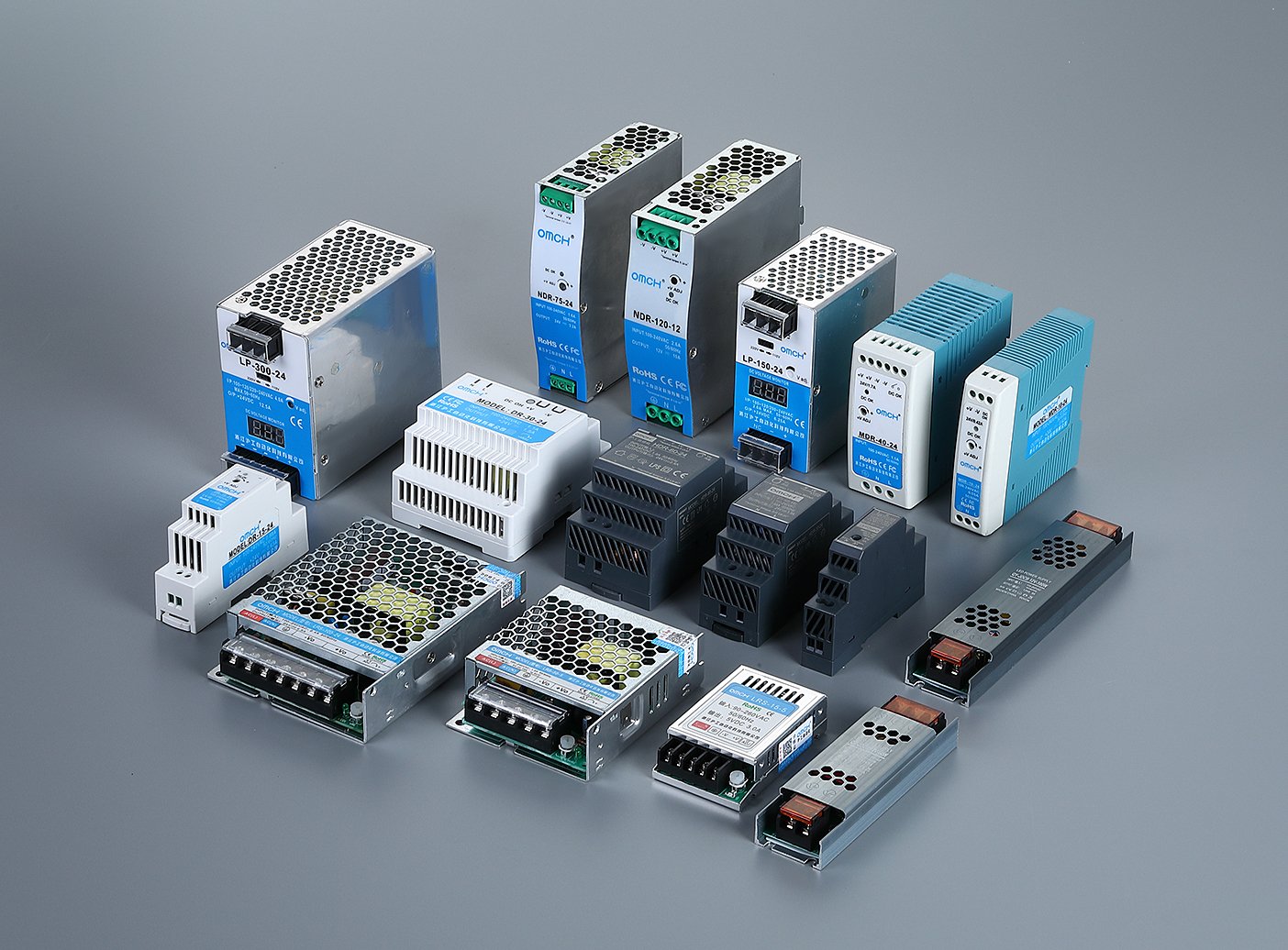
Ask ten sources what good load regulation is and you will get answers spanning three orders of magnitude. One reputable power-supply maker says good regulation typically keeps output “under 5 %.” A lab-grade bench supply lists its CV regulation at “≤ 0.01 % + 3 mV” (EEVblog forum). An industrial DIN-rail unit like the Mean Well NDR-75 specifies load regulation at ±1.0 %.
None of these numbers is wrong. All three are “good,” each for its own class. Regulation is not one benchmark. It is a class benchmark.
Read the figure against its class, and only then decide whether it is healthy. A 24 V DIN-rail supply that publishes ±1.0 % is behaving like its class. The same number on a lab instrument would be a defect. And a figure carries one silent precondition you should check before trusting it: the load range it applies to. Some budget switching supplies only guarantee their specs above a partial load. One experienced tester on r/AskElectronics notes that “their specs are given for above 20% load.” Below that threshold the output can drift, and the datasheet never promised otherwise. When you see “0–100 % load” on a spec sheet, it is a feature worth noticing. When you see “10–100 %,” you now know exactly what the missing 10 % means.
Measuring it yourself is straightforward: a meter at the output terminals, a load that can pull the supply from near-zero to full rated current, two readings, and the formula above. The practical three-point bench check is covered later. That full-load, half-load, no-load procedure takes about five minutes and turns any delivered unit into a verifiable claim.
When the 24 V Bus Doesn’t Hold: Dynamic Dips vs. Wire Loss
A regulated supply’s output can still sit far from 24 V at the load. Usually it is not the supply’s fault. Two very different mechanisms cause this, and confusing them sends technicians chasing the wrong fix.
Scenario A: the momentary dip when big loads switch in
When a motor contactor pulls in, a solenoid valve fires, or a heater bank switches on, the bus can momentarily collapse hard enough to reset a PLC or release a held relay. The supply’s protection did not trip, and nothing was overloaded in a sustained sense. What happened is transient: the load stepped faster than the feedback loop can respond. A switching supply’s correction loop is always “one step late” against a fast current step. That is physics, not a defect (r/AskElectronics). Static load regulation, the ±1.0 % figure on the datasheet, says nothing about this event, because the datasheet number is measured at steady state, after the loop has settled. The transient dip is governed by output capacitance and loop bandwidth. Those are different specs (dip amplitude, recovery time) that many industrial supplies never publish.
This is why a bus that measures “fine” with a multimeter can still reset controllers. A handheld meter averages, so a momentary sag to 19 V for a few milliseconds may never register. If intermittent resets coincide with a large load switching, watch the bus with a scope or a meter in MIN-hold mode while cycling that load. You will usually see the collapse that the steady-state reading hid (DigiKey forum, DIN-rail power supply guide).
Scenario B: the steady-state shortfall at the far end of the wires
The second mechanism is not dynamic at all. The supply holds 24.0 V at its own output terminals while a cabinet 30 feet away measures 23.2 V, steadily, every time. Load regulation is blameless: the spec is measured at the supply’s output terminals, and the missing volts are being consumed by the resistance of the wiring between the supply and the load. The feedback loop cannot see that drop. It regulates what it senses at its own terminals, not what arrives at the device.
Panel builders have a standard countermeasure for this. DIN-rail supplies typically carry a front-panel potentiometer that raises the output above nominal. One widely referenced example class allows adjustment from 24 V up to 29 V (DigiKey forum). The practice is to set the supply high enough that the load sees 24.0 V, compensating the I·R drop in between. PLCs and their I/O are built for exactly this: a 24 V DC-rated controller tolerates a supply band of 20.4 to 28.8 V (Siemens, S7-1200 manual). A bus trimmed to 24.5 or 25 V at the supply end is routine and safe. When the drop is too large to trim away, the fix is heavier gauge wire, a shorter run, or a second supply local to the far cabinet. It is not a different brand of power supply.
Which one is happening to you?
One honest boundary keeps this section honest: none of this tells you a supply is good, only where the problem is not. A supply that holds 24 V at its terminals under a steady full load has passed the easy test. Whether its ±1.0 % figure stays true at temperature extremes, at low line, and through fast load steps is what the remaining specs (and a bench check) are for.
Three Load-Related Specs Datasheets Keep Quiet About
Load regulation is the headline. Three related specifications live in the fine print, and each one matters to a different buyer.
Three specs that answer the questions load regulation can’t
| Spec | What it governs | Who must care | The question to ask the supplier |
|---|---|---|---|
| Cross regulation (multi-output supplies) | How much a load step on one output disturbs the other outputs sharing the loop | Anyone running sensors at 24 V off the same supply as a motor circuit at a different voltage | Does the aux output stay in spec when the main output is at full load? |
| Transient response (dip & recovery) | How far and how long the output sags on a fast load step | Anyone feeding motors, heaters, valves, or print heads — pulse loads | What dip amplitude and recovery time are published for a 50–100 % step? |
| Minimum load | The lowest load at which the output stays regulated or even stable | Anyone who may run the supply nearly unloaded (standby, intermittent duty) | Is the spec valid from 0 % load or only above a stated minimum? |
Cross regulation deserves the most attention because it is the least intuitive. A multi-output supply regulates all outputs through one shared loop, and it can only hold one output tightly: usually the main one. Step the auxiliary output’s load and the main output shifts slightly. Step the main and the aux drifts more. Datasheets that print one tidy load regulation figure for the main channel are not lying. They are just silent about the others. If your equipment pairs a 24 V logic rail with a 5 V or 48 V rail from one supply, ask for the cross-regulation behavior before you trust the headline number.
Buying on the Spec: Missing Numbers, Unit Traps, and a 5-Minute Bench Check
Sooner or later every buyer faces the same moment: a price-attractive 24 V DIN-rail supply whose datasheet has no load regulation row at all, or one that prints only a bare percentage. What do you do?
Missing specs are unknowns, not zeros
A blank load regulation row does not mean the supply regulates perfectly. It means the manufacturer did not commit to a number. The row is a promise, and its absence is the absence of a promise. Three responses, in order. First, ask for the full datasheet and the test conditions behind any number: load range, temperature, input voltage. Second, compare disclosure across the same price class. A category where several brands publish ±1.0 % and a supplier publishes nothing is telling you something. Third, when the supply is going to a real customer, make the bench check below part of receiving goods, not a favor the supplier does you. A distributor who can say “we verified it” has a different conversation with a customer than one who can only say “it should be fine.”
The unit trap
Compare like with like before comparing at all. Percentages may use different denominators (full-load voltage versus nominal voltage), and the two conventions differ by a few tenths of a percent on real supplies. Absolute figures convert back to percentages with the nominal voltage as reference: a 24 V supply that lists “≤ 240 mV” is claiming 1.0 %. And a percentage without its load range is half a specification. “±1.0 %, 0–100 % load” and “±1.0 %, above 20 % load” are different products wearing the same number.
The five-minute bench check
A rough bench check is not a metrology exercise. Room temperature, line voltage, and meter accuracy all move the result a little, so judge the promise, not the precision. Did the unit stay inside the band its datasheet claims? And if there was no claim, is the measured behavior inside the band its class would suggest? Kill a unit that misses its own spec by a wide margin. Do not kill one that lands a hair outside at 40 °C on a cold morning. Incoming inspection exists to separate promises from products, not to reject products for failing a standard their class never promised.
The Distributor’s Take: Load Regulation as a Stock-Keeping Decision
If you resell power supplies rather than design them into equipment, everything above collapses into one operational question: which SKUs do I stock, and what do I tell a customer who asks why this one costs more than that one?
Read the article’s logic as a stock-keeping rule. The supplies that publish their load regulation with test conditions, and survive a five-minute bench check, belong to a category you can sell with a number in hand. The supplies that print no figure, or a bare percentage with no conditions, belong to a category you can only sell on price. Price is the one dimension a competitor can always undercut. When a customer’s machine misbehaves under load, the same split decides your after-sales. A supply with a published, verified figure lets you isolate the fault to wiring or load in minutes. An unverified one leaves you defending a product you never measured. Disclosure and verifiability are not marketing polish. They are the difference between a return you can close with a measurement and a dispute you can only close with a refund.
The rule has an honest limit, and it protects you from overcorrecting. Not every customer needs a ±1.0 % industrial supply. A customer running LED strips, battery chargers, or bench gadgets is well served by a consumer-class unit whose 5 % band is exactly what its class promises. Stock to the application: match the disclosure to the customer’s bus, and sell the verified industrial class where control equipment rides on it. Keep the consumer class where it belongs. The yardstick from earlier in this article (class first, then figure) is also the most useful sentence you can give a customer who is about to buy the wrong class of supply, whether from you or from someone cheaper.
If this checklist reads like work you would rather hand to a supplier, that is exactly what the exercise is for. Sending a spec sheet and getting a matched model with sample testing back is faster than building a resistor bank.
OMCH’s product-selection service matches models against your spec sheet and supports sample testing before you commit stock to a new SKU.
Verify before you stock.
Send the datasheet of the 24 V DIN-rail supply you’re comparing, or your target load profile, and we’ll match a model that publishes its numbers and supports sample testing before you commit stock.
Send my spec sheetReferences
- Wikipedia. “Load regulation.” Accessed 2026. https://en.wikipedia.org/wiki/Load_regulation
- Siemens. “SIMATIC S7 S7-1200 Programmable controller — rated voltage 24 V DC, tolerance 20.4 to 28.8 V DC.” https://support.industry.siemens.com/cs/mdm/109759862
- National Instruments. “Power Supply Line and Load Regulation and Cascading.” https://www.ni.com/en/shop/electronic-test-instrumentation/power-supplies-and-loads/what-are-programmable-power-supplies/line-load-regulation-cascading.html
- DigiKey Forum. “DIN Rail Industrial Power Supply: Defining Characteristics.” https://forum.digikey.com/t/din-rail-industrial-power-supply-defining-characteristics/64213
- r/AskElectronics. “How do you test power supplies under load?” https://www.reddit.com/r/AskElectronics/comments/1rxas3u/how_do_you_test_power_supplies_under_load/
- EEVblog Forum. “Help me with Power supply — CV load regulation ≤ 0.01 % + 3 mV.” https://www.eevblog.com/forum/beginners/help-me-with-power-supply/


 English
  Arabic
  Turkish
  Russian
  Spanish
  French
  Indonesian
  Portuguese
  Thai
Thai  Vietnamese