


Qual é o tamanho atual do mercado de fontes de alimentação industriais?
Se você distribui componentes de automação industrial — sensores, relés, PLCs, contatores —, é quase certo que já lhe tenham solicitado fontes de alimentação. A verdadeira questão é: trata-se de uma categoria secundária que você mantém em estoque porque os clientes esperam por ela, ou de uma linha de receita essencial em torno da qual vale a pena construir uma estratégia de abastecimento?
Os números apontam para a segunda opção.
Visão geral do tamanho do mercado — Os números que todo distribuidor deve conhecer
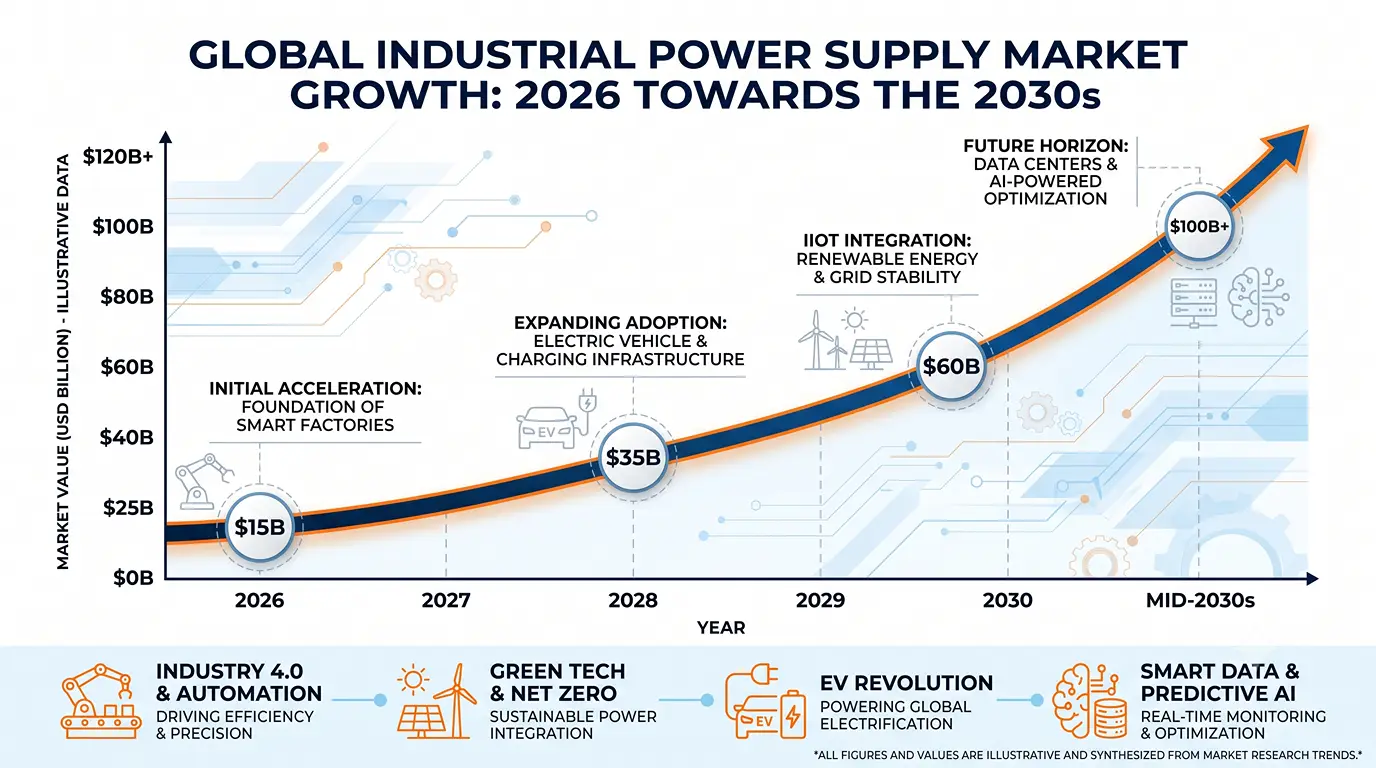
Dependendo da empresa de pesquisa consultada e do que ela leva em consideração, o mercado global de fontes de alimentação industriais ficou em algum ponto entre $10,7 bilhões e $14,2 bilhões em 2026. A Business Research Company estima $10,66 bilhões. A Fortune Business Insights aponta para $14,24 bilhões. A diferença se resume ao escopo: o analista inclui fontes de alimentação ininterruptas e módulos OEM personalizados, ou apenas conversores CA-CC e CC-CC padrão vendidos como unidades independentes?
Mais do que o número exato, o que importa é a trajetória. Todas as principais empresas de pesquisa projetam um crescimento sustentado até 2030–2035, com taxas de crescimento anual compostas (CAGR) variando entre 4,6% e 7,9%. A Fortune Business Insights prevê que o mercado alcance $24,76 bilhões até 2034. A 360iResearch projeta cerca de $19,5 bilhões até 2032. Mesmo a estimativa mais conservadora, da The Business Research Company, aponta para $14,43 bilhões em 2030.
Aqui está outra maneira de analisar esses números. Se uma fonte de alimentação industrial de 24 V para trilho DIN é vendida, em média, por $30–50 no atacado, um mercado de $12 bilhões significa que algo entre 240 e 400 milhões de unidades circulam pelas cadeias de suprimentos globais a cada ano. Todo gabinete de controle, toda linha de produção automatizada e toda rede de sensores precisam de energia CC. Essa demanda não é cíclica. É estrutural.
O que está impulsionando o crescimento — três fatores que os distribuidores não podem ignorar
Três fatores estão impulsionando esse mercado, e nenhum deles dá sinais de desaceleração.
A automação industrial não é mais opcional. Mais de 64% de instalações fabris em todo o mundo adotaram alguma forma de automação — robótica, controle de movimento, E/S distribuída, sensores inteligentes. Todo dispositivo automatizado precisa de energia CC limpa e estável. Uma única célula de produção moderadamente automatizada pode conter de cinco a vinte fontes de alimentação em trilho DIN, sem contar as unidades integradas em cada máquina. À medida que os fabricantes do Sudeste Asiático, da Índia e do Oriente Médio aceleram seus investimentos em automação, a demanda a jusante por fontes de alimentação cresce em paralelo.
A revolução dos veículos elétricos é, na verdade, uma revolução no abastecimento de energia. As vendas globais de veículos elétricos ultrapassaram 17 milhões de unidades em 2024 e devem ultrapassar 20 milhões em 2025, de acordo com a Agência Internacional de Energia. Cada linha de produção de veículos elétricos, cada estação de teste de baterias e cada instalação de infraestrutura de recarga depende da conversão CA-CC e CC-CC de nível industrial. Não se trata do carregador na garagem de um consumidor. Trata-se das fontes de alimentação dentro da fábrica que fabrica o carro e dos equipamentos de teste que validam a bateria.
As normas de eficiência energética estão forçando a renovação dos equipamentos. Padrões como o 80 PLUS, originalmente desenvolvidos para fontes de alimentação de computadores, passaram a ser incorporados aos critérios de aquisição do setor industrial. Pesquisas indicam que cerca de 46% de compradores industriais agora consideram a eficiência energética um fator-chave nas decisões de compra. Unidades que eram aceitáveis há uma década estão se tornando cada vez mais difíceis de incluir nas especificações de novos projetos, especialmente em mercados como a União Europeia, onde a pressão regulatória é mais intensa. A base instalada está em constante renovação — unidades antigas sendo retiradas, unidades de maior eficiência sendo instaladas —, criando um mercado de reposição que ocorre paralelamente à demanda por equipamentos novos.
Para um distribuidor, esses três fatores apontam para uma única conclusão: os clientes que você atende hoje precisarão, amanhã, de mais fontes de alimentação do que compraram ontem. A única questão é se você é o fornecedor deles nessa categoria.
Quais produtos compõem o mercado de fontes de alimentação industriais
Não é preciso ser engenheiro de eletrônica de potência para vender fontes de alimentação. É preciso saber o que seus clientes vão pedir e em que linguagem eles vão fazer isso.
A maneira mais fácil de analisar o panorama dos produtos é por formato, pois o formato determina onde o aparelho será utilizado e quem o comprará.
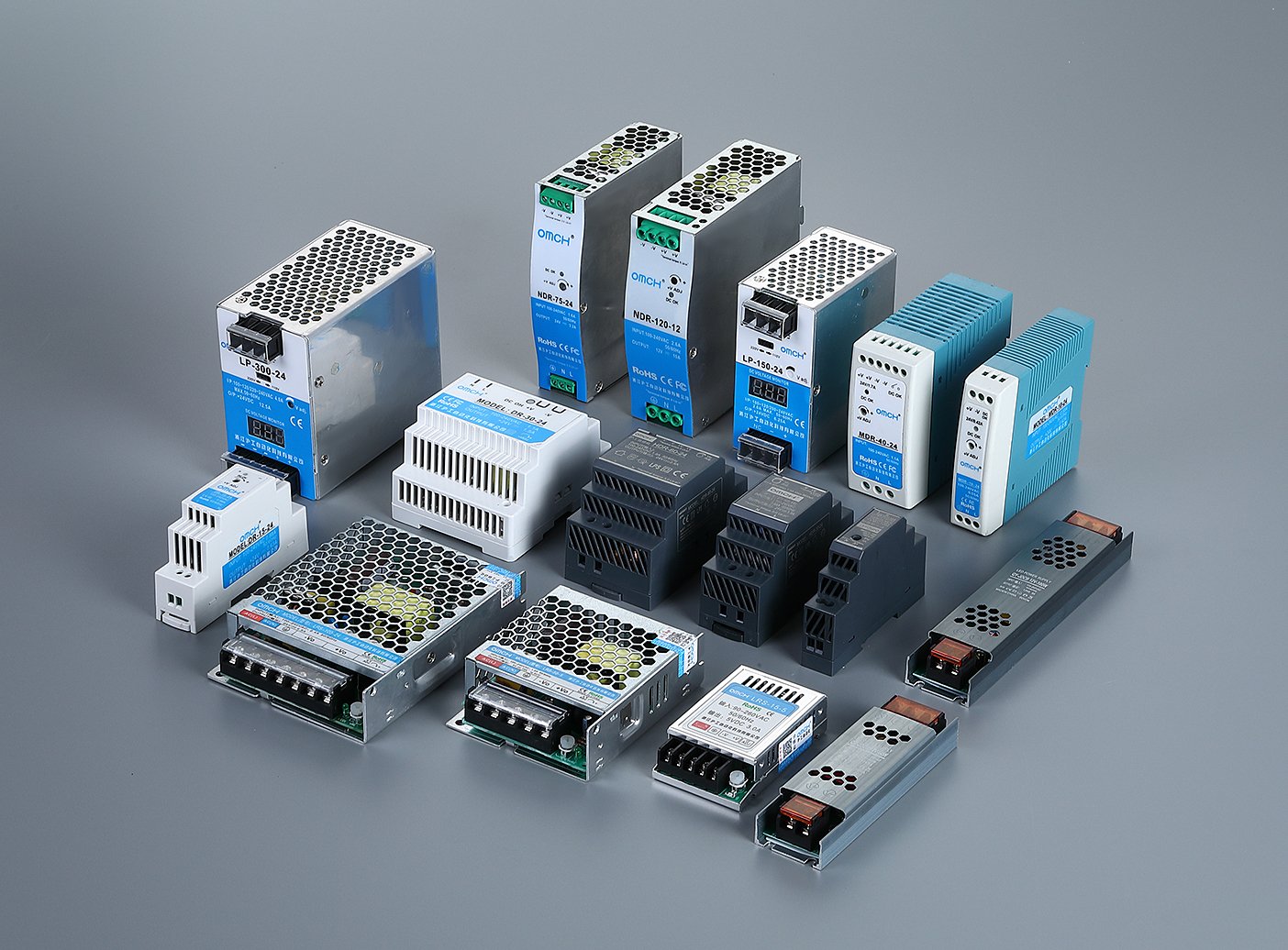
Fontes de alimentação para trilho DIN são a espinha dorsal dos painéis de controle industrial em todo o mundo. Elas se encaixam em trilhos DIN padrão de 35 mm, ao lado de PLCs, relés, disjuntores e blocos de terminais. A grande maioria fornece 24 V CC — a tensão padrão de fato para sensores, controladores e atuadores industriais. Se você vende qualquer produto que seja instalado em um painel de controle, deveria vender fontes de alimentação para trilho DIN junto com ele. Esse segmento é o ponto de entrada para a maioria dos distribuidores que ingressam nessa categoria.
Fontes de alimentação encapsuladas — às vezes chamadas de “montagem em chassi” ou “montagem em painel” — são unidades autônomas com caixa metálica, aparafusadas à estrutura de uma máquina, em vez de encaixadas em um trilho DIN. Elas abrangem uma faixa de potência mais ampla, desde menos de 100 W para dispositivos pequenos até vários quilowatts para equipamentos maiores. Os clientes que adquirem unidades fechadas costumam ser fabricantes de equipamentos originais (OEMs) que fabricam suas próprias máquinas ou integradores que montam sistemas personalizados.
Fontes de alimentação com estrutura aberta são unidades em placa nua projetadas para serem incorporadas ao produto de terceiros — um quiosque, um dispositivo médico, um instrumento de teste. Raramente constituem o principal negócio de um distribuidor, a menos que atendam a clientes OEM com volumes previsíveis.
Por faixa de potência, o mercado se divide, de maneira geral, em três faixas: abaixo de 500 watts (líder em volume — sensores, pequenos controladores, relés individuais), de 500 a 1.000 watts (maquinário de médio porte, gabinetes com vários dispositivos) e acima de 1.000 watts (grandes sistemas, controle de movimento multieixos, automação de processos). Para um distribuidor generalista, a faixa abaixo de 500 W — e, dentro dela, as unidades de 24 V para trilho DIN — representa o maior volume de transações e a base de clientes mais ampla.
A divisão tecnológica é mais simples do que parece. Os conversores CA-CC — que recebem energia CA da rede elétrica e geram CC regulada — dominam o mercado, com uma receita estimada em 42,9%. Essas são as unidades essenciais em todas as fábricas do mundo. Os conversores CC-CC, que transformam uma tensão CC em outra, estão crescendo mais rapidamente, impulsionados pela fabricação de veículos elétricos, sistemas de baterias e eletrônicos de precisão. Ambas as categorias são importantes. Para a maioria dos distribuidores, o segmento CA-CC é onde está o volume diário de vendas.
De onde vem a demanda — Análise do mercado por região
O mercado de fontes de alimentação industriais é global, mas a demanda não está distribuída uniformemente. Compreender a geografia ajuda você a entender onde estão os clientes dos seus clientes e quais certificações serão importantes para suas remessas.
América do Norte é o maior mercado isolado em termos de valor, representando cerca de 32–35% da demanda global. Somente os Estados Unidos representam aproximadamente $3,5 bilhões no consumo anual de energia elétrica industrial. Os compradores nesse mercado priorizam a certificação UL, prazos de entrega curtos e fornecedores que entendam o panorama da legislação elétrica norte-americana. Se seus clientes atendem ao mercado dos EUA, eles precisam de produtos listados pela UL — e precisam que você comprove isso.
Ásia-Pacífico é a maior base industrial do mundo e o mercado com a demanda que mais cresce. A China é responsável por cerca de 32% do consumo global de fontes de alimentação industriais, com previsão de que seu mercado interno cresça a uma taxa de aproximadamente 7,0% ao ano. O Japão, a Coreia do Sul e as economias do Sudeste Asiático constituem outra camada substancial. A dinâmica principal: a Ásia-Pacífico é onde a maioria das fontes de alimentação industriais é fabricada, e uma parcela cada vez maior delas é consumida dentro da região. Para distribuidores fora da Ásia, isso significa que sua base de abastecimento está localizada na mesma região que uma parcela crescente da demanda final — reduzindo os prazos de entrega para o comércio regional, mas aumentando a complexidade da logística intercontinental.
Europa detém cerca de 25–28% do mercado global, sendo que somente a Alemanha representa aproximadamente 18,8% da demanda europeia. Os compradores europeus são os que mais se preocupam com certificações em todo o mundo. A marcação CE é o requisito básico, mas as normas específicas do setor — EN 62368-1 para segurança, EN 55032 para compatibilidade eletromagnética — e as diretivas de eficiência energética acrescentam camadas que os distribuidores precisam cumprir. Se seu cliente estiver vendendo para a Alemanha, ele espera receber a documentação, não apenas o produto.
Mercados emergentes — o Oriente Médio, a África, a América Latina e partes da Ásia Central — detêm, em conjunto, uma participação menor (aproximadamente 10%), mas estão crescendo a partir de uma base mais baixa. Esses mercados costumam ser atendidos por distribuidores que consolidam remessas de várias fábricas chinesas, o que torna a eficiência na aquisição uma vantagem competitiva por si só. Um distribuidor em Dubai ou Moscou que compra de dez fornecedores distintos para dez categorias de produtos enfrenta um desafio operacional fundamentalmente diferente daquele de um distribuidor que compra de um único fornecedor para dez categorias.
Quem é quem no setor de fontes de alimentação industriais — marcas globais, especialistas e o fator China
Um fato define o cenário competitivo mais do que qualquer outro: esse mercado é extremamente fragmentado. Os cinco principais fabricantes detêm, juntos, apenas cerca de 20% de participação de mercado, com a TDK Corporation — por meio de sua divisão TDK-Lambda — liderando com pouco mais de 5%. Nenhuma empresa domina o mercado. Para os distribuidores, essa fragmentação é tanto uma oportunidade quanto uma dor de cabeça. Há muitas opções de fornecedores. É necessária muita pesquisa para separar a essência do marketing.
Nível 1 — Os gigantes globais e o que eles significam para os distribuidores
O segmento de ponta reúne especialistas em eletrônicos e conglomerados industriais, cada um atuando em um nicho específico.
A TDK-Lambda (Japão) é líder em participação de mercado e investimento em P&D, com um portfólio que abrange conversores CA-CC e CC-CC de alta eficiência, desde módulos para placa de circuito até sistemas para montagem em rack. Para os distribuidores, a TDK-Lambda representa o segmento premium: reconhecimento da marca, suporte de engenharia e preços à altura.
A Delta Electronics (Taiwan) construiu sua reputação com base na eficiência energética e, atualmente, fornece produtos de conversão de energia para os setores de automação industrial, transporte, energia renovável e telecomunicações. A Delta é uma das poucas marcas que une a alimentação de nível de TI à alimentação de nível industrial — o que é útil para distribuidores cujos clientes atuam em ambos os setores.
A Mean Well (Taiwan) está em uma categoria à parte: a potência em produtos padrão. Com, sem dúvida, a mais ampla linha de produtos prontos para uso do setor — desde módulos de 15 W para montagem em placa de circuito impresso até unidades de 480 W para trilho DIN e tudo mais —, a Mean Well é a marca que a maioria dos distribuidores generalistas encontra em primeiro lugar. Sua estratégia baseia-se na variedade, na disponibilidade e em preços competitivos. Se um cliente precisa de uma fonte de alimentação e não tem preferência por nenhuma marca, a Mean Well costuma ser a resposta padrão.
A Siemens e a ABB (Europa) competem no aspecto da integração. Suas fontes de alimentação fazem parte de ecossistemas de automação mais amplos. Uma fábrica que adota os PLCs e acionamentos da Siemens como padrão provavelmente optará pelas fontes de alimentação da Siemens por uma questão de compatibilidade. Oferecer produtos da Siemens ou da ABB significa atender a clientes que valorizam a interoperabilidade em nível de sistema mais do que a economia no preço unitário. As margens podem ser mais vantajosas, mas o ciclo de vendas é mais longo e a barreira técnica é maior.
A Schneider Electric e a Eaton completam o grupo de ponta com posições sólidas nas áreas de gerenciamento e distribuição de energia, atendendo a clientes que encaram a infraestrutura elétrica como um todo, em vez de considerar as fontes de alimentação isoladamente.
| Marca | Sede | Força do núcleo | O que isso significa para os distribuidores |
|---|---|---|---|
| TDK-Lambda | Japão | Líder de mercado em conversores CA-CC e CC-CC; forte atividade de P&D | Posicionamento premium; os clientes que optam pela TDK raramente mudam de marca |
| Eletrônica Delta | Taiwan | Eficiência energética; alcance em diversos setores | Bridges: TI e setor industrial — amplo potencial de clientes |
| Bem médio | Taiwan | A mais ampla linha de produtos padrão; preços competitivos | A resposta padrão para distribuidores generalistas; estratégia de alto volume |
| Siemens / ABB | Europa | Integração do ecossistema de automação | Vendas de PLCs e inversores — ciclo mais longo, margem maior |
| Schneider / Eaton | UE / EUA | Gerenciamento e distribuição de energia | Relatórios holísticos de infraestrutura; vendas no nível do sistema |
Nível 2 — Os especialistas que seus clientes pedem pelo nome
Abaixo dos gigantes, há um grupo de especialistas altamente especializados — empresas que dominam segmentos específicos e conquistam uma lealdade de marca férrea entre os engenheiros que as indicam.
A Puls (Alemanha) é a referência em fontes de alimentação de alta confiabilidade para trilhos DIN. Em setores em que o tempo de inatividade dos gabinetes de controle custa milhares de dólares por minuto — montagem automotiva, fabricação de semicondutores, processamento de petróleo e gás —, a Puls costuma ser uma especificação imprescindível. Oferecer produtos da Puls significa ter acesso a clientes que não abrem mão da qualidade da energia.
A Phoenix Contact (Alemanha) oferece um ecossistema completo para gabinetes de controle: fontes de alimentação, relés, blocos de terminais, proteção contra sobretensão e módulos de E/S projetados para funcionar em conjunto. Os distribuidores que comercializam produtos da Phoenix Contact vendem um sistema, não um componente. A lógica de vendas cruzadas está incorporada à linha de produtos.
A Cosel (Japão) é especializada em unidades de altíssima eficiência e formato compacto para aplicações em que espaço e dissipação de calor são fatores críticos — equipamentos de teste e medição, dispositivos médicos e instrumentação de precisão. A XP Power (Reino Unido) concentra-se em aplicações que exigem confiabilidade crítica nos setores de saúde, industrial e de tecnologia, onde a documentação de conformidade é tão importante quanto o hardware. A Recom (Áustria) e a Vicor (EUA) atendem ao segmento modular de alta densidade do mercado — conversores CC-CC e módulos de potência para projetos em que cada centímetro cúbico faz diferença.
O segmento de marcas especializadas é importante para os distribuidores porque são essas as marcas que os clientes solicitam nominalmente. Quando um engenheiro indica “Puls” ou “Cosel” em uma especificação, sua função não é convencê-lo do contrário. É ter estoque, preços competitivos e entrega confiável. O valor que você agrega é o desempenho da cadeia de suprimentos, não a persuasão em relação à marca.
O fator China — Compreendendo os fabricantes chineses na cadeia de suprimentos global
A China é responsável por cerca de 32% do consumo global de fontes de alimentação industriais e por uma parcela ainda maior da produção mundial. No entanto, a internet em língua inglesa contém surpreendentemente pouca informação estruturada sobre os fabricantes chineses de fontes de alimentação industriais — quem são, como estão organizados, o que os diferencia. Para um distribuidor global, isso representa tanto uma lacuna de conhecimento quanto uma oportunidade competitiva.
A fabricação chinesa de fontes de alimentação industriais está geograficamente concentrada. Wenzhou e a região vizinha de Yueqing, na província de Zhejiang — historicamente conhecida como a capital elétrica de baixa tensão da China —, constituem o polo mais denso do país para fontes de alimentação em trilho DIN, disjuntores miniatura, contatores CA e componentes relacionados para gabinetes de controle. Shenzhen e o Delta do Rio das Pérolas se especializam em fontes de alimentação compactas de comutação, conversores CC-CC e unidades modulares adequadas para aplicações industriais ligadas aos setores de consumo e de TI. Xangai e o Delta do Rio Yangtze concentram-se em sistemas para serviços mais pesados: conversores trifásicos, grandes transformadores e fontes de alimentação CC de alta potência para maquinário industrial.
Os próprios fabricantes chineses se dividem em três grandes categorias. Em um extremo: fabricantes contratados exclusivamente como OEM — fábricas que produzem de acordo com os projetos e marcas de outras empresas, com presença mínima de marca própria. No meio: exportadores com marca própria e certificações internacionais — no mínimo CE, RoHS e ISO 9001, frequentemente também UL e CCC — que vendem sob seus próprios nomes por meio de plataformas B2B e feiras comerciais. Na outra extremidade: fornecedores multifuncionais e completos que reúnem 20, 30 ou mais categorias de produtos em uma única relação de fornecimento — sensores, relés, fontes de alimentação, terminais, botões de pressão, componentes pneumáticos, todos provenientes de um único grupo de fábricas.
O modelo de balcão único resolve um problema estrutural na distribuição industrial global. Um distribuidor típico de pequeno a médio porte que atende mercados na Rússia, no Oriente Médio ou no Sudeste Asiático pode se abastecer junto a dez a vinte fábricas chinesas diferentes, cada uma com seu próprio ritmo de comunicação, padrões de qualidade, variabilidade nos prazos de entrega, cronograma de remessa e condições de pagamento. Gerenciar vinte relacionamentos com fornecedores consome a margem que você obtém ao selecionar cuidadosamente o preço unitário mais barato em cada categoria. Um fornecedor que consolida trinta categorias em um único relacionamento não está competindo principalmente pelo preço dos componentes. Ele está competindo pela redução da complexidade do processo de aquisição.
Tendências tecnológicas que estão remodelando as fontes de alimentação industriais
As tendências tecnológicas no setor de fontes de alimentação podem parecer uma aula de engenharia. Mas, para um distribuidor, apenas uma pergunta importa: o que está mudando, com que rapidez e o que devo estocar de maneira diferente?
Antes de se comprometer com um fornecedor, compare outra linha de produtos. Um segundo catálogo não custa nada — uma escolha errada custa anos.
Compare a linha de produtos de energia industrial da OMCHMaior eficiência e densidade de potência Essa é a tendência que abrange todos os segmentos. Os semicondutores de nitreto de gálio (GaN) e carboneto de silício (SiC) — materiais que substituem o silício tradicional nos circuitos de conversão de energia — permitem que os fabricantes produzam fontes de alimentação que são 30–50% menores do que suas versões anteriores, mantendo a mesma potência de saída. Para um distribuidor, isso significa que a unidade para trilho DIN que ocupava 125 mm de espaço no trilho há cinco anos agora cabe em 75 mm. Os clientes que estiverem projetando novos painéis irão especificar a unidade menor. O estoque antigo não se torna obsoleto da noite para o dia, mas a direção a ser seguida é clara: projetos compactos, eficientes e sem ventilador são o novo padrão.
Comunicação digital está transformando as fontes de alimentação de componentes passivos em nós ativos. Protocolos como o PMBus e o CAN Bus permitem que uma fonte de alimentação informe sua própria temperatura, porcentagem de carga, tensão de entrada e status de falha a um controlador de nível superior. Pesquisas sugerem que cerca de 51% de novos projetos industriais agora especificam fontes de alimentação com algum tipo de capacidade de comunicação. Isso ainda se concentra no segmento de médio a alto do mercado — uma unidade básica de 24 V e 60 W em trilho DIN para um circuito simples de sensor não precisa de um link de dados. Mas, para aplicações que envolvem locais remotos, processos críticos ou programas de manutenção preditiva, a fonte de alimentação com comunicação está se tornando a expectativa. Os distribuidores devem saber quais de seus fornecedores oferecem unidades com capacidade de comunicação, mesmo que a maioria dos pedidos hoje seja de modelos básicos.
Arquiteturas modulares e redundantes estão ganhando força nas indústrias de processo, onde o tempo de inatividade é medido em dólares por segundo. Aproximadamente 42% das instalações de manufatura agora exigem configurações de alimentação com troca a quente ou redundância N+1 para sistemas críticos, o que representa um avanço em relação a uma exigência de nicho de uma década atrás. Um sistema de alimentação redundante normalmente inclui um módulo de redundância — um dispositivo separado que conecta em OR (diodo) duas ou mais fontes de alimentação, de modo que, se uma falhar, a outra assuma a carga sem interrupção. Para os distribuidores, isso cria uma oportunidade de venda adicional: o cliente que adquire uma fonte de alimentação para uma aplicação crítica também precisa do módulo de redundância, do módulo de buffer e, possivelmente, do módulo de sinalização que alerta a equipe de manutenção quando uma unidade deixa de funcionar.
Regulamentação sobre eficiência energética está passando de uma prática recomendada voluntária para um padrão mínimo obrigatório. A estrutura de certificação 80 PLUS — originalmente destinada a fontes de alimentação de computadores — agora influencia as compras industriais em diversos setores. Na União Europeia, a Diretiva de Ecodesign estabelece requisitos de eficiência cada vez mais rigorosos para fontes de alimentação externas. O nível de eficiência do seu estoque é agora um fator competitivo, e não apenas uma nota de rodapé na ficha técnica.
Como avaliar fornecedores de fontes de alimentação industriais — Uma estrutura de referência para distribuidores
Esta seção é a razão pela qual o artigo existe.
Os dados de mercado indicam se a categoria merece sua atenção. O conhecimento do produto indica o que estocar. Mas é na avaliação de fornecedores que se ganha ou se perde margem — e esse é o tema menos abordado pelo conteúdo existente. Guias de compra voltados para engenheiros explicam como escolher uma fonte de alimentação para uma aplicação específica. Relatórios de pesquisa de mercado indicam quem são os maiores fabricantes. Nenhum deles, porém, explica como construir um relacionamento com fornecedores que gere margem confiável ano após ano.
Aqui está uma estrutura criada para a realidade das compras do distribuidor, e não para a lista de verificação de projeto do engenheiro.
O Quadro de Avaliação de Fornecedores em 8 Pontos — Além do Preço
O preço unitário é o indicador mais fácil de comparar e o menos revelador da lucratividade total. Essas oito dimensões são mais importantes.
1. Integridade da certificação. As certificações CE e RoHS constituem o requisito mínimo para qualquer fornecedor que exporte para os mercados globais. Se uma fábrica não puder apresentar documentação CE válida, desista. Além desses requisitos mínimos, adapte as certificações aos seus mercados-alvo: UL para a América do Norte, EAC para a União Econômica Eurasiática liderada pela Rússia e relatórios do Esquema CB para cobertura em vários países. Peça os números dos certificados, não os logotipos. Um certificado com um número rastreável no banco de dados de um órgão de testes reconhecido tem valor. Um logotipo em um site, não.
2. Capacidade de produção. A fábrica opera linhas automatizadas de montagem SMT ou as placas são montadas manualmente? A montagem SMT automatizada não é um luxo — é a diferença entre a consistência entre lotes e a variação aleatória. Igualmente importante: a fábrica realiza testes de burn-in internamente, submetendo cada unidade a carga total por 4 a 24 horas antes da remessa? O burn-in detecta as falhas precoces que, de outra forma, chegariam ao painel do seu cliente. Fábricas sem testes de burn-in sistemáticos geralmente apresentam taxas de falha em campo de três a cinco vezes maiores do que aquelas que investem nesse processo.
3. Confiabilidade na entrega dentro do prazo. A referência do setor para um desempenho aceitável em entregas é de 95% ou mais. Os fornecedores de primeira linha atingem 98–99%. Abaixo de 95%, o custo das remessas atrasadas — em reclamações de clientes, frete expresso e perda de novos pedidos — rapidamente supera qualquer economia obtida no preço unitário. Solicite os dados de desempenho de entrega do fornecedor referentes aos últimos doze meses. Não basta uma garantia verbal. Querem-se os dados.
4. Amplitude da categoria. Esse fornecedor é um especialista em uma única categoria ou um consolidador de várias categorias? Nenhuma das duas opções é, por si só, melhor. Elas atendem a diferentes estratégias de distribuição. Um especialista em fontes de alimentação pode oferecer suporte técnico mais aprofundado e um fluxo de inovações mais focado. Um fornecedor de várias categorias reduz o número de relações com fornecedores que você precisa gerenciar. A escolha é real: conhecimento técnico mais aprofundado por parte do especialista ou menores custos administrativos de aquisição por parte do consolidador. Sua escolha deve depender de se o seu modelo de negócios valoriza a diferenciação técnica ou a eficiência operacional.
5. Capacidade de personalização. O fornecedor pode modificar a tensão de saída, os tipos de conectores, o formato do invólucro, a marca ou a embalagem de acordo com suas necessidades? Mesmo que você atualmente venda apenas produtos padrão, a capacidade de personalização de um fornecedor é um indicador de profundidade de engenharia e flexibilidade de fabricação. As seis dimensões comuns de personalização são: aparência, dimensões, cor, material, funcionalidade e embalagem. Um fornecedor capaz de personalizar em todas essas seis dimensões é um tipo de parceiro fundamentalmente diferente daquele que apenas fornece produtos de um catálogo fixo.
6. Garantia e assistência pós-venda. A garantia padrão no mercado de fontes de alimentação industriais varia de um a três anos, com fornecedores premium oferecendo até cinco anos. Mais importante do que a duração é o processo de reclamação. Trata-se de substituição, reparo ou reembolso? Quem arca com os custos de frete de devolução? Existe um contato de atendimento local ou apenas um endereço da fábrica na China? Uma garantia de dois anos com um processo de substituição simples vale mais do que uma garantia de cinco anos com um procedimento burocrático de reclamação que leva seis semanas.
7. Capacidade de resposta. Com que rapidez o fornecedor responde a uma solicitação de cotação — não uma confirmação automática, mas uma resposta humana com preços e prazo de entrega? O padrão de excelência é menos de quatro horas durante o horário comercial. Atrasos constantes nas respostas são um indicador importante de problemas operacionais mais graves. Se eles não conseguem responder prontamente a uma consulta de vendas, também não lidarão prontamente com uma reclamação de qualidade.
8. Taxa de repetição de pedidos. Uma taxa de repetição de pedidos superior a 20% — o que significa que mais de um em cada cinco compradores de primeira viagem faz um segundo pedido — é sinal de satisfação genuína do cliente. Pergunte diretamente ao fornecedor: qual é a porcentagem de seus clientes de exportação que fazem um novo pedido dentro de doze meses? Um fornecedor que não possa ou não queira responder está desorganizado ou está ocultando a resposta.
| Categoria | O que perguntar | Bandeira Vermelha | Bandeira Verde |
|---|---|---|---|
| Certificações | “Envie-me os números dos seus certificados CE e UL” | Não há números de certificados rastreáveis | Números de certificados verificáveis no banco de dados do órgão de certificação |
| Fabricação | “Mostre-me sua área de testes de queima de tela — foto ou vídeo” | Sem capacidade de burn-in nem racks vazios | Racks completos para teste de burn-in com monitoramento automatizado |
| Entrega | “Compartilhe os dados de pontualidade nas entregas dos últimos 12 meses’ | Abaixo de 95% ou se recusa a compartilhar dados | 98%+ com documentação |
| Capacidade de resposta | Envie uma solicitação de cotação (RFQ) oficial e cronometre o tempo de resposta | >Resposta em até 24 horas ou apenas automática | <4 horas com preços reais e prazo de entrega |
| Taxa de reabastecimento | “Qual é a taxa de repetição de pedidos dos seus clientes de exportação?” | Não pode ou não quer responder | >20% com explicação do método de medição |
O que uma visita à fábrica deve revelar — A lista de verificação da auditoria
Se você ou um representante puder visitar a fábrica, seis observações dirão mais do que qualquer folheto.
A linha de SMT. Máquinas automáticas de montagem SMT operando em alta velocidade são um indicador de consistência na produção. Estações de soldagem manual espalhadas pelo chão de fábrica indicam o contrário. Pergunte quantas máquinas de montagem estão em operação e qual é a taxa de utilização. Uma fábrica que opera uma única máquina com uma taxa de utilização de 95% não possui capacidade de resposta a picos de demanda. Seu pedido ficará na fila, atrás de todos os outros.
A área de queimadura. Essa é a etapa mais reveladora em qualquer visita a uma fábrica de fontes de alimentação. Uma área de teste de envelhecimento bem administrada conta com racks de unidades operando sob carga, com registro automatizado de dados — temperatura, tensão e corrente ao longo do tempo. Uma fábrica mal administrada possui um cantinho simbólico de teste de envelhecimento, com poucas unidades em funcionamento e sem nenhum sistema de registro. A dimensão e a disciplina da operação de teste de envelhecimento são um indicador confiável da cultura geral de qualidade.
O almoxarifado de componentes. Abra alguns rolos e caixas de componentes. Quais são as marcas dos capacitores eletrolíticos — Rubycon, Nichicon, Nippon Chemi-Con ou genéricos sem marca? A marca do capacitor não é uma questão de esnobismo. É um indicador direto da vida útil da fonte de alimentação. Capacitores genéricos podem ter um tempo médio entre falhas (MTBF) de três a cinco vezes menor do que as marcas japonesas de primeira linha, e o capacitor é o ponto de falha mais comum em uma fonte de alimentação comutada.
O fluxo do controle de qualidade. Todas as unidades passam por uma inspeção óptica automatizada após a montagem SMT? É realizado um teste funcional 100% — e não apenas uma verificação aleatória — antes da embalagem? O teste de alta tensão (hipot) é aplicado a todas as unidades ou apenas a amostras? As respostas indicam se a qualidade é incorporada durante a fabricação ou verificada posteriormente.
A escala de produção. Uma fábrica com 5.000 metros quadrados ou mais de área de produção, várias linhas de SMT e um fluxo de trabalho organizado — desde o armazenamento de componentes até a montagem, os testes, o envelhecimento e a embalagem — indica uma operação madura, com capacidade para absorver seu volume de pedidos sem interrupções. Instalações menores podem produzir boa qualidade, mas suas limitações de capacidade se traduzem em variabilidade no prazo de entrega.
A organização da embalagem e do almoxarifado. Os produtos acabados são armazenados em embalagens antiestáticas em condições de umidade controlada? As caixas são rotuladas com números de lote para fins de rastreabilidade? A qualidade da embalagem é a etapa final da qualidade da fabricação. Uma fábrica que economiza na embalagem está economizando em outros aspectos que você não consegue perceber.
Custo Total de Propriedade — Por que o preço unitário mais barato geralmente acaba saindo mais caro
A fonte de alimentação mais cara que você já comprará é aquela que falhar no quadro de comando do seu cliente.
O custo total de propriedade de uma fonte de alimentação industrial é composto por cinco elementos. O preço de compra. O custo de energia ao longo de sua vida útil. O custo do espaço que ocupa e do resfriamento necessário. O custo de uma falha — incluindo os equipamentos a jusante que ela possa danificar. E o custo de gestão do próprio relacionamento com o fornecedor, desde a aquisição inicial até a reposição de estoque e a resolução de problemas de qualidade.
Veja os cálculos. Considere uma fonte de alimentação de 100 W para trilho DIN, operando a 24 V, funcionando 24 horas por dia, 365 dias por ano, em uma região onde a energia elétrica industrial custa $0,10 por quilowatt-hora. Uma unidade com eficiência de 85% consome aproximadamente 118 W da rede elétrica para fornecer 100 W à carga — 18 W perdidos na forma de calor, continuamente. Ao longo de cinco anos, isso representa cerca de 790 quilowatts-hora de energia desperdiçada, custando aproximadamente $79. Uma unidade com eficiência de 92% consome cerca de 109 W — com perda de apenas 9 W. Ao longo de cinco anos, são aproximadamente 394 quilowatts-hora desperdiçados, custando cerca de $39. Somente a economia de energia de $40 já supera o preço unitário adicional típico do modelo de maior eficiência. E isso sem levar em conta a redução da carga de resfriamento do gabinete e a menor probabilidade estatística de falha que acompanha projetos com melhor engenharia e maior eficiência.
Agora, some o custo de uma falha em campo. Dados do setor mostram consistentemente que o custo total de uma falha em uma fonte de alimentação em operação — envio de técnico, tempo de inatividade, perda de produção, perda de boa vontade do cliente — varia entre cinco e vinte vezes o preço de compra da unidade com falha. Uma fonte de alimentação $35 que apresenta falha em campo não custa $35. Ela custa de $175 a $700, além dos danos ao relacionamento com o cliente, que são mais difíceis de quantificar, mas mais caros do que qualquer um desses valores.
Por fim, há uma dimensão oculta do TCO que a maioria das estruturas de compras dos distribuidores ignora: os custos indiretos da gestão de fornecedores. Se você se abastece em dez fábricas diferentes para atender a dez categorias de produtos, está pagando um custo adicional de gestão — em termos de tempo da equipe, atritos na comunicação, variação de qualidade e complexidade logística — que não aparece na fatura de nenhum fornecedor. Consolidar várias categorias em um único relacionamento com o fornecedor não é, em primeiro lugar, uma questão de preço. É uma questão de eficiência operacional. A redução de custos se reflete nas despesas gerais, não no custo unitário.
Certificações que fazem a diferença — Um guia rápido por segmento de mercado
O erro mais caro que um distribuidor pode cometer com fontes de alimentação industriais não é uma negociação de preço mal feita. É um contêiner de produtos que chega ao porto de destino sem as certificações necessárias para passar pela alfândega ou atender às exigências do cliente final. Veja a seguir o que importa, mercado por mercado.
| Mercado-alvo | Certificações obrigatórias | Pontos-chave |
|---|---|---|
| União Europeia | CE + RoHS + REACH; EN 62368-1 (segurança); EN 55032 (EMC) | A CE é uma autodeclaração do fabricante — verifique a Declaração de Conformidade, não apenas o logotipo |
| América do Norte | UL/cUL (segurança); FCC (EMC) | A certificação UL é realizada por um órgão independente — com critérios significativamente mais rigorosos do que a certificação CE. Um produto com apenas a certificação CE não pode ser comercializado como estando em conformidade com a UL |
| Rússia / UEEA | EAC (segurança); EAC EX (áreas perigosas) | A certificação EAC é obrigatória para a União Econômica Eurasiática. A certificação CE não é aceita como substituto |
| Sudeste Asiático | Esquema CB (base IEC); específico por país (SNI, SIRIM) | Um relatório de teste CB pode ser convertido em certificações locais — pergunte aos fornecedores se eles possuem relatórios CB |
| Oriente Médio | Esquema CB + Específico para o Golfo (SASO, ESMA) | Os países do Golfo exigem cada vez mais certificação local. Os relatórios dos organismos de certificação simplificam o processo, mas podem não ser suficientes por si só |
| China | CCC (Certificação Obrigatória da China) | A certificação CCC é obrigatória para o mercado interno chinês. Fabricantes que atuam exclusivamente no mercado de exportação não são obrigados a possuir a certificação CCC |
Vale a pena compreender a distinção entre CE e UL em um nível mais profundo do que simplesmente “equivalentes europeus e americanos”. A marcação CE funciona com base em um modelo de autodeclaração do fabricante: o fabricante declara, sob sua própria responsabilidade legal, que o produto atende às diretivas da UE aplicáveis. A certificação UL é um modelo de terceirização: um laboratório independente testa o produto em relação às normas publicadas e certifica a conformidade. Um produto com a marcação CE pode ou não atender às normas UL. Os dois sistemas são estruturalmente diferentes. Se o seu cliente estiver na América do Norte, a certificação UL não é opcional, e a documentação CE não a substitui.
O Esquema CB, administrado pela IECEE, é o que mais se aproxima de um “passaporte de certificação” no setor. Um relatório de teste CB emitido por um laboratório credenciado em um país membro pode ser apresentado a organismos de certificação em outros países membros como base para a aprovação local. Para distribuidores que atendem a vários mercados, um fornecedor que possua relatórios do Esquema CB para seus produtos simplifica drasticamente o processo de conformidade. Solicite certificados CB, e não apenas marcas de conformidade do mercado final.
Caso deseje comparar a linha de produtos e as especificações de outro fornecedor para fontes de alimentação industriais e categorias relacionadas à automação, o catálogo de produtos da OMCH está disponível em omch.com.


 English
  Arabic
  Turkish
  Russian
  Spanish
  French
  Indonesian
  Portuguese
  Thai
Thai  Vietnamese