





¿Qué es un carril DIN? Explicación de la norma
Tanto si almacenas componentes eléctricos para fabricantes de cuadros eléctricos como si seleccionas piezas para tus propios proyectos, siempre trabajas con un elemento de hardware concreto: el riel metálico que recorre la placa trasera y en el que se encajan, en filas ordenadas, los bloques de bornes, los disyuntores, los relés y las fuentes de alimentación. Ese riel es un riel DIN. Y sus dimensiones no son arbitrarias: acertar con ellas es fundamental para cada uno de tus clientes.
El origen del carril DIN se remonta a 1928, cuando la empresa eléctrica alemana RWE necesitaba una forma estandarizada de montar componentes en el interior de las cajas de los equipos. Posteriormente, Phoenix Contact comercializó este concepto y lo codificó en una serie de normas que evolucionaron desde la norma alemana original DIN 46277-3, pasando por la norma europea EN 50022, hasta la norma internacional actual Comisión Electrotécnica Internacional 60715 (edición actual: 2017, edición 2.0). En Alemania, la norma nacional correspondiente es la DIN EN 60715 / VDE 0660-520:2018-07.
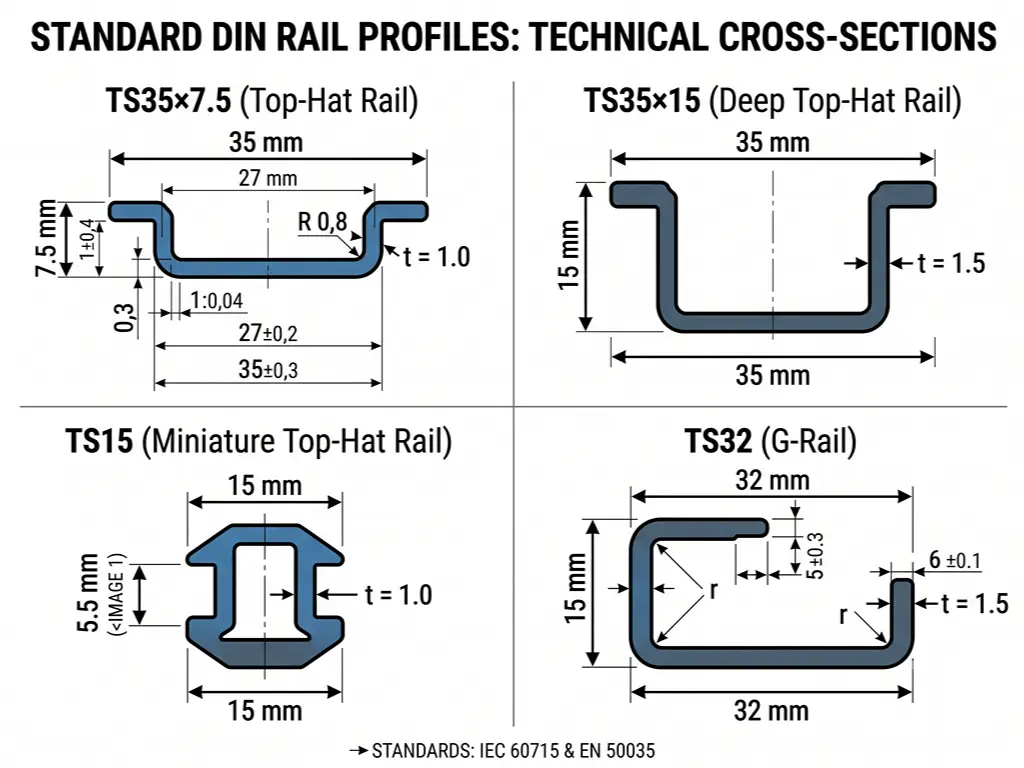
“El término ”carril DIN» no hace referencia a un único tamaño. La norma IEC 60715 define cuatro perfiles estándar, cada uno de ellos identificado por dos números: la anchura y la altura en milímetros. La familia TS35, de 35 mm de anchura, representa más del 90% de las instalaciones a nivel mundial. Sin embargo, incluso dentro de la familia TS35, existen dos variantes de profundidad distintas que se utilizan para fines muy diferentes.
Piensa en el carril DIN como una base de LEGO: una interfaz mecánica universal que permite que componentes de diferentes fabricantes —un disyuntor de Schneider, un bloque de bornes de Weidmüller, un módulo de PLC de Siemens— se acoplen al mismo sistema de montaje.
Dimensiones estándar de los rieles DIN según el tipo
La norma IEC 60715 reconoce cuatro perfiles estándar de carril DIN, cada uno de ellos definido por una combinación única de anchura × altura. La serie TS35 es la más utilizada en las instalaciones modernas; las series TS15 y TS32 se emplean en aplicaciones específicas de nicho. A continuación, se detallan los distintos tipos con sus dimensiones exactas, tolerancias y casos de uso típicos.
TS35 × 7,5 — El carril tipo «top-hat» de referencia mundial
Cuando un ingeniero dice “carril DIN” sin especificar nada más, se refiere al TS35 × 7,5. Este es el estándar universal por defecto. Lo encontrarás en prácticamente todos los cuadros de control, cuadros de distribución y armarios de automatización de todo el mundo.
Dimensiones exactas:
- Ancho: 35 mm (tolerancia de ±0,3 mm según la norma IEC 60715)
- Altura: 7,5 mm (tolerancia de +0 / −0,4 mm)
- Espesor del material: 1,0 mm (acero laminado en frío DC01, según la norma EN 10130)
- Peso: aproximadamente entre 0,30 y 0,35 kg por metro (acero galvanizado)
Aplicaciones habituales:
- Disyuntores miniatura (MCB): un disyuntor unipolar estándar de 18 mm de ancho se acopla directamente al TS35
- Bloques de bornes: la gran mayoría de los bornes de sujeción por tornillo y por resorte son compatibles con TS35
- Módulos de E/S para PLC, acondicionadores de señal y relés pequeños
La mayoría de los rieles TS35 perforados cuentan con ranuras de montaje oblongas de 6,2 mm × 15 mm, con una distancia entre centros de 25 mm. Este patrón de orificios es una convención de facto del sector. La norma IEC 60715 no lo exige explícitamente, pero prácticamente todos los fabricantes lo siguen. Las longitudes estándar de suministro son de 1 metro y 2 metros, y la mayoría de los proveedores ofrecen cortes a medida.
A modo de referencia rápida: un metro de TS35 × 7,5 admite aproximadamente entre 10 y 12 disyuntores monopolares estándar (de 18 mm cada uno), o entre 150 y 200 bloques de bornes compactos (de 5-6 mm cada uno).
TS35 × 15 — El casquete profundo para aplicaciones de alta resistencia
El mismo ancho de 35 mm, el doble de profundidad… y una rigidez considerablemente superior al doble.
Dimensiones exactas:
- Ancho: 35 mm
- Altura: 15 mm
- Espesor del material: 1,5 mm (algunos fabricantes ofrecen versiones reforzadas de 2,0 a 2,3 mm)
- Peso: aproximadamente entre 0,62 y 0,65 kg por metro
La diferencia fundamental es de carácter estructural. El perfil de 15 mm de profundidad tiene aproximadamente entre 3 y 4 veces el módulo de sección de la versión de 7,5 mm, por lo que resiste mucho mejor la flexión bajo cargas pesadas. En entornos propensos a las vibraciones —armarios de control de maquinaria en naves industriales, paneles en el interior de equipos en movimiento—, el TS35 × 15 es la opción habitual.
Cuándo utilizar TS35 × 15 en lugar de TS35 × 7,5:
- Instalación de fuentes de alimentación pesadas (200 W y más)
- Contactores grandes y arrancadores de motor
- Cualquier componente que pese más de 2-3 kg por unidad
- Entornos con vibraciones mecánicas continuas
- Cuando la distancia entre los tornillos de fijación supera los 400 mm: el perfil más profundo permite cubrir luces más largas sin que se combe
Una regla práctica: si notas el peso del componente al cogerlo con una sola mano, móntalo en TS35 × 15.
TS15 — El raíl en miniatura para espacios reducidos
El TS15 es su versión reducida. Tiene la misma geometría de «sombrero de copa», pero mide 15 mm de ancho y solo 5,5 mm de alto.
Dimensiones exactas:
- Ancho: 15 mm (±0,15 mm — tolerancia más estrecha que la del TS35)
- Altura: 5,5 mm (±0,1 mm)
- Espesor del material: 1,0 mm
- Peso: aproximadamente 0,14 kg por metro
- Norma aplicable: EN 50045 (no EN 50022)
El TS15 se utiliza en cajas de conexiones compactas, controladores de automatización de edificios y módulos de relés en miniatura, en los que un raíl completo de 35 mm supondría un desperdicio de valioso espacio en la caja. También es habitual en paneles de control de climatización y sistemas de control de iluminación.
Nota importante sobre la compatibilidad: Los componentes montados en TS15 no se pueden encajar directamente en un carril TS35. Si necesitas combinar dispositivos TS15 y TS35 en el mismo panel, necesitarás soportes adaptadores o secciones de carril independientes.
TS32 (Sección G) — El carril de alta resistencia «Legacy»
El TS32 es el perfil más antiguo que sigue utilizándose actualmente, y data de la época anterior a la IEC. A diferencia de la forma simétrica de «sombrero de copa», el TS32 presenta una sección transversal asimétrica en forma de G.
Dimensiones exactas:
- Ancho: 32 mm
- Altura: 15 mm
- Espesor del material: 1,5 mm
- Norma aplicable: EN 50035
El perfil en G asimétrico ofrece una ventaja inesperada: los componentes solo se pueden encajar desde una dirección, lo que crea una protección natural contra la polaridad inversa. Es físicamente imposible instalar un dispositivo al revés. Esto hizo que el TS32 se popularizara para contactores de alta resistencia, transformadores de gran tamaño y arrancadores de motor en instalaciones europeas más antiguas.
Hoy en día, la mayoría de las aplicaciones del TS32 se han migrado al TS35 × 15. Sin embargo, el TS32 sigue utilizándose en las adaptaciones de equipos antiguos, sobre todo en Alemania, Austria y Europa del Este. También existe una variante de perfil en C (C20, C30, C40, C50 —denominadas según su altura en mm—, principalmente en mercados en los que se aplica la norma australiana AS 2756-1997.
En los nuevos diseños, el TS35 × 15 es el recambio recomendado para el TS32 en casi todos los casos.
Comparativa de tamaños de carril DIN de un vistazo
Si necesitas una única referencia para confirmar las dimensiones de un carril DIN, aquí la tienes.
| Tipo | Ancho | Altura | Espesor | Peso (kg/m) | Lo mejor para |
|---|---|---|---|---|---|
| Tres y medio cinco | 35 mm | 7,5 mm | 1,0 mm | 0,30–0,35 | Disyuntores, terminales, relés, PLC |
| Tres de cinco por quince | 35 mm | 15 mm | 1,5 mm | 0,62–0,65 | Fuentes de alimentación, contactores, cargas pesadas |
| TS15 | 15 mm | 5,5 mm | 1,0 mm | 0.14 | Cajas compactas, relés en miniatura |
| Tres estrellas (Oro) | 32 mm | 15 mm | 1,5 mm | ~0.58 | Contactores y transformadores antiguos |
Equivalentes en pulgadas (para los mercados en los que se especifican unidades imperiales):
- 35 mm = 1,378″
- 15 mm = 0,591″
- 7,5 mm = 0,295″
- 5,5 mm = 0,217″
- 32 mm = 1,260″
Disposición estándar de los orificios de montaje (riel perforado): ranuras oblongas de 6,2 mm × 15 mm con una distancia entre centros de 25 mm.
Longitudes estándar de suministro: 1 metro y 2 metros. La mayoría de los fabricantes y distribuidores ofrecen longitudes a medida.
Nota: La norma IEC 60715 también define un perfil TH 75-25 (75 mm de ancho × 25 mm de alto), pero esta variante prácticamente no tiene uso comercial y, por lo tanto, no se incluye en la comparación anterior.
Guarda esta tabla o haz una captura de pantalla. En ella se recogen todos los tamaños estándar de carril DIN con los que probablemente te encontrarás en la práctica.
Cómo elegir el tamaño adecuado de carril DIN
Conocer las dimensiones es el primer paso. Ayudar a tus clientes a elegir el perfil adecuado para su aplicación es el segundo paso, y ese mismo conocimiento te permite tener en stock los tamaños que realmente se venden. Hay tres factores que influyen en la decisión: qué se va a montar, dónde se va a colocar el panel y qué normas exige el mercado al que te diriges.
Por peso de la carga y tipo de aplicación
El error más habitual a la hora de elegir un carril DIN —tanto si es tu cliente quien monta el cuadro eléctrico como si tú te encargas de abastecer el stock para su reventa— es subestimar el peso acumulado de los componentes montados.
Guía rápida de selección:
| Aplicación | Tren recomendado | Notas |
|---|---|---|
| Carga ligera: bloques de terminales, relés pequeños, acondicionadores de señal | Tres y medio cinco | Se aceptan tornillos de fijación cada 400-500 mm |
| Carga media: interruptores automáticos, PLC compactos, fuentes de alimentación pequeñas (≤120 W) | Tres y medio cinco | Reducir la distancia entre tornillos a 250-300 mm |
| Carga pesada: fuentes de alimentación de gran potencia (200 W o más), contactores, variadores de frecuencia | Tres de cinco por quince | Distancia entre tornillos ≤ 200 mm; añadir abrazaderas en los extremos |
| Cargas y vibraciones extremas: cuadros de transformadores, equipos marítimos y móviles | TS35 × 15 (reforzado) | Topes con una fuerza de retención ≥ 50 N |
A modo de referencia práctica: un TS35 × 7,5 sobre soportes separados entre sí 300 mm soporta aproximadamente entre 8 y 15 kg por metro de carga distribuida uniformemente en condiciones estáticas. En entornos con vibraciones, se debe reducir la capacidad de carga según la norma 50%. La misma luz en un TS35 × 15 triplica la carga de seguridad.
Los topes (abrazaderas de extremo) son imprescindibles en instalaciones pesadas. Una abrazadera de extremo estándar proporciona una fuerza de retención lateral de al menos 20 N, lo que evita que los componentes se desplacen a lo largo del carril debido a las vibraciones.
Según el material y las condiciones ambientales
Una talla adecuada pero con el material equivocado falla con la misma seguridad que una talla incorrecta.
| Material | Resistencia a la corrosión | Coste relativo | El mejor entorno |
|---|---|---|---|
| Acero galvanizado (DC01) | Moderado | Valor de referencia (1×) | Paneles estándar para interiores, salas climatizadas |
| Aluminio | Bien | ~1,5× | Aplicaciones ligeras, humedad moderada |
| Acero inoxidable 304 | Muy bien | ~2,5–3 veces | Armarios para la industria alimentaria, farmacéutica y de uso en exteriores |
| Acero inoxidable 316 | Excelente | ~3–4 veces | Sector marítimo, plantas químicas, entornos con alto contenido en cloruro |
La diferencia fundamental entre el acero inoxidable 304 y el 316: el 316 contiene entre 2 y 3% de molibdeno, lo que le confiere una resistencia a la corrosión por picaduras de cloruro aproximadamente entre 3 y 5 veces superior a la del 304. Si tu panel se encuentra a menos de 5 km de la costa, o en cualquier instalación en la que se utilicen productos de limpieza químicos, el 316 es la opción más segura.
El acero galvanizado sigue siendo la opción predeterminada para la gran mayoría de las aplicaciones industriales en interiores. El espesor estándar del recubrimiento de zinc es de un mínimo de 6 micras (según la norma DIN 50960, grado de recubrimiento gal Zn 8c).
Según las normas de cumplimiento y los requisitos regionales
Este es el aspecto que la mayoría de las guías pasan por alto. También es el que provoca las sorpresas más costosas en los proyectos de exportación.
El carril DIN en sí mismo no lleva el marcado CE. Se trata de un componente, no de un dispositivo acabado. Sin embargo, el uso de un carril no conforme con la norma puede provocar que todo el conjunto del cuadro no supere la certificación en el mercado de destino.
Referencia a las normas específicas de cada mercado:
| Mercado | Norma aplicable | Diferencia clave |
|---|---|---|
| Unión Europea | IEC/EN 60715 | Norma global por defecto |
| América del Norte | UL 60715 | Técnicamente es idéntica a la norma IEC 60715, pero la homologación UL es una certificación independiente. Comprueba que tu proveedor de rieles cuente con el reconocimiento UL. |
| Reino Unido | BS 5584 | Norma británica anterior; la norma IEC 60715 se acepta para los nuevos diseños |
| Australia / Nueva Zelanda | AS 2756-1997 | Incluye perfiles de sección en C (C20, C30) que no están contemplados en la norma IEC 60715 |
| Oriente Medio / Asia Meridional | IEC o BS (según el proyecto) | Muchas licitaciones en antiguos territorios británicos siguen haciendo referencia a las normas BS. Comprueba qué norma exige realmente el pliego de condiciones. |
Un consejo práctico para proyectos de exportación: especifica “Conforme a la norma IEC 60715” en tu lista de materiales. Es la referencia más ampliamente aceptada a nivel mundial. En el caso de los paneles norteamericanos, comprueba que el carril lleve la marca de «Componente reconocido por UL». Esto es independiente del cumplimiento de la norma IEC y se comprueba durante las inspecciones de paneles según la norma UL 508A.
Adquisición de rieles DIN: qué hay que tener en cuenta a la hora de comprarlos
Una vez que hayas determinado el tamaño, el material y los requisitos de conformidad, la fase de adquisición cuenta con su propia lista de comprobación. Estos cinco puntos te ayudarán a evitar los errores más comunes en el proceso de adquisición.
1. Solicita la documentación que acredite el cumplimiento de la norma IEC 60715. Cualquier proveedor de confianza debería facilitar, previa solicitud, un certificado de materiales y un informe de conformidad dimensional. Si no puede presentarlos, mejor descartarlo. Las desviaciones dimensionales, incluso tan pequeñas como 0,5 mm en el borde de la brida, pueden impedir que los componentes encajen correctamente.
2. Aclara desde el principio los requisitos de perforación. El riel perforado (con ranuras de montaje preperforadas) es la opción predeterminada para la mayoría de las aplicaciones. Si necesitas un riel sin perforar —por ejemplo, cuando tengas previsto taladrar orificios de montaje a medida—, indícalo antes de realizar el pedido. Confirma las dimensiones de los orificios (6,2 × 15 mm es el estándar) y la distancia entre centros (25 mm).
3. Comprueba las especificaciones de los materiales y los recubrimientos. No aceptes “acero” como descripción del material. Solicita el tipo específico (DC01 según la norma EN 10130 es el estándar para el acero laminado en frío), el espesor del recubrimiento de zinc (mínimo 6 µm) y el tratamiento de pasivación. Para los pedidos de acero inoxidable, el certificado de fábrica debe indicar el tipo exacto: 1.4301 para el 304, 1.4401/1.4404 para el 316.
4. Confirma las longitudes de suministro y las cantidades mínimas de pedido. Las longitudes estándar son de 1 m y 2 m. Si tu diseño requiere longitudes no estándar, comprueba si el corte está incluido o se cobra por separado. Las cantidades mínimas de pedido habituales para los rieles DIN industriales oscilan entre 100 y 500 metros, dependiendo del proveedor y de las especificaciones.
5. Comprueba el embalaje y las medidas de protección durante el transporte. El carril DIN es largo, delgado y se dobla con facilidad durante el transporte. Asegúrate de que el proveedor utilice un embalaje rígido; lo ideal son cajas de madera o tubos de cartón reforzado para longitudes superiores a 1 m. Un carril doblado que a simple vista parezca estar en buen estado puede provocar fallos en el montaje una vez instalados los componentes.
Esta es la realidad de la distribución industrial: el carril DIN en sí mismo es un artículo con un margen reducido. Pero el tiempo que supone adquirir el carril de un proveedor, las regletas de conexión de otro, los relés de un tercero y las fuentes de alimentación de un cuarto merma rápidamente tu margen. Los distribuidores que triunfan son aquellos que consolidan: una única relación con un proveedor que cubre tanto el carril como todo lo que se monta en él. Tus clientes reciben un solo envío y una sola factura, y tú tienes que gestionar un solo proveedor en lugar de cuatro.
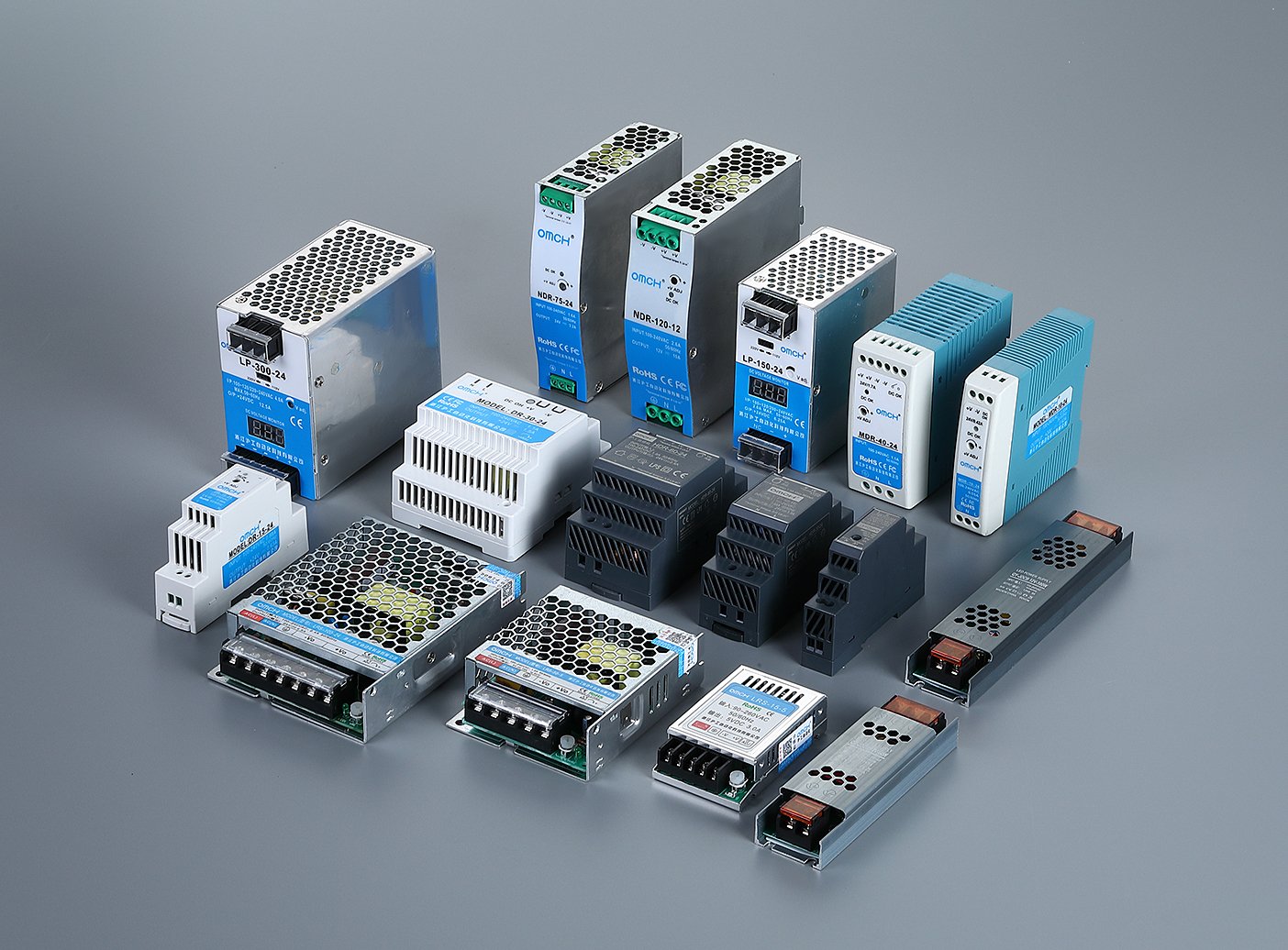
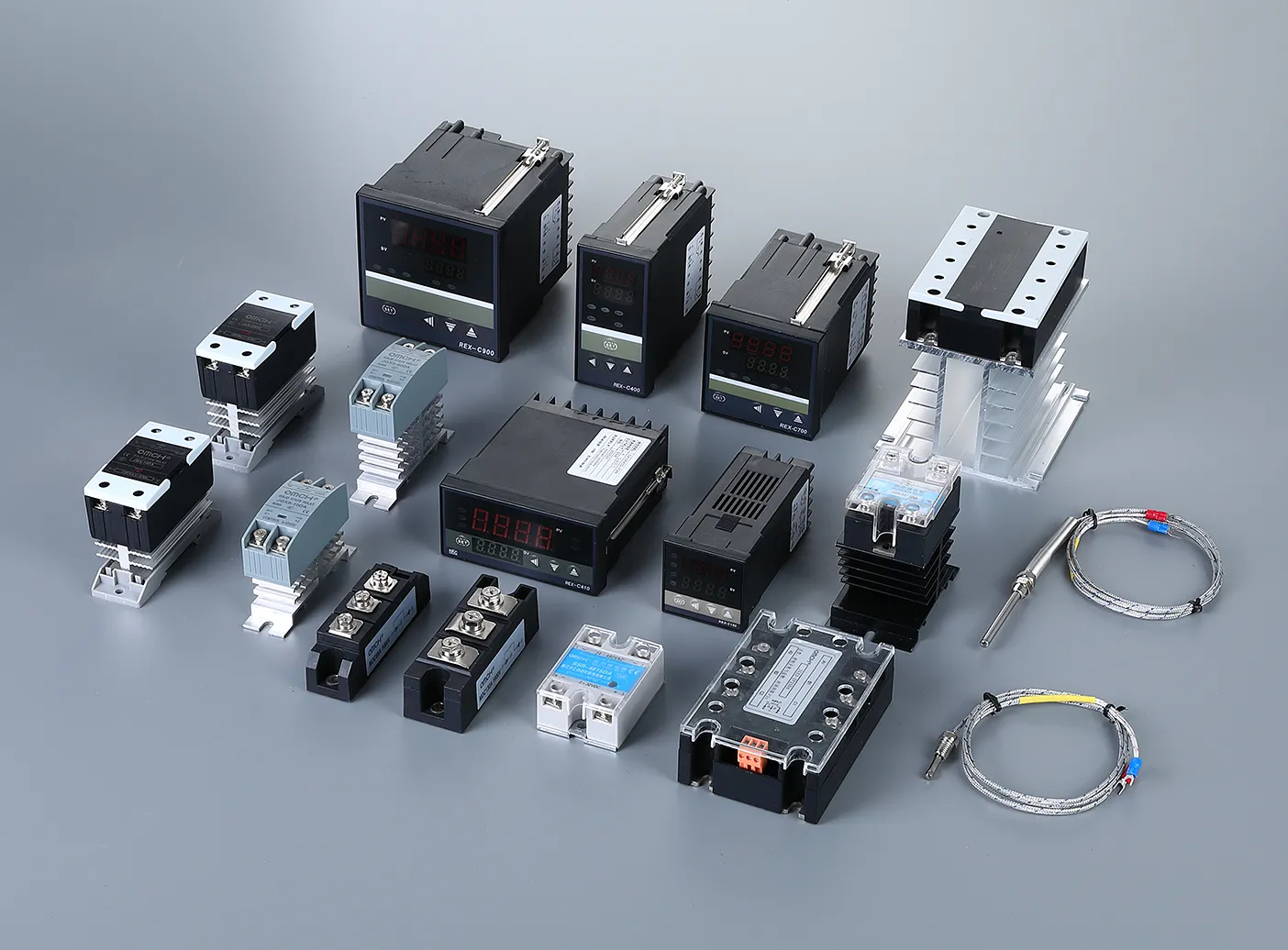
Para los distribuidores que estén evaluando socios proveedores, OMCH cuenta con un catálogo que abarca más de 30 categorías de productos y más de 3.000 referencias, que incluyen componentes compatibles con carril DIN, desde fuentes de alimentación y disyuntores hasta relés y bornes. Esto se traduce en menos relaciones con proveedores que gestionar y un mayor margen en tus operaciones. Descubre la gama completa en www.omch.com.



 English
  Arabic
  Turkish
  Russian
  Spanish
  French
  Indonesian
  Portuguese
  Thai
Thai  Vietnamese