




Entra en cualquier fábrica, planta de tratamiento de aguas o sala eléctrica de un edificio comercial y abre un cuadro de control. Lo primero que verás es un riel metálico horizontal repleto de dispositivos perfectamente encajados: disyuntores, relés, fuentes de alimentación y bloques de terminales. Ese riel es un riel DIN. Los dispositivos que se montan en él son componentes de riel DIN, los bloques de construcción estandarizados de los sistemas eléctricos industriales modernos.
Para los distribuidores y mayoristas, conocer a la perfección el panorama de los componentes para carril DIN no es una opción: tus clientes confían en ti para que les recomiendes las piezas adecuadas, dispongas de las referencias correctas en stock y detectes los problemas de compatibilidad antes de que se conviertan en devoluciones. Tanto si estás ampliando tu catálogo como si estás ayudando a un cliente a definir las especificaciones de un cuadro de control, esta guía te explica todo lo que necesitas saber: tipos de carril, categorías de componentes, criterios de selección y qué debes buscar en un socio proveedor.
¿Qué es un carril DIN? Entender el estándar del sector
Un carril DIN es un carril de montaje metálico normalizado, definido por la norma internacional IEC/EN 60715 (IEC, 2017). Proporciona soporte mecánico a los dispositivos eléctricos situados en el interior de los armarios de control y las cajas de los equipos. No conduce corriente. Su función es puramente estructural: permite encajar los componentes a presión, deslizarlos hasta su posición y fijarlos sin necesidad de taladrar ni un solo agujero.
El concepto surgió en 1928 en Essen, Alemania. La empresa de servicios públicos RWE se enfrentaba a un problema práctico: a medida que los cuadros eléctricos se volvían más complejos, atornillar cada dispositivo individualmente a una placa trasera se estaba convirtiendo en una tarea inmanejable. Contrataron a una joven empresa llamada Phoenix Contact para resolverlo. De esa colaboración surgió un sistema modular de bloques de terminales montado sobre un carril de perfil G asimétrico. Ese carril es el antecesor de todos los carriles DIN que se utilizan hoy en día. En la década de 1950, el organismo nacional alemán de normalización DIN había formalizado el diseño, y su posterior adopción por parte de la IEC convirtió una convención industrial alemana en una norma de infraestructura verdaderamente global.
Por qué es importante: dado que el carril DIN es una norma dimensional y no un sistema específico de una marca, los componentes de distintos fabricantes se acoplan al mismo carril de 35 mm y funcionan juntos. Un disyuntor de Schneider, un bloque de terminales de Phoenix Contact, una fuente de alimentación de Mean Well… todo en un mismo carril. Esta interoperabilidad es lo que hace que el ecosistema del carril DIN sea tan potente para los fabricantes de cuadros eléctricos y tan rentable para los usuarios finales. Piensa en el carril como una base de Lego: cualquier pieza compatible encaja a la perfección y puedes reorganizar la disposición a medida que cambian tus necesidades.
Tipos y materiales de los rieles DIN: cómo elegir la base adecuada
No todos los rieles DIN son iguales. Existen cuatro perfiles principales porque las distintas aplicaciones requieren diferentes resistencias mecánicas, diferentes espacios y diferentes tolerancias ambientales.
| Tipo de carril | Ancho | Profundidad | Uso principal |
|---|---|---|---|
| TS35 (Top-Hat) | 35 mm | 7,5 mm (estándar) / 15 mm (profundo) | El estándar mundial: disyuntores, relés, controladores lógicos programables (PLC), bloques de bornes y fuentes de alimentación |
| TS15 (Mini Top-Hat) | 15 mm | 5,5 mm | Cajas compactas, pequeñas cajas de conexiones, trabajos de adaptación en espacios reducidos |
| TS32 (cesárea) | 32 mm | 20-50 mm (varía) | Los sistemas antiguos y los componentes más pesados, como los transformadores, pueden necesitar adaptadores para los dispositivos modernos. |
| G-Rail (G32) | 32 mm | Perfil asimétrico | El diseño original de 1928: componentes pesados y de gran potencia; poco habituales en las nuevas construcciones |
Para más de 90% de aplicaciones industriales modernas, El TS35/7,5 es la elección acertada. Prácticamente todos los componentes que se fabrican hoy en día están diseñados en torno al perfil tipo «top-hat» de 35 mm. La variante TS35/15, de mayor profundidad, ofrece una mayor capacidad de carga para dispositivos excepcionalmente pesados, como transformadores de gran tamaño o variadores de frecuencia (VFD), pero en un armario de control estándar basta con la profundidad de 7,5 mm.
La elección del material resulta igualmente sencilla una vez que se adapta al entorno de funcionamiento. Acero galvanizado Es la solución más rentable y versátil para los cuadros de control de interior. Ofrece una buena resistencia a la corrosión al precio más bajo, razón por la cual representa la gran mayoría de los rieles DIN que se venden en todo el mundo. Aluminio Reduce el peso y resiste la corrosión de forma natural, lo que lo convierte en la opción ideal para equipos instalados en vehículos, apoyo en tierra para el sector aeroespacial y bancos de pruebas portátiles. Acero inoxidable (grado 304/V2A) Es esencial para las plantas de procesamiento de alimentos, las instalaciones farmacéuticas y las instalaciones al aire libre expuestas a la humedad o a la niebla salina. El sobrecoste inicial es modesto en comparación con el coste que supone sustituir un riel oxidado en el interior de un panel en funcionamiento. Cobre El riel es una opción específica, que solo se utiliza cuando el propio riel debe hacer las veces de barra colectora de puesta a tierra.
Catálogo completo de componentes para carril DIN: qué se puede montar en el carril
El ecosistema de los rieles DIN abarca docenas de tipos de dispositivos. Se organizan de forma clara en tres capas funcionales: infraestructura de alimentación (llevar la electricidad al cuadro y distribuirla de forma segura), control y conectividad (hacer que el sistema «piense» y se comunique) y accesorios (mantener todo seguro, organizado y fácil de mantener).
Gestión de la alimentación: disyuntores, fuentes de alimentación y protección contra sobretensiones
Todo sistema de carril DIN comienza por la alimentación eléctrica. Sin un suministro eléctrico fiable y protegido, nada más importa.
Disyuntores constituyen la primera línea de defensa. Los interruptores automáticos miniatura (MCB) protegen cada uno de los circuitos derivados contra sobrecorrientes y cortocircuitos. Son los dispositivos para carril DIN que instalarás en mayor cantidad. Parámetros clave de selección: número de polos (1P para monofásicos, 3P para trifásicos), corriente nominal (de 1 A a 63 A para los MCB estándar) y curva de disparo (B para cargas resistivas como la iluminación, C para cargas inductivas como los motores, D para equipos con alta corriente de arranque como los transformadores). Para cuadros industriales, insiste en interruptores con una capacidad nominal de IEC 60947-2 (la norma industrial) en lugar de la norma IEC 60898 (la norma doméstica). La clasificación industrial exige una mayor capacidad de resistencia a los cortocircuitos. Los interruptores automáticos en caja moldeada (MCCB) se encargan de las entradas principales a partir de 100 A. Los dispositivos de corriente residual (RCCB/RCBO) añaden protección contra fugas a tierra para garantizar la seguridad del personal.
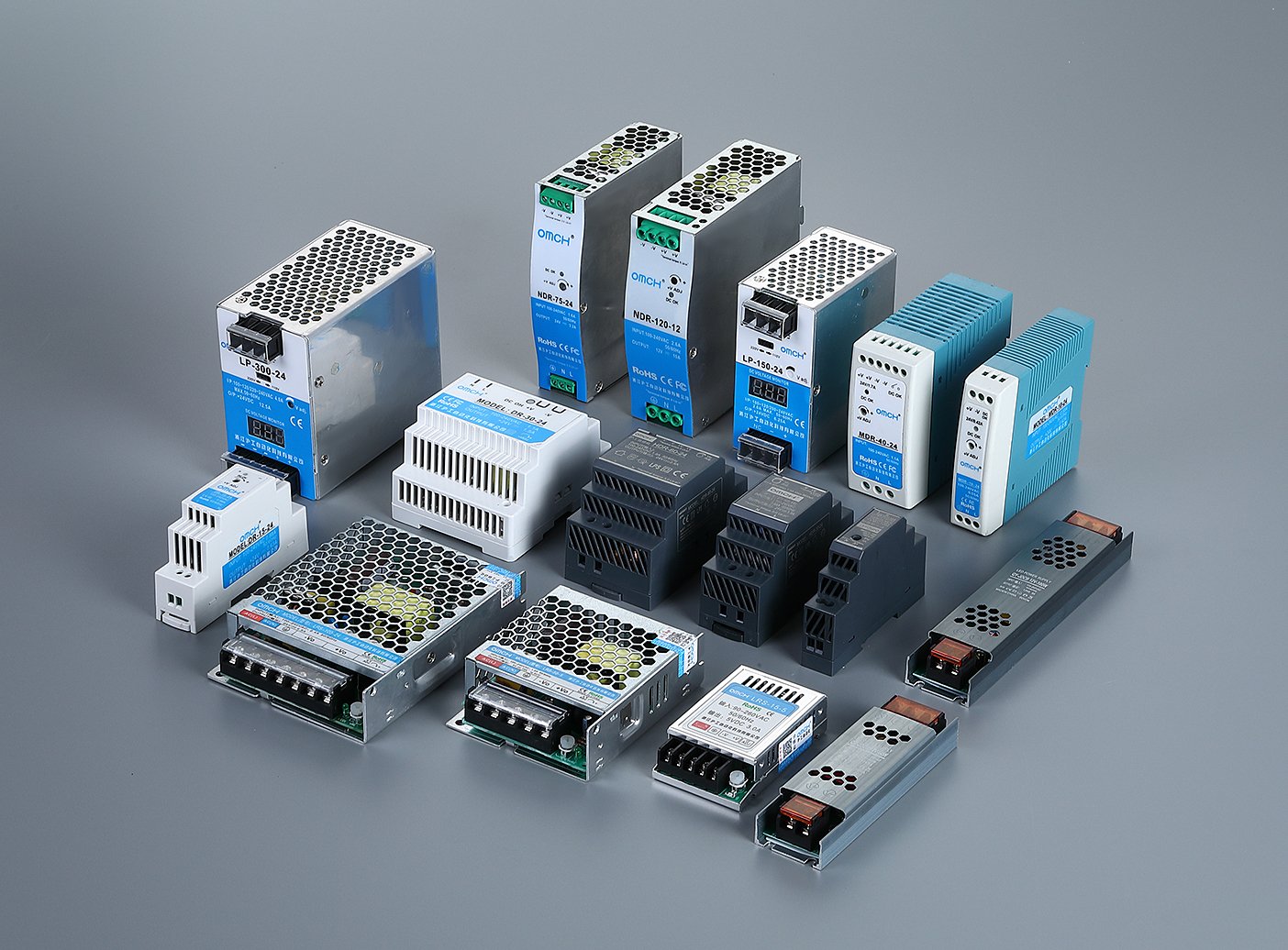
Fuentes de alimentación para carril DIN son el núcleo del sistema de control. Convierten la tensión de red de CA de entrada (normalmente 230 V o 400 V) en la 24 V CC que alimenta los PLC, los relés, los sensores y los paneles HMI. La tensión de 24 V CC es la tensión de control universal en la automatización industrial, especificada por la norma IEC 61131-2 para los requisitos de alimentación de los PLC. A la hora de seleccionar una fuente de alimentación para carril DIN, no te limites a la potencia nominal. Compruebe la eficiencia (≥88% con una entrada de 230 V CA es el punto de referencia para las unidades de calidad), el tiempo de mantenimiento (el tiempo que mantiene la salida durante una breve interrupción de la red eléctrica, 20 ms como mínimo) y las especificaciones de ondulación y ruido (≤150 mV pico a pico para un funcionamiento fiable del PLC). Las fuentes de alimentación de la serie NDR con carcasa metálica ofrecen una mejor disipación del calor que las alternativas con carcasa de plástico.
Dispositivos de protección contra sobretensiones (SPD) y los portafusibles son los componentes que los principiantes suelen pasar por alto con mayor frecuencia. Un solo pico de tensión provocado por el arranque de un motor cercano o por un rayo puede destruir todos los dispositivos electrónicos de la línea eléctrica. Un SPD instalado en la entrada principal cuesta una fracción del precio de los equipos que protege y debería ser una práctica habitual en cualquier cuadro que contenga PLC, variadores de frecuencia o equipos de red.
Control, conmutación y conectividad: relés, PLC y redes industriales
Si la fuente de alimentación es el corazón de un sistema de carril DIN, la capa de control es el cerebro y el sistema nervioso. Es la que decide lo que ocurre y canaliza las señales para que así sea.
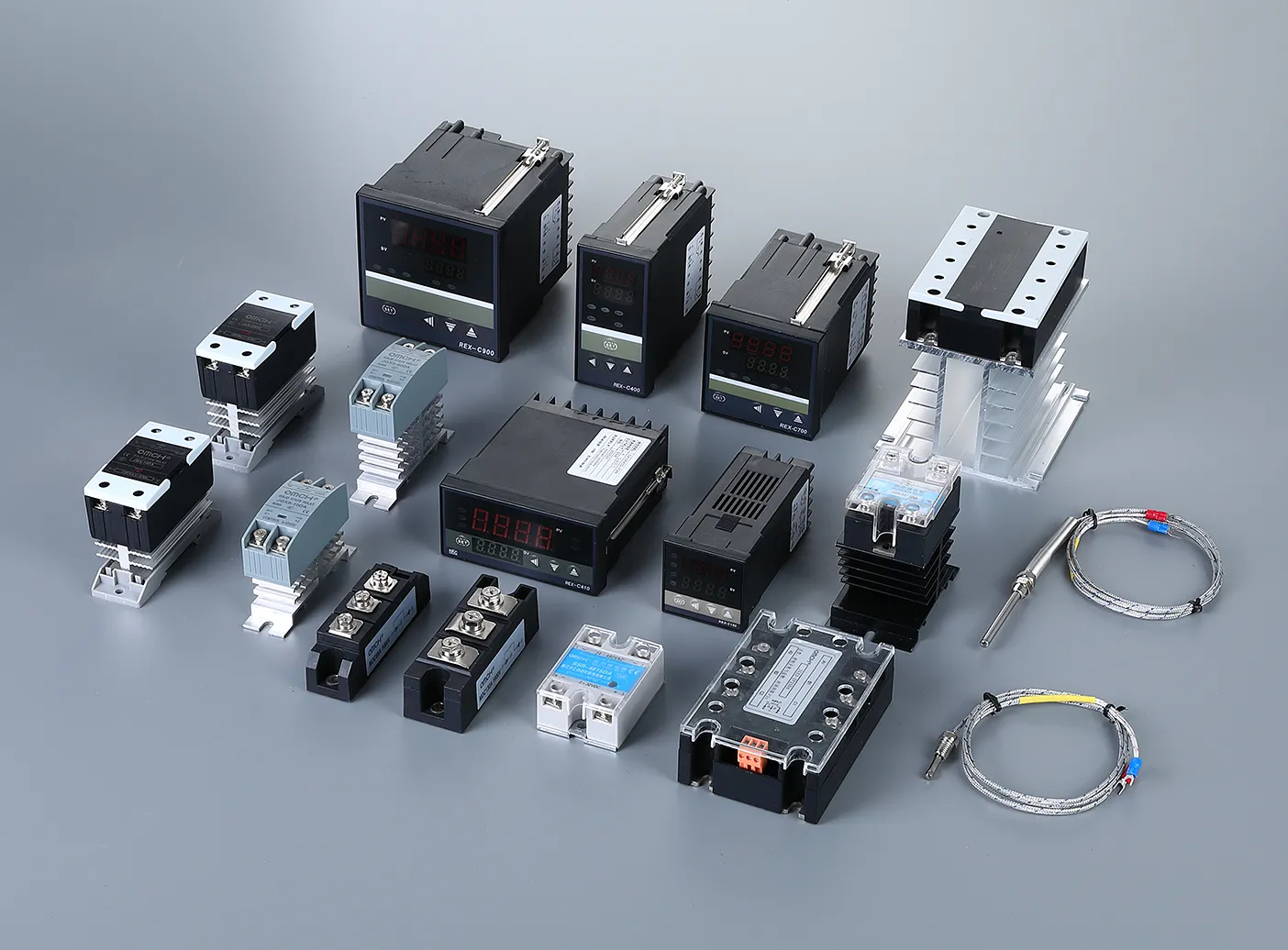
Relés y contactores salvar la diferencia entre las señales de control de baja potencia y las cargas de alta potencia. Un relé electromagnético permite que una señal de 24 V CC procedente de un PLC accione un contactor de motor de 230 V CA. Los dos circuitos están aislados eléctricamente, por lo que un fallo en el lado de la alimentación no puede provocar una retroalimentación hacia el controlador. Para aplicaciones que requieran conmutaciones frecuentes (más de unas pocas veces por minuto) o un funcionamiento silencioso, relés de estado sólido (SSR) utilizan conmutación por semiconductores sin piezas móviles. Sin embargo, generan calor y deben reducirse en un 30–50% de su corriente nominal, a menos que se monten sobre un disipador térmico. Este requisito de reducción térmica es la causa más común de fallo de los SSR en el campo. Afecta incluso a ingenieros experimentados que tratan las corrientes nominales de los SSR de la misma manera que las de los relés electromecánicos. Para cargas de motor, un contactor Es imprescindible que esté clasificado para la categoría de utilización AC-3 (arranque directo del motor). El uso de un contactor clasificado únicamente para AC-1 (cargas resistivas) en un motor provocará la soldadura prematura de los contactos.
PLC y módulos de E/S remotos son cada vez más compatibles de serie con el carril DIN. Los PLC compactos de marcas como Siemens (S7-1200), Allen-Bradley (MicroLogix) y Mitsubishi (serie FX) se acoplan directamente al carril TS35, y los módulos de E/S de expansión se encajan junto a ellos. Esta modularidad permite empezar con una CPU básica de 8 entradas y 6 salidas y ampliarla hasta cientos de puntos de E/S sin necesidad de cambiar el sistema de montaje físico.
Conmutadores Ethernet industriales, pasarelas de protocolo y convertidores de medios representan la categoría de dispositivos para carril DIN que más rápido está creciendo. A medida que las fábricas adoptan arquitecturas de la Industria 4.0, los conmutadores gestionados y no gestionados en formato de carril DIN se están volviendo tan habituales dentro de los cuadros de control como las regletas de bornes. Estos conmutadores canalizan el tráfico de Profinet, EtherNet/IP y Modbus TCP entre los PLC, las IHMs y las redes a nivel de planta.
Accesorios: topes, marcadores y organizadores de cables
Los accesorios son aquellas piezas de las que nadie habla hasta que surge algún problema. Un cuadro de control puede contar con los mejores disyuntores, el PLC más avanzado y una fuente de alimentación de primera calidad, y aun así no superar una inspección o provocar una avería porque alguien haya pasado por alto los accesorios.
Topes (abrazaderas de extremo) evitan que los componentes se deslicen lateralmente por el carril. Son obligatorios en ambos extremos de cada segmento de carril, no son opcionales. En cualquier entorno con vibraciones (compresores, punzonadoras, generadores diésel, a bordo de buques), los componentes que no estén bien sujetos se desplazarán poco a poco a lo largo del carril a lo largo de semanas y meses. Un bloque de bornes puede abrirse. Un interruptor puede aflojarse. Los topes son la póliza de seguro más económica de todo el cuadro eléctrico.
Placas finales y placas separadoras Tienen dos funciones. Cubren las partes vivas expuestas del bloque de bornes más exterior de un grupo (lo que supondría un riesgo de descarga eléctrica si se omitieran). Además, proporcionan una separación visual y física entre los circuitos que funcionan a diferentes niveles de tensión. La norma IEC 60445 exige una identificación y segregación claras. La placa separadora es la forma de cumplir con esta norma sin tener que rediseñar la disposición.
Barras de puenteo (enlaces de conexión cruzada) distribuyen un potencial común entre varios terminales adyacentes. Sustituyen a docenas de cables de puente individuales por una única barra metálica con forma de peine, lo que reduce drásticamente el tiempo de cableado y elimina los errores de conexión. Los puentes estándar tienen una intensidad nominal (normalmente ≤32 A). Para la distribución de potencia por encima de ese umbral, utilice bloques de terminales de distribución de potencia específicos con entradas con terminales atornillados.
Etiquetas de identificación, tiras de etiquetas y conductos para cables son lo que distingue a un cuadro eléctrico profesional de uno amateur. Cada borne y cada cable deben ser identificables de un solo vistazo. No se trata solo de complacer al inspector, sino de que el técnico que esté solucionando un problema a las 3 de la madrugada, durante una parada de producción, pueda localizar el circuito correcto en segundos, en lugar de en minutos.
Bloques de terminales: la columna vertebral de todo sistema de carril DIN
Las regletas de bornes son los dispositivos más numerosos en cualquier carril DIN. Un armario de control de tamaño medio puede contener entre 100 y 300 bornes individuales, muchos más que cualquier otro tipo de componente. Elegir correctamente las regletas de bornes resulta rentable durante toda la vida útil del armario.
Tipos de bloques de bornes según su función
El árbol genealógico de los bloques de bornes comienza con el humilde terminal de paso: una entrada y una salida. Constituye la mayor parte de los terminales de la mayoría de los cuadros eléctricos. A partir de ahí, existen variantes especializadas que cumplen funciones específicas en los circuitos.
Terminales de tierra (PE) Se conectan al propio carril DIN mediante un pie metálico, lo que permite la conexión del carril al sistema de tierra de protección. Su carcasa de color amarillo verdoso es obligatoria según la norma IEC 60445. Cada grupo de bornes debe incluir al menos un borne PE; la norma IEC 60947-7-2 regula sus requisitos de diseño y ensayo.
Desconectar los terminales Añade un mecanismo de interruptor de cuchilla que te permita aislar un bucle de corriente de 4–20 mA para realizar pruebas sin tener que desconectar físicamente ningún cable. Los técnicos de mantenimiento te lo agradecerán cada vez que tengan que calibrar un transmisor.
Terminales de varios niveles apilar dos o tres niveles de conexión en el mismo espacio físico que ocupa un bloque de conexiones de un solo nivel. El ahorro de espacio es considerable: un bloque de conexiones de doble nivel ahorra aproximadamente 30% de longitud de carril en comparación con dos bloques equivalentes de un solo nivel instalados uno al lado del otro. Un bloque de terminales de tres niveles puede aumentar esa cifra hasta casi 45%. En un cuadro denso, donde cada milímetro de espacio en el carril es muy disputado, los bloques de terminales de varios niveles son la forma más rentable de añadir capacidad sin ampliar el armario.
Tecnologías de conexión: ¿de tornillo, de resorte o de encaje a presión?
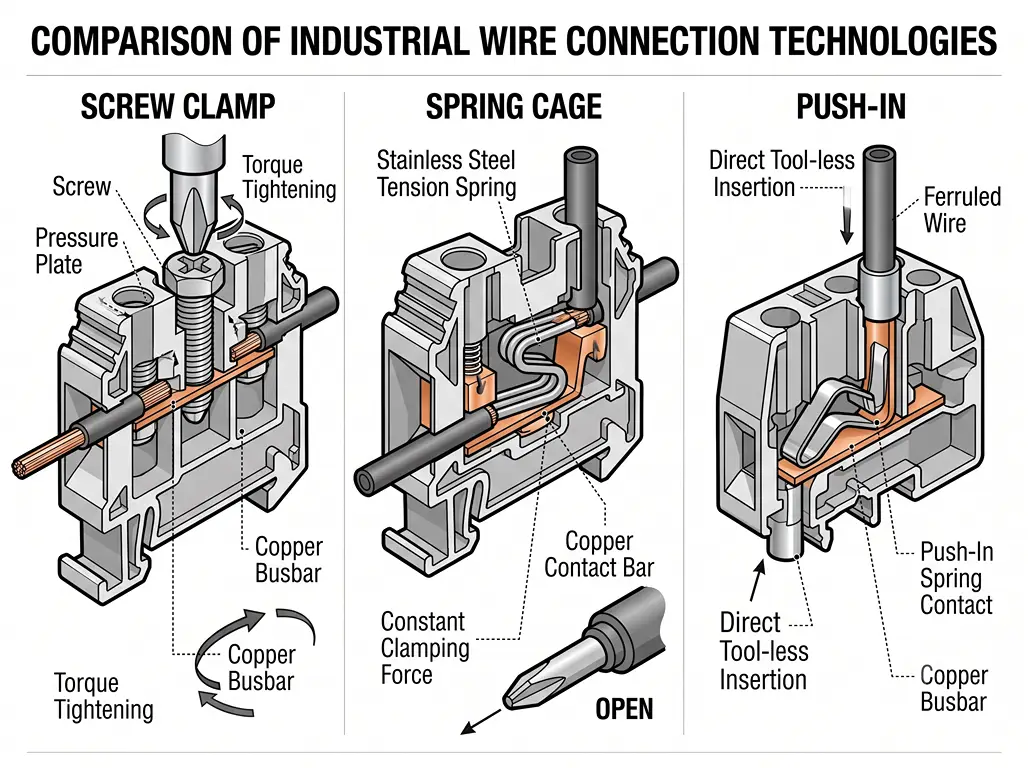
Los tres métodos de conexión suponen una auténtica evolución tecnológica. La elección entre ellos tiene consecuencias reales en cuanto al tiempo de instalación, la fiabilidad a largo plazo y la facilidad de mantenimiento.
Abrazadera de tornillo Este es el método tradicional: pelar el cable, introducirlo en el terminal y apretar el tornillo al par de apriete especificado (normalmente entre 0,5 y 0,8 Nm). Es un método que conocen todos los electricistas del mundo, funciona con cualquier tipo de cable y no requiere herramientas especiales más allá de un destornillador. La desventaja es que las conexiones atornilladas necesitan un reajuste periódico del par de apriete, ya que los ciclos térmicos y las vibraciones pueden aflojar la sujeción con el paso del tiempo. Para los cuadros situados en entornos estáticos y climatizados, cuyo mantenimiento corre a cargo del personal interno, la abrazadera de tornillo sigue siendo una opción perfectamente válida.
Jaula de muelles (abrazadera de jaula) sustituye el tornillo por un resorte de acero inoxidable precargado. Se abre la jaula con un destornillador plano estándar, se introduce el cable y se suelta. El resorte mantiene una presión de contacto constante durante toda la vida útil del terminal. Las pruebas independientes realizadas con varios fabricantes demuestran sistemáticamente que los terminales de jaula con resorte reducen el tiempo de instalación por cable en 50–75% en comparación con la abrazadera de tornillo (Contacto en Phoenix; WAGO). Y lo que es más importante, la fuerza constante del muelle garantiza que la conexión nunca se afloje. Esta es una ventaja fundamental en cualquier entorno sujeto a vibraciones: salas de máquinas de ascensores, cabinas de señalización ferroviaria o sistemas eléctricos a bordo de buques. La norma IEC 60068-2-6 define el protocolo estándar de ensayo de vibraciones; los terminales de jaula de muelle superan habitualmente el ensayo con un barrido de 10 a 150 Hz y una aceleración de 5 g.
De encaje a presión Esta tecnología va un paso más allá: no hace falta ninguna herramienta. Pela el cable (con un casquillo engarzado si es trenzado), introdúcelo directamente en el terminal y la abrazadera de resorte interna lo sujeta y lo mantiene en su sitio. La conexión por inserción es el método más rápido que existe, con una velocidad de hasta 6 veces más rápido por cable que la abrazadera de tornillo en la producción en serie. Sin embargo, hay una salvedad fundamental que todo fabricante de paneles debe tener en cuenta: Nunca se debe introducir un cable trenzado sin recubrimiento en un terminal de conexión rápida.. Sin un casquillo engarzado, los hilos individuales se separan contra el mecanismo de resorte, creando una conexión parcial de alta resistencia. Esta conexión puede superar una prueba inicial de continuidad, pero fallar bajo carga. Se trata del error de instalación más habitual y más peligroso con los terminales de conexión a presión.
- Compatible con cualquier tipo de cable
- Ideal para paneles estáticos para interiores
- Requiere un mantenimiento periódico retorquing
- Algo que todo electricista conoce bien
- 50–75% más rápido para cablear
- Resistente a las vibraciones — nunca se afloja
- Ideal para móvil / ferroviario / marítimo
- Presión de contacto constante de por vida
- 6 veces más rápido — Inserción sin herramientas
- Requisitos: conductores con casquillo
- Ideal para producción en serie
- ⚠️ Cable de hilos pelados = riesgo de avería
Cómo elegir los componentes para carril DIN adecuados para tu aplicación
Saber qué hay disponible te lleva hasta la línea de salida. Elegir los componentes adecuados para tu instalación concreta es lo que marca la diferencia entre un cuadro eléctrico fiable y un quebradero de cabeza constante.
Adaptar los componentes a tu entorno operativo
El mismo componente que funciona a la perfección en una sala de control de una fábrica con aire acondicionado puede fallar en cuestión de meses en una instalación al aire libre sin calefacción. El entorno es el factor determinante en todas las decisiones de selección.
Planta de producción estándar (en interior, con temperatura controlada y vibraciones mínimas): la opción más sencilla. Un carril TS35/7,5 galvanizado, bornes de sujeción por tornillo o con jaula de resorte, interruptores automáticos estándar y fuentes de alimentación comunes funcionarán de forma fiable durante décadas. Esta es la configuración básica. Se pueden actualizar componentes individuales cuando sea necesario sin necesidad de sobredimensionar todo el cuadro eléctrico.
Entorno exterior o húmedo (plantas de tratamiento de aguas, estaciones de bombeo, puertos): la resistencia a la corrosión se convierte en el factor determinante. Carril DIN de acero inoxidable 304, bornes de jaula de muelles (la humedad acelera la corrosión y el aflojamiento de los tornillos) y todos los dispositivos con clasificación mínima de IP65 cuando se alojan en una caja estanca. Presta especial atención a la gestión de la condensación. Una caja sellada en un entorno húmedo con oscilaciones de temperatura formará condensación interna a menos que esté equipada con un tapón de drenaje o un calentador anticondensación.
Instalación móvil o con altas vibraciones (instalados en vehículos, señalización ferroviaria, a bordo de buques, plataformas de generadores): la resistencia al peso y a las vibraciones es fundamental. El carril DIN de aluminio permite ahorrar varios kilogramos en comparación con el acero, lo cual es importante cuando cada kilo supone un coste adicional de combustible. Los terminales de jaula de muelles o de inserción a presión son obligatorios, no opcionales. Se prefieren los relés con contactos de enclavamiento mecánico o salidas de estado sólido frente a los tipos electromecánicos estándar, que pueden vibrar bajo la acción de las vibraciones.
Alimentación, bebidas y productos farmacéuticos (entorno de lavado a presión): acero inoxidable 304 o 316 en todas las piezas, incluido el propio carril DIN, todos los elementos de fijación y todas las piezas metálicas expuestas. El acero galvanizado estándar se oxida y se descascarilla, lo que genera riesgos de contaminación. Es posible que se requiera una clasificación de la carcasa de IP69K (para lavado a presión con agua caliente) en función del régimen de limpieza específico.
Certificaciones, compatibilidad y valor a largo plazo
La ficha técnica solo te da una visión parcial. Hay tres aspectos ocultos que determinan si los componentes que elijas seguirán teniendo buen aspecto dentro de cinco años.
Las certificaciones son documentos que permiten el acceso al mercado, no distintivos de calidad. La marca CE permite que tu cuadro eléctrico acceda a la Unión Europea. Las normas UL 508 (equipos de control industrial) y UL 1059 (bloques de terminales) permiten su acceso a Norteamérica. La marca CE por sí sola no se reconoce al otro lado del Atlántico, y lo mismo ocurre a la inversa. La certificación CCC es obligatoria para los equipos que se comercializan en China. Si su cuadro eléctrico pudiera exportarse, o si forma parte de una máquina que se vaya a exportar, diseñe teniendo en cuenta los requisitos de certificación del mercado de destino desde el primer momento. Adaptar un diseño ya terminado para que cumpla con los requisitos de certificación resulta mucho más costoso que incorporarlos desde el principio.
La interoperabilidad es física, pero no eléctrica. La norma TS35 garantiza el ajuste mecánico. Cualquier componente compatible con TS35 se acoplará físicamente a cualquier carril TS35. No garantiza que un disyuntor automático (MCB) con una capacidad de corte de 10 kA se coordine correctamente con un dispositivo situado aguas arriba de 6 kA. Tampoco garantiza que el tiempo de mantenimiento de tensión de una fuente de alimentación de 24 V sea suficiente para el PLC al que alimenta. La coordinación eléctrica sigue siendo responsabilidad del diseñador.
El coste total de propiedad (TCO) da la vuelta a la lógica del precio de etiqueta. Un bloque de terminales que cuesta $0,15 por unidad, pero que tiene una tasa de fallos en campo de 2%, resulta mucho más caro a lo largo de la vida útil del cuadro que un bloque de terminales de $0,35 con una tasa de fallos de 0,1%. La diferencia se refleja en la mano de obra para la resolución de averías, el tiempo de inactividad de la producción y el coste de enviar a un técnico a las instalaciones. El precio de un componente es lo que se paga una sola vez. La fiabilidad de un componente es lo que se paga cada año a partir de entonces.
De los componentes al sistema completo: cómo montar tu primer panel para carril DIN
Un panel de carril DIN diseñado con cuidado dura entre 15 y 20 años con una intervención mínima. En cambio, uno montado a toda prisa a partir de una lista de la compra se convierte en una fuente de irritación constante.
Planifica la disposición antes de pedir ningún componente. Esboza la disposición de los rieles teniendo en cuenta el flujo de corriente: entrada principal (extremo izquierdo o parte superior), interruptor general, terminales de distribución de energía, interruptores de circuitos derivados, fuentes de alimentación y dispositivos de control, bloques de terminales para el cableado de campo (extremo derecho o parte inferior). Esto se ajusta al principio eléctrico según el cual la corriente debe fluir de alto a bajo, de lo desprotegido a lo protegido y de la fuente de alimentación a la carga.
Instálalo en el orden correcto: monta primero el riel DIN, después los conductos para cables (que definen los canales de cableado) y, a continuación, fija los componentes al riel de mayor a menor tamaño. Las fuentes de alimentación y los contactores se colocan primero, ya que son pesados y requieren un acceso libre para su montaje. Las regletas de bornes y los relés pequeños se colocan en último lugar. Realiza el cableado solo después de haber montado todos los componentes. Un cableado prematuro bloquea el acceso al riel y da lugar a tendidos de cables desordenados y difíciles de seguir.
Deja espacio para el futuro. El error más costoso en la fabricación de cuadros eléctricos no es comprar el componente equivocado, sino llenar cada milímetro de riel desde el primer día. El coste real de un cuadro eléctrico se mide a lo largo de su vida útil, y esa vida útil casi siempre incluye modificaciones: añadir unos cuantos puntos de E/S más, instalar un nuevo módulo de comunicaciones o dividir un circuito en dos. Reserva al menos 30% de la longitud del carril DIN como espacio libre, junto con las posiciones de terminales sin utilizar y la capacidad de reserva en la fuente de alimentación. El coste de ese raíl vacío hoy en día es de unos pocos dólares. El coste de añadir una caja completamente nueva porque la existente está completamente llena asciende a miles. Utiliza anchos de módulo (1M = 18 mm, el ancho de un MCB unipolar) en lugar de milímetros a la hora de planificar tu diseño. Esto se ajusta a la forma de pensar del sector y a cómo se dimensionan los componentes.
Si estás desarrollando una gama de componentes para carril DIN para tus clientes, OMCH dispone de fuentes de alimentación, relés, sensores y accesorios para bornes para carril DIN, todos ellos con certificación CE, CCC y RoHS. Más información sobre sus página de certificaciones.
Referencias
-
IEC. “IEC 60715:2017 — Dimensiones de los equipos de conmutación y control de baja tensión: montaje normalizado sobre carriles para el soporte mecánico de equipos de conmutación, control y accesorios”. 2017.
https://en.wikipedia.org/wiki/DIN-rail -
Hackaday. “El carril DIN y cómo llegó a ser lo que es”. 2018.
https://hackaday.com/2018/09/13/the-din-rail-and-how-it-got-that-way/ -
WAGO. “Sin tornillos: tecnología de conexión por presión de resorte”. Libro blanco.
https://www.wago.com/ -
Phoenix Contact. “Lo primero que debes saber sobre Phoenix Contact”. Blog.
https://blog.phoenixcontact.com/marketing-sea/2018/04/first-thing-know-phoenix-contact-probably-dont/ -
Eaton. “Terminales de inserción rápida frente a terminales con resorte”. Blog.
https://eatonparts.cl/


 English
  Arabic
  Turkish
  Russian
  Spanish
  French
  Indonesian
  Portuguese
  Thai
Thai  Vietnamese