





¿Qué es una fuente de alimentación para carril DIN?
Una fuente de alimentación para carril DIN es un convertidor de CA a CC diseñado para encajarse en un carril metálico estandarizado de 35 mm dentro de los armarios de control industriales. Es la forma habitual de suministrar corriente continua estable a los equipos de automatización. Si alguna vez has abierto un cuadro eléctrico y has visto una caja metálica compacta con cables que entran por un lado y salen por el otro —instalada junto a los disyuntores y los relés en la misma banda metálica—, eso es precisamente lo que estabas viendo.
Para entenderlo a fondo, tenemos que analizar ambas partes del nombre.
La norma del carril DIN: el origen de su nombre
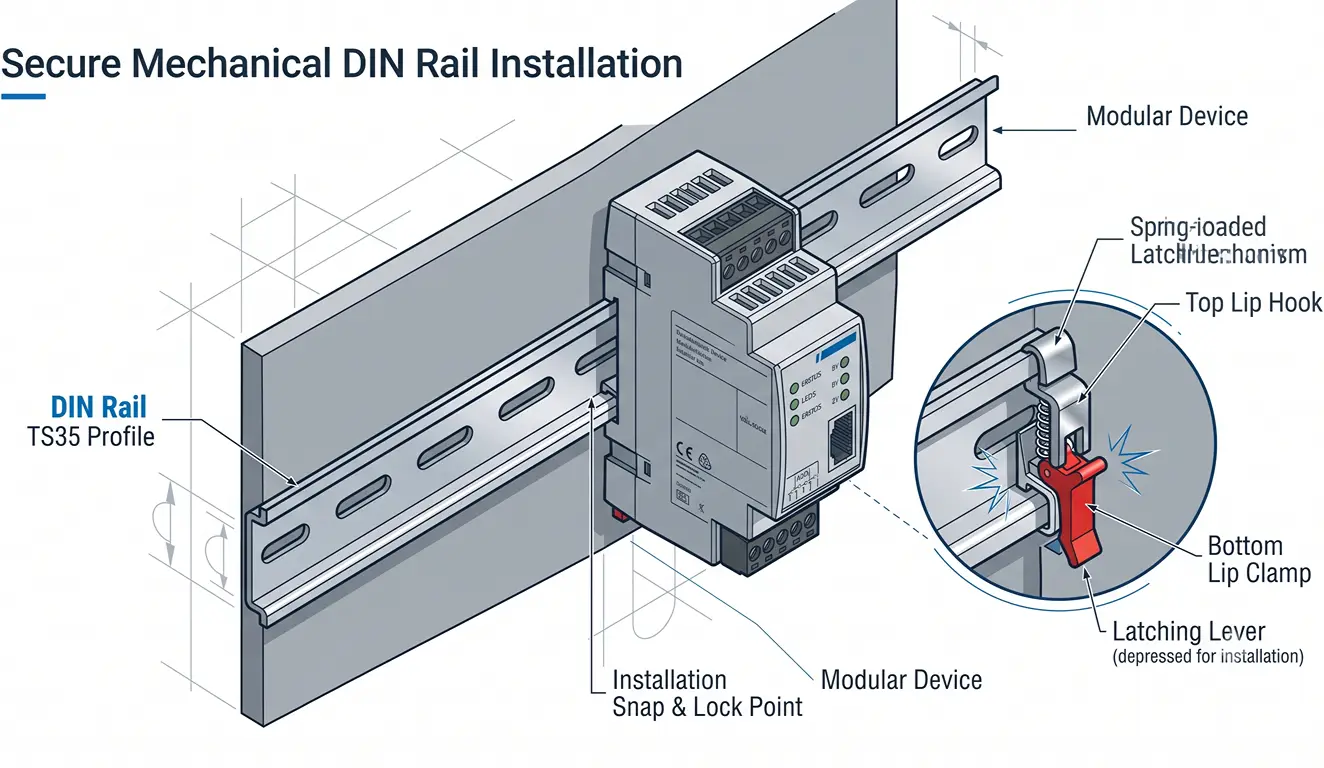
DIN significa Instituto Alemán de Normalización, el Instituto Alemán de Normalización, fundado en 1917. El riel de montaje que utilizamos hoy en día está definido por la norma internacional IEC/EN 60715, que especifica una tira metálica de 35 mm de ancho con una sección transversal característica en forma de “sombrero de copa”. Esta forma (a menudo denominada TS35 en Norteamérica) permite que los dispositivos compatibles se enganchen en el borde superior y se fijen mediante un clip con resorte en la parte inferior. Sin herramientas, sin tornillos, sin taladrar.
¿Por qué 35 mm? Porque la estandarización facilita la interoperabilidad. Un disyuntor de una marca, un relé de otra y una fuente de alimentación de una tercera se acoplan al mismo carril dentro del mismo armario. Piensa en un carril DIN como el puerto USB del mundo de los armarios eléctricos: una interfaz física universal que elimina la necesidad de soportes y adaptadores a medida.
Los carriles DIN se comercializan en dos perfiles de profundidad según la norma: Tres pulgadas y media por siete pulgadas y media (de perfil bajo, para dispositivos ligeros como bloques de bornes y relés pequeños) y Tres por cinco por quince (profundo, para componentes más pesados, como fuentes de alimentación y controladores de motor). La mayoría de las fuentes de alimentación para carril DIN se montan en el perfil más profundo, de 15 mm.
La propia fuente de alimentación
La parte de la ecuación correspondiente a la fuente de alimentación realiza una función muy sencilla: toma la corriente alterna (CA) de la red eléctrica y la convierte en la corriente continua (CC) que necesitan los equipos electrónicos industriales para funcionar.
¿Por qué es importante esta conversión? La corriente de la red eléctrica de tu fábrica es de CA, es decir, una tensión que oscila 50 o 60 veces por segundo. Sin embargo, un PLC, una pantalla táctil HMI o un conjunto de sensores necesitan una tensión de CC estable y sin fluctuaciones, normalmente 24 V CC, para que funcionen de forma fiable. Si se conectara corriente alterna directamente a estos dispositivos, se estropearían. La fuente de alimentación para carril DIN se coloca entre la red eléctrica y el equipo, sirviendo de puente entre ambos.
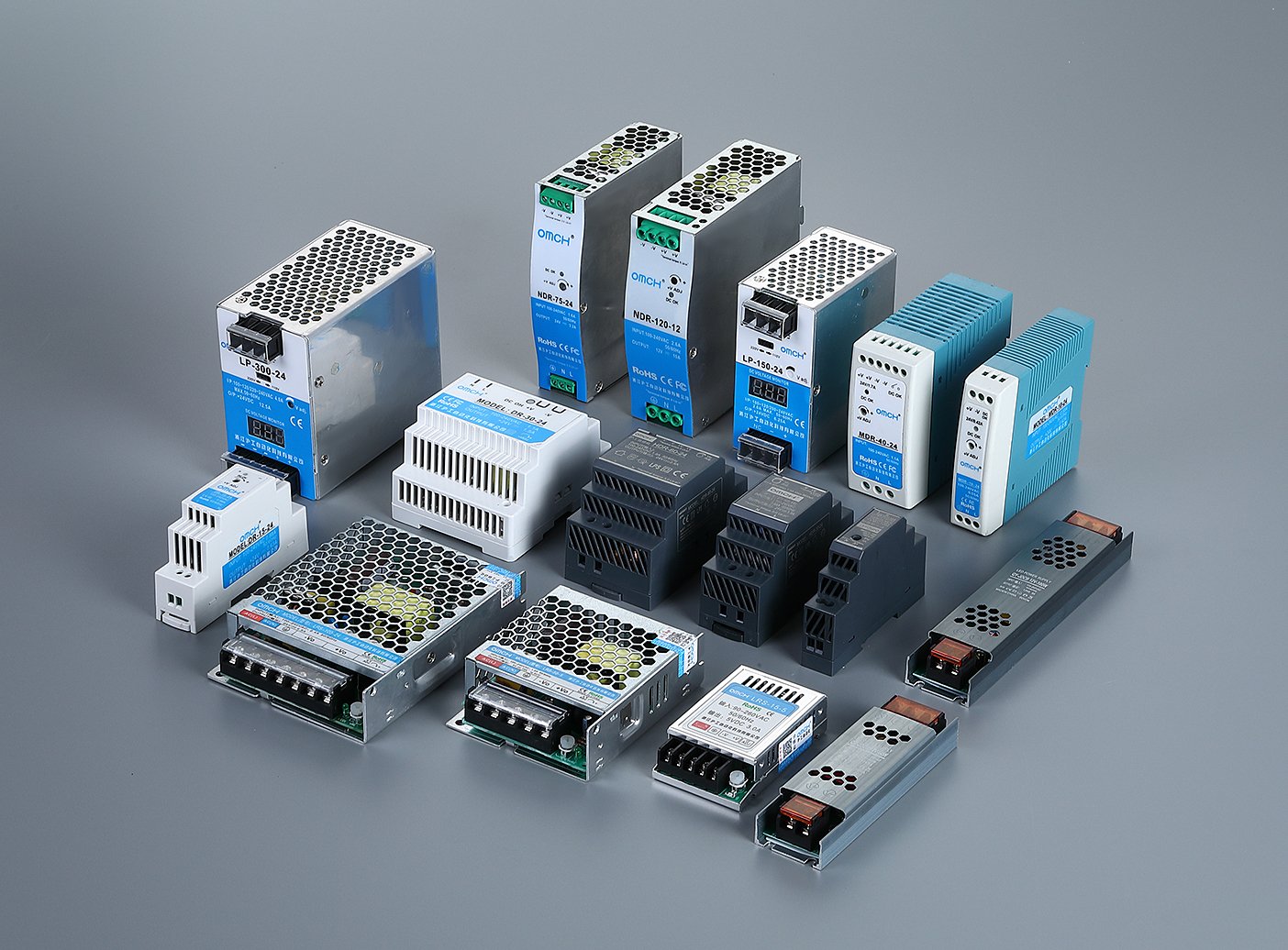
Físicamente, estas unidades son cajas compactas de metal o plástico. Su anchura varía desde el ancho de dos dedos (18 mm para una unidad de 15 W) hasta aproximadamente el ancho de la mano (110 mm para una unidad de 480 W). En la parte frontal se encuentran los terminales de entrada (marcados con L, N y PE para tierra), los terminales de salida (V+ y V-), un LED verde que indica “DC OK” y, a menudo, un pequeño potenciómetro para ajustar con precisión la tensión de salida.
Resumen de las características principales
Hay tres decisiones de diseño que definen toda fuente de alimentación para carril DIN:
Fijación a presión. La parte trasera de la unidad cuenta con un cierre mecánico que encaja en el riel TS35. La instalación se realiza en cuestión de segundos: engancha la parte superior, gira hacia abajo y espera a oír el clic. Desmontarla es igual de rápido. Tira del cierre con un destornillador y levántala para sacarla. Esta modularidad permite sustituir una unidad averiada en menos de un minuto, lo que minimiza el tiempo de inactividad en la producción.
Refrigeración por convección. Casi todas las fuentes de alimentación para carril DIN carecen de ventilador. Esto sorprende a mucha gente. ¿No deberían necesitar refrigeración activa los dispositivos electrónicos que gestionan cientos de vatios? La respuesta está en el entorno. Los armarios de control industriales suelen estar sellados según la norma NEMA 12 para impedir la entrada de polvo, neblina de aceite y humedad. Un ventilador no haría más que recircular el aire caliente y se convertiría en el primer componente en fallar. En su lugar, estas fuentes de alimentación utilizan su carcasa de aluminio como disipador térmico, aprovechando la convección natural: el aire caliente asciende, el aire frío entra por debajo y el ciclo se mantiene por sí solo sin necesidad de ninguna pieza móvil.
Protección integrada. Cortocircuito, sobrecarga, sobretensión y sobrecalentamiento. Estas cuatro protecciones son estándar en cualquier unidad de grado industrial. Si el cable de un sensor queda aprisionado y se produce un cortocircuito a tierra, la fuente de alimentación lo detecta, corta la salida en cuestión de microsegundos y se recupera automáticamente una vez que se subsana la avería. Esto protege tanto a la propia fuente de alimentación como a todos los dispositivos conectados a ella.
Cómo funciona una fuente de alimentación para carril DIN
Todas las fuentes de alimentación para carril DIN tienen una única función: tomar la corriente alterna de la red eléctrica, que es impredecible, y convertirla en corriente continua limpia y predecible en la que puedan confiar los sistemas electrónicos industriales sensibles. A continuación explicamos cómo se produce esa conversión y por qué el método de refrigeración es tan importante como la propia electrónica.
De la entrada de CA a la salida de CC: la cadena de conversión
La conversión se lleva a cabo en tres fases, todas ellas integradas en esa compacta carcasa metálica.
Etapa 1: Rectificación y filtrado. La tensión de CA de entrada puede oscilar entre 85 V (red eléctrica japonesa) y 264 V (red eléctrica británica) en el caso de una unidad de entrada universal. En primer lugar, pasa por un filtro EMI para impedir que el ruido eléctrico entre o salga de la fuente de alimentación. A continuación, un puente rectificador convierte la onda sinusoidal de CA en una forma de onda de CC pulsante. Unos grandes condensadores de entrada suavizan las ondulaciones, produciendo una tensión de corriente continua aproximada de entre 170 V y 370 V, dependiendo de la entrada.
Etapa 2: Conversión por conmutación. Aquí es donde reside la magia y la eficiencia. La corriente continua bruta se corta a una frecuencia elevada, normalmente De 50 kHz a 500 kHz, mediante un transistor de conmutación. Esta corriente alterna de alta frecuencia pasa a través de un pequeño transformador de ferrita que reduce la tensión hasta el nivel deseado. Dado que el transformador funciona a más de 50 000 ciclos por segundo, en lugar de a los 50/60 Hz de la red eléctrica, puede ser considerablemente más pequeño y ligero. El propio proceso de conmutación es el secreto de la eficiencia: el transistor de conmutación está o bien completamente activado (caída de tensión casi nula) o bien completamente desactivado (flujo de corriente casi nulo). Se desperdicia muy poca energía en forma de calor. Así es como las unidades modernas logran Rendimiento del 87% al 96% (RECOM, 2025).
Etapa 3: Regulación y filtrado de la salida. La tensión reducida se rectifica de nuevo y, a continuación, pasa a través de condensadores e inductores de filtrado de salida para eliminar el ruido de conmutación de alta frecuencia. Un circuito de retroalimentación supervisa continuamente la tensión de salida y ajusta el ciclo de trabajo de la conmutación en tiempo real para mantener la regulación, normalmente dentro de un margen de ±1% respecto al valor de consigna. El resultado final es una corriente continua limpia con una ondulación que suele estar por debajo de 50 mV de pico a pico en una salida de 24 V.
¿Por qué no hay ventilador? — Las ventajas de la refrigeración por convección
Como señaló Bruce Desmond, de Phoenix Contact, en un análisis ampliamente citado sobre fuentes de alimentación de grado industrial (Electronic Design, 2004), al menos el 80% de las aplicaciones de grado industrial utilizan armarios sin ventilación. En una carcasa sellada NEMA 12, un ventilador es peor que inútil. Lo único que hace es remover el aire caliente y, con el tiempo, se atasca debido al polvo y a las vibraciones.
La refrigeración por convección resuelve este problema gracias a su diseño. La fuente de alimentación se monta en posición vertical, con los terminales orientados hacia abajo. A medida que los componentes internos generan calor, la carcasa de aluminio lo transfiere al aire circundante, que asciende de forma natural. Esto hace que entre aire más fresco por la parte inferior, creando un ciclo de refrigeración pasivo pero continuo. La ausencia de ventilador elimina el punto de fallo más habitual en la electrónica industrial, lo que contribuye a que los valores de MTBF (tiempo medio entre fallos) alcancen los más de 500.000 horas (según la norma IEC 61709) en unidades de calidad.
La contrapartida es que el espacio libre es importante. Una fuente de alimentación necesita al menos 50 mm de espacio libre por encima y por debajo para que se establezca la corriente de convección. Si se bloquea ese espacio, la unidad se sobrecalentará y comenzará a reducir su potencia, protegiéndose a sí misma mediante la disminución de la potencia de salida. Trataremos este tema con más detalle en la sección dedicada a la instalación.
Explicación de las especificaciones clave
Una vez que se superan los conceptos básicos, una fuente de alimentación para carril DIN se define mediante una serie de parámetros clave. Comprenderlos marca la diferencia entre echar un vistazo superficial a una ficha técnica y leerla de verdad.
Rango de tensión de entrada. “Entrada universal” significa 85-264 V CA, monofásica. Es compatible con cualquier tensión de red, desde los 100 V japoneses hasta los 230 V británicos, sin necesidad de realizar ningún cambio manual. Para aplicaciones de mayor potencia (normalmente a partir de 480 W), es habitual la entrada trifásica (320-575 V CA). Algunas unidades especializadas también admiten entrada de corriente continua (430-815 V CC) para aplicaciones solares y de almacenamiento en baterías.
Tensión y corriente de salida. La tensión de 24 V CC es el estándar del sector por una razón. Es lo suficientemente baja como para que su contacto sea seguro según la normativa SELV (tensión extra baja de seguridad) —por debajo del umbral de peligro de 50 V definido tanto por las normas de la OSHA como por las de la IEC— y, al mismo tiempo, lo suficientemente alta como para alimentar de forma fiable válvulas solenoides, bobinas de relé y sensores a través de cables de gran longitud. Existen salidas de 12 V y 48 V para aplicaciones especializadas (automoción, telecomunicaciones), pero, a menos que tengas una razón específica para elegir otra opción, 24 V es el valor por defecto.
Potencia nominal. La potencia se calcula simplemente multiplicando la tensión por la intensidad: una unidad de 24 V y 10 A tiene una potencia de 240 W. La regla fundamental es dimensionar con un Margen 20–30% por encima de la carga total calculada. Este margen tiene en cuenta las corrientes de arranque, las fluctuaciones de carga, futuras ampliaciones y la reducción de potencia debida a la temperatura.
Eficiencia. Una diferencia de eficiencia en el modelo 5% no es algo meramente teórico. Las pruebas realizadas por PULS han demostrado que una menor eficiencia en el modelo 5% se traduce en un aumento de la temperatura interna de entre 10 y 16 °C aproximadamente dentro de una carcasa sellada. Esto es suficiente para reducir potencialmente a la mitad la vida útil de los condensadores electrolíticos. Para las unidades de más de 75 W comercializadas en la UE, la norma EN 61000-3-2 exige una corrección activa del factor de potencia (PFC > 0,9). La capacidad de entrada universal es una consecuencia del diseño del circuito de PFC.
Tiempo de retención. Este es el número de milisegundos durante los que la fuente de alimentación puede mantener su salida tras la pérdida de la alimentación de entrada; normalmente ≥20 ms para instalaciones industriales. Veinte milisegundos equivalen a un ciclo completo de corriente alterna a 50 Hz. En la práctica, esto significa que la fuente de alimentación puede soportar una caída momentánea de tensión o la pérdida de un único ciclo de la red eléctrica sin que el PLC se reinicie ni se detenga la línea de producción.
Ondulaciones y ruido. Expresado en milivoltios de pico a pico (mVpp), este valor indica el grado de pureza de la salida de corriente continua. Para una salida de 24 V, cualquier valor inferior a 50 mVpp se considera de buena calidad industrial. Una ondulación excesiva puede provocar lecturas erráticas de los sensores y errores de comunicación en las redes industriales.
Funciones de protección. La protección contra cortocircuitos (reinicio automático en modo «hiccup»), la protección contra sobrecargas (limitación de corriente constante), la protección contra sobretensiones (limitación de salida) y la protección contra sobrecalentamiento (apagado térmico) son características de serie. Si una unidad carece de cualquiera de estas cuatro protecciones, no es de grado industrial.
Dónde se utilizan las fuentes de alimentación para carril DIN
Si tu trabajo tiene que ver con alguno de los siguientes aspectos, es casi seguro que haya una fuente de alimentación para carril DIN funcionando silenciosamente en segundo plano.
| Aplicación | A qué da energía | ¿Por qué una fuente de alimentación para carril DIN? |
|---|---|---|
| Automatización industrial | PLC, interfaces hombre-máquina (HMI), módulos de E/S, sensores | Red troncal estandarizada de 24 V para todo el sistema de control |
| Control de procesos | Transmisores, caudalímetros, analizadores | Corriente continua limpia y estable para garantizar la precisión de las mediciones |
| Embalaje y manipulación de materiales | Controladores de cintas transportadoras, clasificadoras, lectores de códigos de barras | Modular, fácil de ampliar a medida que crecen las líneas de producción |
| Gestión de edificios | Alarmas contra incendios, controladores de climatización, control de accesos | Compacto, cabe en los cuadros eléctricos estándar |
| Energías renovables | Pasarelas de supervisión, equipos de comunicación | Opciones de entrada de corriente continua para la conexión directa a la batería o al sistema solar |
| Infraestructura | Semáforos, controles de estaciones de bombeo, tratamiento de aguas | Fiabilidad en recintos exteriores sin supervisión |
Si abres cualquier armario de control industrial, la fuente de alimentación se encuentra casi siempre en la esquina superior izquierda. Ese es el punto de partida de la distribución de corriente continua. Todos los demás dispositivos conectados a ese carril dependen de ella. Cuando falla, todo lo que hay a continuación se queda sin corriente. Por eso es tan importante elegirla bien.
Cómo elegir la fuente de alimentación para carril DIN adecuada
Elegir una fuente de alimentación para carril DIN no es complicado si lo desglosas en tres pasos sucesivos. Piensa en ello como una lista de comprobación. Cada paso descarta las opciones erróneas hasta que solo queda la correcta.
Paso 1 — Calcula tu presupuesto energético
Este es el paso en el que la mayoría de los prescriptores noveles se equivocan, y el error suele ser casi siempre el mismo: subestimar la carga total.
Empieza por hacer una lista de todos los dispositivos que van a recibir corriente continua de esta fuente de alimentación: el PLC, la HMI, cada sensor, cada bobina de relé, cada luz indicadora. Busca el consumo de cada uno. La mayoría aparecerá indicado en vatios. En el caso de los dispositivos cuyo consumo se indique en amperios a 24 V, multiplícalo por 24 para obtener los vatios. Suma todo y, a continuación, multiplica por 1,2 a 1,3 (un margen de seguridad de 20–30%).
He aquí un ejemplo real. Un pequeño armario de control de una cinta transportadora podría contener un PLC (30 W), un panel HMI (15 W), 12 sensores fotoeléctricos de 1 W cada uno (12 W), 8 bobinas de relé de 2 W cada una (16 W) y un conmutador de red (10 W). Total: 83 W. Con un margen de 25%: 104 W. Se elegiría una unidad de 120 W, el siguiente tamaño estándar superior.
Comprueba también si hay dispositivos con una corriente de arranque elevada, como motores y válvulas solenoides. Estos pueden consumir brevemente entre 150% y 300% de su corriente nominal al arrancar. Si tu fuente de alimentación ofrece una función de “aumento de potencia” (por ejemplo, 150% durante 3-5 segundos), podrá soportar estas picos sin dispararse. De lo contrario, deberás dimensionarla en función del pico, no del valor medio.
Paso 2: adapta la entrada y la salida a tu sistema
En cuanto a la producción, La tensión de 24 V CC cubre la gran mayoría de las necesidades industriales. Elige 12 V solo si trabajas con equipos de especificaciones para automoción. Elige 48 V para telecomunicaciones, infraestructuras PoE o cuando necesites suministrar energía a través de tramos de cable muy largos (mayor tensión = menor corriente = menor caída de tensión).
En cuanto a la entrada, una entrada universal monofásica (85–264 V CA) admite prácticamente cualquier potencia inferior a 480 W. Funciona en todo el mundo y elimina el riesgo de que alguien coloque el selector de 110 V/220 V en la posición incorrecta, ya que no hay ningún selector. Para sistemas que consumen 480 W o más, lo habitual es una entrada trifásica (320–575 V CA), sobre todo cuando la fábrica ya dispone de suministro trifásico distribuido a la máquina.
| Monofásico | Trifásico | |
|---|---|---|
| Rango de entrada | 85–264 V CA | 320–575 V CA |
| Rango de potencia típico | 10 W–480 W | 480 W–960 W+ |
| Ideal para | La mayoría de los paneles de control | Maquinaria de gran tamaño, automatización a gran escala |
Paso 3: Comprobar el entorno, las certificaciones y las características
La misma fuente de alimentación de 240 W que funciona perfectamente a plena carga en una sala climatizada a 25 °C puede que solo suministre 180 W en un armario sellado a 55 °C. Todas las fichas técnicas incluyen una curva de reducción de potencia: un gráfico que muestra en qué medida disminuye la potencia de salida a medida que aumenta la temperatura ambiente. Por lo general, la potencia máxima está disponible hasta los 50 °C o 60 °C, y luego disminuye entre un 2 y un 3% por cada grado adicional. Si tu armario se encuentra en una fábrica sin aire acondicionado en verano, debes tener esto en cuenta.
Las certificaciones son la prueba de que el aparato ha sido sometido a pruebas independientes. En el mercado norteamericano, UL 508 (Equipos de control industrial) es el requisito mínimo. Para zonas peligrosas con gases o polvo inflamables, busca ATEX o UL HazLoc Clase I, División 2 certificación. En la UE, CE Es obligatorio que el marcado vaya acompañado de una declaración de conformidad. CCC es obligatorio para el mercado chino.
Más allá de lo básico, hay algunas características que merece la pena buscar. A Contacto del relé de CC OK te permite conectar una alarma remota en caso de que falle el suministro eléctrico. Capacidad de funcionamiento en paralelo/redundancia te permite conectar dos unidades a través de un módulo de redundancia para configuraciones N+1 en sistemas críticos. Recubrimiento conformado en las placas de circuito impreso protege contra la humedad y las atmósferas corrosivas en plantas químicas, instalaciones de procesamiento de alimentos e instalaciones al aire libre.
Riel DIN frente a otros formatos de fuentes de alimentación
No todas las cajas que suministran tensión continua son iguales. Aquí es donde el formato de carril DIN encaja entre sus homólogos.
| Factor de forma | Montaje | Refrigeración | Lo mejor para |
|---|---|---|---|
| Fuente de alimentación para carril DIN | Se acopla al riel TS35 | Convección | Armarios de control, paneles modulares de automatización |
| Montaje en caja / Montaje en panel | Tornillos para un subcuadro eléctrico | A menudo refrigerados por ventilador | Máquinas independientes, industria general |
| Estructura abierta | Se atornilla al chasis del equipo principal | Varía | Fabricantes de equipos originales que integran fuentes de alimentación en sus propios productos |
| Adaptador de pared / Controlador LED | De enchufe o en línea | Convección (pequeña) | Electrónica de consumo, iluminación LED |
La diferencia clave: si tu equipo se encuentra dentro de un armario de control junto con otros componentes montados en carril DIN, elige una fuente de alimentación para carril DIN. Comparte el mismo carril, el mismo formato y el mismo procedimiento de mantenimiento que el resto de componentes del armario. Si tu dispositivo es una máquina independiente con su propia carcasa y sin otros componentes en carril DIN, puede que sea más adecuado utilizar una fuente de alimentación cerrada para montaje en panel.
Un punto de confusión habitual: un controlador LED no es una fuente de alimentación para carril DIN, aunque algunos controladores LED se monten en carriles DIN. Los controladores LED son fuentes de corriente constante diseñadas para una característica de carga específica. Las fuentes de alimentación para carril DIN son fuentes de tensión constante diseñadas para alimentar una variedad de cargas industriales. Utilizar una en lugar de la otra, en el mejor de los casos, no funcionará. En el peor de los casos, dañará tu equipo.
Primeros pasos con la instalación
La instalación física de una fuente de alimentación en carril DIN es sencilla, pero hay algunos principios que marcan la diferencia entre un cuadro eléctrico fiable y un problema que te dará dolores de cabeza seis meses después.
Montaje. Engancha el borde superior de la fuente de alimentación al riel, gírala hacia abajo hasta que el pestillo inferior haga clic y tira de ella suavemente para comprobar que queda bien fijada. Eso es todo. Para retirarla, introduce un destornillador plano en la ranura de liberación del pestillo y levántala.
Espaciado. Esta es la norma que más se ignora y la que más cuesta a largo plazo. Deja al menos 50 mm de espacio libre por encima y por debajo la fuente de alimentación para el flujo de aire por convección, y 10-15 mm a cada lado (25 mm para unidades de más de 240 W). Apilar los dispositivos demasiado juntos es como cubrir la fuente de alimentación con una manta. Se calentará en exceso, perderá potencia antes de tiempo y provocará un desgaste prematuro de sus condensadores.
Cableado. Lado de entrada: conecta L (fase), N (neutro) y PE (tierra de protección) a los terminales de entrada. Instala siempre un disyuntor o un fusible antes de la fuente de alimentación. Lado de salida: V+ y V- alimentan tu red de distribución de corriente continua. Utiliza casquillos (casquillos de presión) en todas las conexiones de cables trenzados. Los cables trenzados sin aislamiento introducidos en un terminal de tornillo se aflojarán con el tiempo debido a los ciclos térmicos y a las vibraciones. Apriete los terminales según las especificaciones de par de apriete del fabricante, que suelen oscilar entre 0,5 y 1,2 Nm.
Puesta a tierra. El terminal PE debe conectarse a la barra colectora de puesta a tierra del cuadro mediante un conductor específico de color verde/amarillo. Nunca se debe confiar únicamente en el riel DIN para la conexión a tierra. El riel es un soporte mecánico, no una vía eléctrica garantizada.
Puesta en servicio. Enciende primero la unidad sin carga y comprueba la tensión de salida con un multímetro. Comprueba que el LED «DC OK» esté en verde. A continuación, aplica carga gradualmente —25%, 50%, 75%, 100%— supervisando la tensión de salida y la temperatura de la carcasa de la unidad en cada paso. Si se produce alguna desviación, la habrás detectado antes de que se convierta en un fallo en servicio.
Si te encuentras en la fase de comparar modelos concretos, OMCH te ofrece una gama de Fuentes de alimentación para carril DIN desde 75 W hasta 480 W en su serie NDR — todas ellas con certificación CE, CCC y RoHS, entrada de CA universal y diseño con refrigeración por convección. Tanto si está montando un único cuadro de control como si está equipando una línea de producción, disponer de la fuente de alimentación, los disyuntores, los relés y los sensores en un único proveedor puede simplificar el proceso de adquisición y garantizar la compatibilidad.
Referencias
- IEC. “IEC 60715: Dimensiones de los equipos de conmutación y control de baja tensión — Montaje normalizado sobre rieles para el soporte mecánico de dispositivos eléctricos”.” Wikipedia: Carril DIN
- Morrison, David. “Las fuentes de alimentación para carril DIN van más allá de la planta de producción”. Electronic Design, agosto de 2004. Artículo completo
- RECOM. “Cómo elegir la fuente de alimentación para carril DIN adecuada para tu aplicación”. 2025. Guía de selección
- PowerVolt Group. “Por qué 24 V es la tensión estándar en los cuadros de control industriales”.” Entrada de blog
- OMCH. Página del producto «Fuente de alimentación conmutada». https://www.omch.com/switch-mode-power-supply/
- OMCH. Página de inicio. https://www.omch.com/



 English
  Arabic
  Turkish
  Russian
  Spanish
  French
  Indonesian
  Portuguese
  Thai
Thai  Vietnamese