



Por que as fontes de alimentação comutadas são a espinha dorsal da automação predial
Cada controlador DDC, cada painel de controle de acesso, cada conjunto de sensores espalhados por um prédio comercial — todos funcionam com alimentação de corrente contínua (CC) de baixa tensão. O dispositivo que converte a corrente alternada (CA) da rede elétrica nessa corrente contínua (CC) limpa e regulada é a fonte de alimentação comutada. É fácil tratá-la como algo secundário. Uma caixa de metal no canto do gabinete de controle. Algo que você especifica no último minuto.
Isso seria um erro. A fonte de alimentação é o único ponto de falha de todos os subsistemas que ela alimenta. Se você escolher a fonte errada, não estará lidando apenas com um problema de energia. Estará lidando com controladores que reiniciam aleatoriamente, sensores que apresentam leituras fantasmas e um cliente que perdeu a confiança em toda a instalação. Este artigo aborda todos os aspectos da seleção de uma fonte de alimentação comutada para automação predial, desde a tensão até as certificações, para que você tome a decisão certa logo de início.
Seleção de tensão — 12 V, 24 V ou 48 V para o seu BAS?
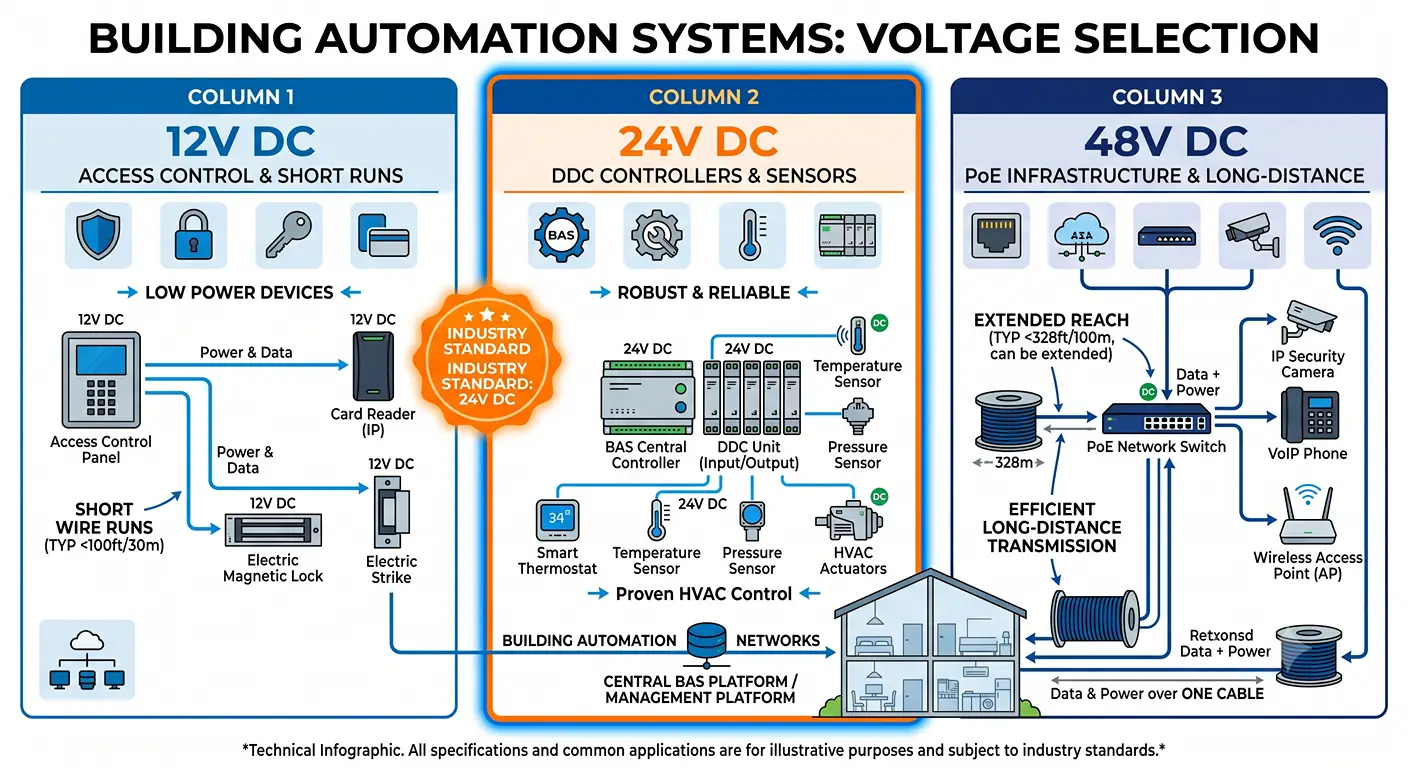
A tensão é o ponto de partida para qualquer escolha de fonte de alimentação. É também o aspecto ao qual, muitas vezes, se dá menos atenção. A regra é simples: adapte a tensão aos seus dispositivos, e não o contrário. Mas “meus dispositivos” raramente se referem a um único tipo de equipamento. Um gabinete de controle típico de um sistema BAS alimenta simultaneamente controladores, sensores, atuadores, gateways de comunicação e periféricos de segurança — e nem todos funcionam com a mesma tensão. Veja a seguir como avaliar cada opção.
12 V CC — Quando usá-la em dispositivos de controle de acesso e segurança
Doze volts é o padrão histórico e mais utilizado em sistemas de segurança e eletrônicos de baixo consumo de energia. Leitores de acesso a portas, fechaduras elétricas, câmeras de CFTV, sensores de presença PIR — esses dispositivos construíram seus ecossistemas em torno de 12 V há décadas, e a cadeia de suprimentos ainda o utiliza por padrão. Se o seu projeto envolver um uso intenso de controle de acesso, a tensão de 12 V será a escolha mais natural.
A desvantagem é a distância. A 12 V, uma carga de 10 A passando por um fio de cobre de 1,5 mm² sofre uma queda de tensão de aproximadamente 0,7 volts em um percurso de ida e volta de 15 metros. Aos 20 metros, a tensão na extremidade mais distante já caiu o suficiente para que uma fechadura possa vibrar ou uma câmera possa apresentar queda de tensão durante a mudança para o modo noturno por infravermelho. Se seus trechos de cabo forem curtos e suas cargas previsíveis, 12 V funcionam bem. Caso contrário, continue lendo.
24 V CC — O padrão do setor para controladores e sensores prediais
A automação predial opera na tensão de 24 volts. Os controladores DDC de todos os principais fabricantes — Johnson Controls, Honeywell, Siemens — funcionam com 24 V CC. O mesmo ocorre com os sensores de campo (temperatura, umidade, CO₂, pressão), atuadores de registros e válvulas, módulos de relé e gateways BACnet/IP. Um único andar comercial de tamanho médio pode ter de duas a quatro fontes de alimentação de 24 V para trilho DIN em seu gabinete de controle, cada uma alimentando uma zona ou subsistema diferente.
A razão pela qual a tensão de 24 V se destaca é simples. Ela permanece dentro dos limites de SELV (Tensão Extra-Baixa de Segurança) definidos pela norma IEC 60364-4-41, o que significa que não há risco de choque elétrico durante a manutenção. Além disso, ela transmite aproximadamente o dobro da potência pelo mesmo fio de cobre que a tensão de 12 V, para a mesma porcentagem de queda de tensão. Com 10 amperes em um fio de 1,5 mm², um circuito de 24 V atinge uma queda de 5% em cerca de 40 a 50 metros — o dobro do alcance de 12 V. Para um gabinete de controle no nível do piso que alimenta dispositivos em uma ala de 30 metros, a tensão de 24 V dá conta do recado sem a necessidade de amplificadores intermediários.
Se você precisar escolher uma tensão sem ainda conhecer a lista completa de dispositivos, opte por 24 V. O ecossistema é amplo o suficiente para que você, com quase toda a certeza, encontre equipamentos compatíveis.
48 V CC — Trajetos de longa distância e infraestrutura PoE
A tensão de 48 volts é menos comum em sistemas BAS tradicionais, mas está crescendo rapidamente, impulsionada pela tecnologia Power over Ethernet (PoE). De acordo com a norma 802.3bt (PoE Tipo 4), um único cabo Cat6A pode fornecer até 100 watts a 48 V. Isso é suficiente para alimentar um pequeno controlador, um painel sensível ao toque e alguns sensores por meio de um único conector RJ45. Em novas construções, nas quais a empreiteira de TIC já está instalando a cablagem estruturada, os sistemas BAS baseados em PoE podem eliminar totalmente a necessidade de fiação de alimentação separada.
Além do PoE, a tensão de 48 V também é uma boa opção para percursos muito longos de distribuição de corrente contínua. Pense em uma sala central de equipamentos que alimenta dispositivos em um armazém de 200 metros ou em uma coluna vertical de um arranha-céu, onde a queda de tensão prejudicaria um sistema de 24 V. A desvantagem é a compatibilidade dos dispositivos. O ecossistema BAS de 48 V ainda é limitado em comparação com o de 24 V, e os equipamentos disponíveis têm um preço mais elevado. A menos que o PoE ou a distribuição de longa distância sejam requisitos imprescindíveis, 24 V continua sendo a opção padrão mais segura.
Dimensionamento da fonte de alimentação — Como calcular a carga e evitar a armadilha da “fonte de alimentação subdimensionada”
O dimensionamento da fonte de alimentação parece ser uma questão de aritmética: some todas as potências dos dispositivos, escolha a fonte de alimentação imediatamente superior e pronto. Na prática, porém, três fatores costumam confundir até mesmo engenheiros experientes. Levá-los em consideração desde o início faz toda a diferença entre um gabinete de controle que funciona por uma década e outro que gera chamadas de manutenção mensais.
Passo 1 — Some sua carga real, dispositivo por dispositivo
Comece elaborando um cronograma de carga. Para cada dispositivo conectado à fonte de alimentação, anote seu consumo nominal de energia e, em seguida, some o total. Aqui estão faixas realistas para equipamentos comuns de sistemas de automação predial (BAS), com base nas linhas de produtos de gama média disponíveis atualmente:
| Tipo de dispositivo | Consumo típico de energia (24 V CC) |
|---|---|
| Controlador DDC (tamanho médio, ~32 pontos de E/S) | 8–15 W |
| Painel sensível ao toque / visor do operador (7–10 polegadas) | 10–25 W |
| Sensor de campo (temperatura, umidade, CO₂) | 1–3 em cada |
| Atuador de válvula/amortecedor (retorno por mola, 10 Nm) | 5–15 W (em funcionamento), 0 W (em espera, se for mecânico) |
| Fecho elétrico de porta | 10–30 W (pulsado) |
| Câmera de vigilância IP (PoE ou 24 V) | 5–15 W |
| Roteador BACnet / gateway de protocolo | 3–8 W |
O problema está na contagem de sensores. Cinco sensores de 2 W cada somam 10 W — nada significativo. Duzentos sensores espalhados por um campus somam 400 W, e esse número muitas vezes só fica evidente depois que a fonte de alimentação já está instalada. Elabore seu cronograma de carga com antecedência e mantenha-o atualizado à medida que a lista de dispositivos for mudando.
Etapa 2 — Adicione uma margem de 20–30% (e saiba quando adicionar mais)
A regra padrão é multiplicar a carga total por 1,2 a 1,3 e escolher uma fonte de alimentação com potência igual ou superior a esse valor. Uma carga total de 168 W (7 A a 24 V) indica uma unidade de 240 W (10 A), e não uma de 200 W (8,3 A).
Três cenários elevam esse multiplicador:
Corrente de irrupção do motor e do solenóide. Um atuador elétrico ou um atuador com retorno por mola pode consumir de duas a três vezes sua corrente de funcionamento nos primeiros 100 a 200 milissegundos. Se vários atuadores forem acionados simultaneamente durante uma sequência de alarme de incêndio, o pico instantâneo de carga pode acionar a proteção contra sobrecorrente da fonte de alimentação — e todos os controladores nesse trilho reiniciam no meio do evento.
Armários para altas temperaturas. A maioria das fontes de alimentação para trilho DIN apresenta uma curva de redução de potência. Uma unidade típica, como a série NDR-240 da Mean Well, fornece 100% de potência nominal a 40 °C de temperatura ambiente, reduz para aproximadamente 80% a 50 °C e cai para cerca de 60% a 60 °C. Um gabinete NEMA vedado, instalado em um telhado exposto ao sol no verão, pode facilmente atingir 50 °C em seu interior. Se sua carga for de 180 W e a fonte de alimentação tiver potência nominal de 240 W a 25 °C, você pode pensar que tem uma margem de 25%. A 50 °C dentro do gabinete, a margem real está mais próxima de zero.
Expansão futura. Os sistemas de automação predial vão crescendo com o tempo. Uma reforma em um andar acrescenta mais 30 controladores VAV. Uma atualização do sistema de segurança acrescenta mais câmeras. Se você dimensionar o sistema com base na carga exata de hoje, precisará substituir as fontes de alimentação dentro de três a cinco anos. O custo da mão de obra para trocar uma unidade em trilho DIN em um gabinete em operação custa muito mais do que a capacidade extra do modelo 30% que você poderia ter adquirido desde o início.
Etapa 3 — Separar as cargas críticas das cargas ruidosas
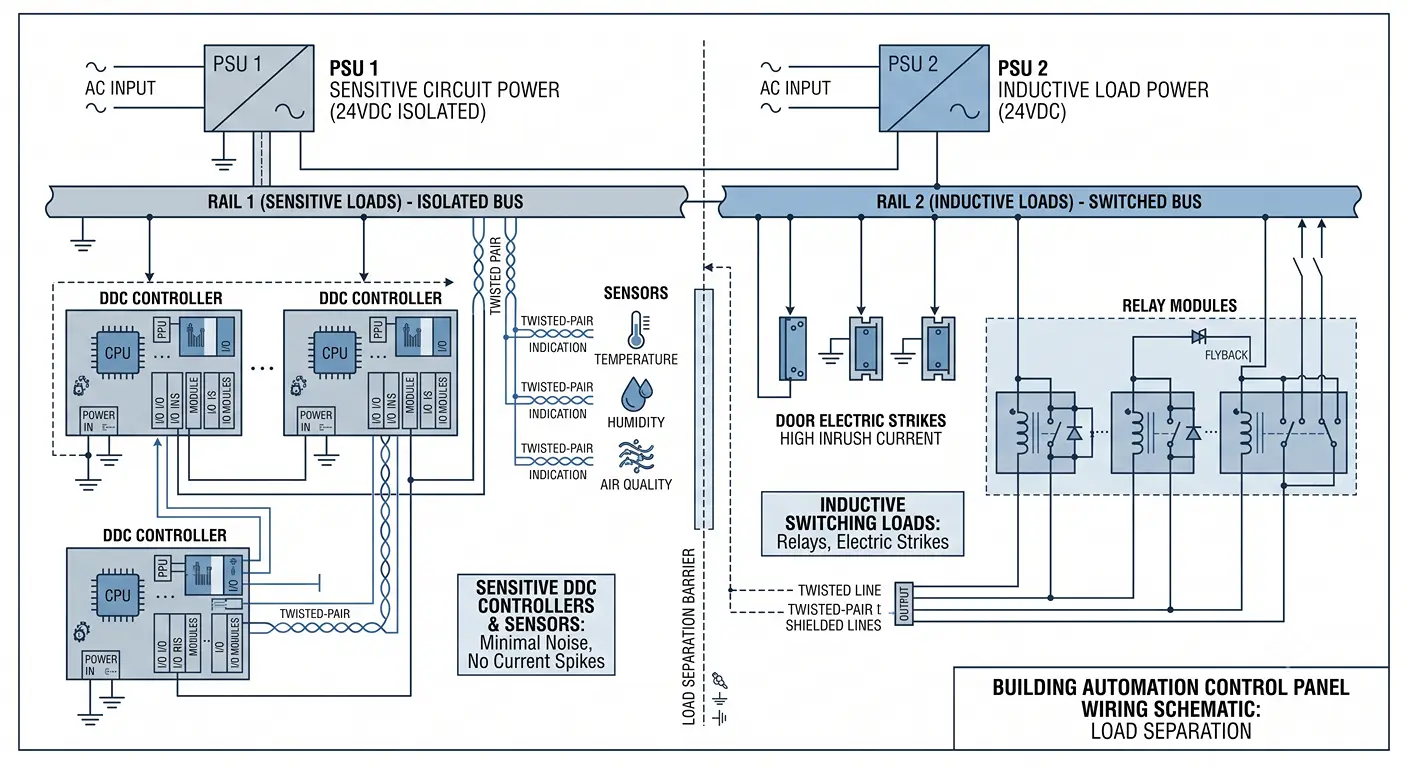
Eis um padrão de falha que gera mais chamadas de assistência técnica do que qualquer fonte de alimentação (PSU) com capacidade insuficiente: um controlador de porta reinicia toda vez que a fechadura elétrica é acionada. A causa não é um bug de software nem uma fechadura com defeito. Trata-se de uma queda de tensão causada pela conexão de uma carga indutiva com alto pico de corrente no mesmo rail da fonte de alimentação em que estão conectados componentes eletrônicos sensíveis.
Quando a bobina de um relé ou solenóide é desenergizada, o colapso do campo magnético gera um pico de tensão reverso que pode atingir de 10 a 20 vezes a tensão nominal da bobina. Sem um diodo de retorno, esse pico é descarregado diretamente no trilho de corrente contínua na forma de EMI conduzida — o suficiente para causar uma queda de tensão ou reiniciar um DDC baseado em microcontrolador.
A solução é simples e não custa quase nada na fase de projeto. Dedique uma fonte de alimentação (PSU) aos dispositivos de controle e comunicação (DDC, sensores, gateways, visores). Coloque as cargas de comutação (fechaduras, relés, válvulas solenóides) em uma fonte de alimentação separada. Uma terceira fonte de alimentação para cargas auxiliares, como indicadores LED, iluminação do gabinete e tomadas de conveniência, é opcional, mas facilita o diagnóstico de problemas. Identifique a saída de cada fonte de alimentação com a função a que se destina. O técnico que abrir este gabinete às 2 da manhã vai agradecer a você.
Trilho DIN, montagem em painel ou em caixa? Escolhendo o formato adequado para a sua instalação
A esta altura, você já escolheu uma tensão e calculou seu orçamento de potência. Agora, a questão é física: como é a fonte de alimentação e onde ela fica instalada?
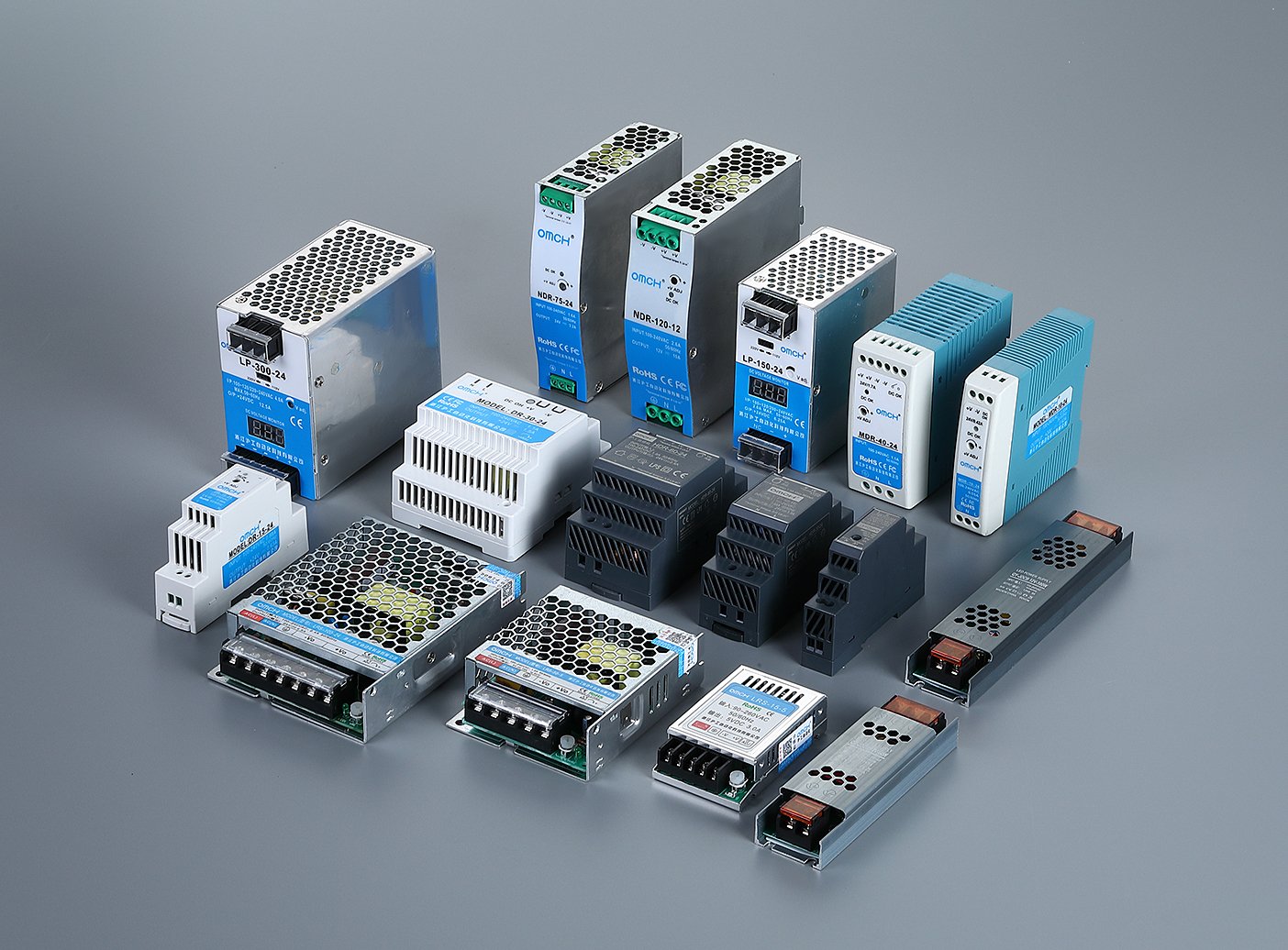
Para gabinetes de controle de automação predial, a montagem em trilho DIN — especificamente no perfil TS35/7,5 — é o padrão e a solução ideal na maioria dos casos. Uma fonte de alimentação para trilho DIN encaixa-se no mesmo trilho que seus disjuntores, relés e blocos de terminais, tornando o layout do gabinete organizado e modular. Quando uma unidade falha — e, eventualmente, toda fonte de alimentação falha —, a troca leva 30 segundos. Desaparafuse dois terminais, solte o clipe DIN, encaixe a peça de reposição e reconecte os terminais. Sem perfuração, sem suportes, sem tempo de inatividade além de um ciclo de reinicialização.
As fontes de alimentação para montagem em painel ou em chassi são maiores, geralmente com 200 W ou mais, e são fixadas diretamente no painel traseiro de um gabinete. Elas são indicadas quando é necessária alta densidade de potência em uma única unidade — por exemplo, uma fonte de 480 W alimentando todos os controladores de um andar inteiro — ou quando se está montando um gabinete personalizado que não possui trilho DIN. A desvantagem é a facilidade de manutenção. Substituir uma unidade montada em painel exige ferramentas, tempo e, possivelmente, desligar equipamentos adjacentes para acessar os parafusos de fixação.
As fontes de alimentação (PSUs) encapsuladas ou com classificação IP são indicadas para locais em que o ambiente, e não a carga, determina a escolha. Uma caixa de junção no teto de um corredor. Um armário de equipamentos em um estacionamento. Uma unidade de tratamento de ar ao ar livre. Procure por classificação IP65 ou superior, com entrada de cabo vedada por prensa-cabos e placas de circuito impresso (PCBs) com revestimento conformacional. Esteja preparado para pagar de duas a três vezes o preço de uma unidade equivalente para trilho DIN. Reserve esse valor no orçamento desde o início, pois a instalação posterior de gabinetes é cara.
Eficiência, desempenho térmico e o que realmente significa “nível industrial”
Os índices de eficiência indicados na ficha técnica de uma fonte de alimentação — 89%, 91%, 93% — parecem diferenças mínimas e, em uma única unidade, de fato são. A diferença se torna significativa em grande escala. Um prédio com 50 fontes de alimentação em trilho DIN operando 24 horas por dia, 7 dias por semana, cada uma dissipando 10 W a mais de calor devido a uma diferença de eficiência do modelo 3%, consome 4.380 kWh a mais por ano. Isso é suficiente para fazer diferença tanto na conta de energia quanto na carga de refrigeração. Ao longo de um ciclo de vida do equipamento de 10 anos, essa diferença pode cobrir uma parcela significativa do próprio orçamento destinado às fontes de alimentação.
O projeto térmico é mais importante do que o número de eficiência divulgado. As fontes de alimentação resfriadas por ventilador alcançam maior densidade de potência em um chassi menor, mas os ventiladores têm rolamentos, e os rolamentos se desgastam. Em um gabinete de controle BAS vedado, onde ninguém abre a porta por cinco anos, a falha de um ventilador significa que a fonte de alimentação vai superaquecer até danificar-se, sem nenhum aviso sonoro. Projetos sem ventilador, resfriados por convecção, custam um pouco mais por watt, mas eliminam o ponto de falha mecânica mais comum. Para automação predial, onde a confiabilidade supera a densidade, o modelo sem ventilador é a escolha padrão correta.
A qualidade dos componentes é onde reside a verdadeira diferença — a distinção entre uma fonte de alimentação classificada para uso comercial e outra fabricada de acordo com um padrão industrial. O indicador mais claro é a classificação de temperatura do capacitor eletrolítico. Os capacitores são os componentes que limitam a vida útil de qualquer fonte de alimentação de comutação. Seu eletrólito se seca com o tempo, e o calor acelera esse processo exponencialmente. Um capacitor classificado para 105 °C, operando em ambiente interno de 40 °C, pode durar de três a quatro vezes mais do que um capacitor classificado para 85 °C, seguindo a lei de Arrhenius que rege a degradação do eletrólito. Fabricantes que especificam capacitores de marcas japonesas — série Rubycon ZLH, Chemi-Con KZE, Nichicon PW — estão fazendo uma escolha na lista de materiais que prolonga diretamente a vida útil em campo. Verifique a marca do capacitor e a classificação de temperatura na ficha técnica. Se nenhuma das duas informações estiver publicada, pergunte.
Recursos de proteção e certificações — O que procurar na ficha técnica
Os recursos de proteção são a primeira linha de defesa da fonte de alimentação. As certificações representam um voto de confiança de terceiros. Ambos precisam constar na sua lista de verificação. Uma fonte de alimentação com ótimas especificações, mas sem testes de segurança independentes, é um risco à espera de ser detectado por um inspetor.
Os cinco recursos essenciais de proteção que toda fonte de alimentação BAS deve ter
Todas as fontes de alimentação para trilho DIN comercializadas para uso industrial afirmam possuir proteções. O que importa é o que acontece quando elas são acionadas — especialmente se a unidade se recupera automaticamente ou se desliga definitivamente.
| Proteção | O que previne | O que verificar |
|---|---|---|
| Proteção contra sobretensão (OVP) | Aumento descontrolado da tensão de saída que danifica os componentes eletrônicos a jusante | Limite de disparo e tempo de resposta |
| Proteção contra sobrecorrente/sobrecarga (OCP) | Danos térmicos causados por sobrecorrente prolongada | Limitação de corrente constante versus modo “hiccup” |
| Proteção contra curto-circuito (SCP) | Falha catastrófica causada por defeitos na fiação ou curtos-circuitos de carga | Recuperação automática vs. desligamento automático (a recuperação automática é obrigatória para gabinetes sem supervisão) |
| Proteção contra superaquecimento (OTP) | Sobrecarga térmica em situações de alta temperatura ambiente ou falha do ventilador | Reinício automático após o resfriamento |
| Proteção contra picos de tensão | Danos causados por transientes induzidos por raios ou por comutação na entrada da rede elétrica | A conformidade com a norma IEC 61000-4-5; Classe 3 (2 kV linha-terra) é adequada para a maioria dos sistemas BAS internos; Classe 4 (4 kV) para painéis alimentados externamente |
O comportamento de recuperação do SCP é o que deve ser analisado com cuidado. Uma fonte de alimentação com desligamento automático que desarma devido a um curto-circuito momentâneo na fiação permanecerá desligada até que alguém reinicie fisicamente a alimentação. Em um gabinete BAS trancado em uma sala mecânica remota, isso pode levar dias. A recuperação automática com repetição no modo “hiccup” — em que a fonte de alimentação tenta reiniciar a cada poucos segundos até que o curto-circuito seja eliminado — é o único comportamento aceitável para sistemas prediais não supervisionados.
UL 508, UL 1310, EN 62368, CE — Entendendo o alfabeto das certificações
As certificações são uma linguagem, e a maioria das fichas técnicas pressupõe que você a domine. Aqui está uma tabela de conversão para as certificações que realmente importam na aquisição de sistemas de automação predial:
| Certificação | Região | O que está coberto | Por que isso é importante para o BAS |
|---|---|---|---|
| CE | UE / EEE | Segurança básica + conformidade com a EMC (declarada pelo fabricante) | Barreira mínima à entrada para projetos europeus; sem ela, o desembaraço aduaneiro pode ser negado |
| UL 508 | América do Norte | Segurança dos equipamentos de controle industrial | Exigido pela maioria dos inspetores elétricos dos EUA para a aprovação do painel de controle; abrange a fonte de alimentação (PSU) como um componente dentro de um painel de controle industrial maior |
| Underwriters Laboratory 1310 | América do Norte | Unidades de alimentação da Classe 2 — saída limitada a ≤60 V CC, ≤8 A e ≤100 VA por canal | Essencial em locais onde as normas de segurança contra incêndio exigem circuitos com potência limitada (espaços plenum, edifícios históricos, estabelecimentos de saúde); uma saída Classe 2 significa que não é necessário usar conduíte para a instalação elétrica de baixa tensão |
| EN 62368-1 | UE (IEC 62368 em nível global) | Segurança para equipamentos de áudio/vídeo, TI e comunicação — a norma moderna que substitui a EN 60950 | Cada vez mais adotada como norma básica de segurança para equipamentos BAS com interfaces de comunicação; baseada em riscos, em vez de prescritiva |
Para projetos de exportação, a combinação mais segura é CE + UL. A certificação UL pode ser substituída pela ETL ou pela CSA — todas as três são marcas NRTL reconhecidas pela OSHA nos EUA. Se o seu projeto incluir espaços classificados como plenum ou edifícios históricos sem aterramento, a conformidade com a norma UL 1310 Classe 2 é a especificação que impedirá que o inspetor elétrico sinalize sua instalação como irregular.
Como verificar se as certificações são verdadeiras (e não apenas logotipos em uma página da web)
A fraude em certificações é tão comum no mercado de fontes de alimentação industriais que vale a pena dedicar cinco minutos a uma verificação. As certificações UL podem ser verificadas por meio do banco de dados UL Product iQ, no site productiq.ul.com. Insira o nome do fabricante ou o número do arquivo UL e confirme se o certificado está ativo e abrange o modelo específico que você está comprando. Para a marcação CE, solicite o documento da Declaração de Conformidade da UE. Uma Declaração de Conformidade (DoC) legítima lista as normas harmonizadas específicas segundo as quais o produto foi testado — por exemplo, EN 55032:2015 + A1:2020 para emissões de EMC. Um logotipo CE sem uma DoC acompanhante não é uma marcação CE válida. Fornecedores idôneos disponibilizam esses documentos mediante solicitação. Qualquer hesitação é um sinal de alerta.
Separação de cargas e fiação — práticas simples que evitam falhas em campo
A maioria dos guias de seleção de fontes de alimentação termina após a ficha técnica. Mas uma fonte de alimentação escolhida com perfeição, se for mal instalada, gerará o mesmo número de chamadas de assistência técnica que uma fonte inadequada. Dois casos reais mostram por que as práticas de instalação devem ser consideradas na discussão sobre a seleção.
Padrão 1: a reinicialização do controlador às 14h. Um novo sistema de controle de acesso em um andar de escritórios comerciais funciona perfeitamente — exceto todos os dias úteis, por volta das 14h, quando todos os quatro controladores de porta da ala leste reiniciam simultaneamente. Após três visitas ao local e duas substituições de controladores, a causa raiz vem à tona. Todos os controladores compartilham uma única fonte de alimentação com as fechaduras elétricas. E às 14h é quando a equipe de limpeza da tarde passa seus crachás pela rampa de carga, acionando todas as quatro fechaduras eletrônicas em rápida sucessão. O retorno indutivo de cada fechadura reduz a tensão do trilho de corrente contínua (CC) a um nível baixo o suficiente para causar uma queda de tensão nos microcontroladores (MCUs) dos controladores.
Padrão 2: o sensor fantasma. Um conjunto de sensores de CO₂ em um sistema VAV apresenta leituras que sofrem desvios de 200 a 300 ppm todas as tardes, recuperando-se durante a noite. Os sensores já foram substituídos duas vezes. O problema não está nos sensores. Trata-se da ondulação na saída da fonte de alimentação (PSU), que aumenta à medida que a temperatura do gabinete sobe ao longo da tarde. Um osciloscópio conectado ao trilho de 24 V mostra uma ondulação de 300 mV às 16h, contra 80 mV às 8h. O front-end analógico do sensor não consegue filtrar o ruído.
Três regras evitam a maioria dessas falhas sem nenhum custo adicional com hardware:
- Separe o controle da comutação de cargas. Controladores DDC, sensores, gateways e módulos de comunicação compartilham uma única fonte de alimentação. Fechaduras elétricas, válvulas solenóides, bobinas de relé e atuadores motorizados compartilham uma fonte de alimentação diferente. Os dois trilhos são eletricamente independentes. Nenhum evento de comutação isolado pode interferir no sistema eletrônico de controle.
- Calcule a queda de tensão para cada trecho de cabo com mais de 30 metros. A 24 V e 10 A em um cabo de cobre de 1,5 mm², um trecho de 60 metros (ida e volta) apresenta uma queda de aproximadamente 7 V — quase 30% da tensão nominal, o que é suficiente para causar mau funcionamento nos dispositivos no final da linha. Aumente a seção do cabo (2,5 mm² reduz a queda pela metade para o mesmo comprimento) ou adicione uma fonte de alimentação local na extremidade mais distante.
- Identifique todas as saídas da fonte de alimentação. Um pedaço de tubo termorretrátil ou um marcador de cabo com clipe com a inscrição “DDC-Zone-3” ou “Lock-PSU-East” poupa ao próximo técnico 80% de tempo na resolução de problemas. Em um gabinete com quatro fontes de alimentação em trilho DIN de aparência idêntica, saídas sem identificação transformam uma troca de 10 minutos em um exercício de rastreamento de duas horas.
Lista de verificação para a escolha do comprador — Um modelo para comparar fontes de alimentação comutadas de forma objetiva
Você já analisou tensão, potência, formato, eficiência, proteções, certificações e práticas de instalação. A tabela a seguir reúne todos esses aspectos em uma única lista de verificação. Imprima-a, guarde-a junto com as especificações do seu projeto e verifique cada fonte de alimentação em potencial com base nela antes de fazer o pedido.
| # | Dimensão de seleção | O que verificar | Seu projeto |
|---|---|---|---|
| 1 | Tensão de saída | 12 V / 24 V / 48 V — compatível com todos os dispositivos conectados | |
| 2 | Potência total | Soma de todas as cargas dos dispositivos × 1,2–1,3 de margem de segurança | |
| 3 | Montagem | Trilho DIN (TS35/7,5) / montagem em painel / em caixa (com classificação IP) | |
| 4 | Eficiência | ≥85% a 230 V em carga total (≥90% é recomendado para operação 24 horas por dia, 7 dias por semana) | |
| 5 | Resfriamento | Convecção (sem ventilador) — altamente recomendada para gabinetes vedados | |
| 6 | Proteções | OVP, OCP, SCP com recuperação automática, OTP, picos de tensão (IEC 61000-4-5 Classe 3+) | |
| 7 | Certificações | CE + UL 508 ou UL 1310 Classe 2 (conforme o mercado-alvo e o ambiente de instalação) | |
| 8 | Temperatura operacional | De pelo menos −10 °C a +60 °C; verifique a curva de redução de potência de acordo com a temperatura ambiente prevista para o seu gabinete | |
| 9 | Separação de cargas | Eletrônica de controle em uma fonte de alimentação dedicada; cargas de comutação em uma fonte de alimentação separada | |
| 10 | Verificação de fornecedores | Certificado UL verificável em productiq.ul.com; Declaração de Conformidade (DoC) da UE disponível; relatórios de testes realizados por terceiros fornecidos mediante solicitação |
A seleção não é uma decisão única. As listas de equipamentos mudam durante o comissionamento. Um cliente acrescenta um andar. Um consultor de segurança especifica mais câmeras. A fonte de alimentação que você dimensionou na fase de desenvolvimento do projeto pode ficar no limite na aceitação final. Preveja margem suficiente para que uma adição de última hora não exija um novo pedido. Quando precisar adquirir fontes de alimentação que atendam a todos os requisitos desta lista, procure fornecedores que disponibilizem publicamente suas certificações e curvas de redução de potência, em vez de mantê-las ocultas atrás de um formulário de contato de vendas. A transparência na ficha técnica é um indicador razoável da transparência do produto.
Para projetos que exigem fontes de alimentação comutadas em trilho DIN na faixa de 15 W a 480 W — com certificações CE, RoHS e ISO 9001, respaldadas por 38 anos de experiência em fabricação —, o catálogo completo de fontes de alimentação comutadas da OMCH está disponível online, com suporte à seleção de produtos para adequar as especificações aos requisitos do projeto.
Referências
- Normas e Participação da UL. “UL 1310 — Norma para unidades de alimentação da Classe 2.” https://standardscatalog.ul.com/ProductDetail.aspx?productId=UL1310
- IEC. “IEC 61000-4-5: Compatibilidade eletromagnética (EMC) — Parte 4-5: Técnicas de teste e medição — Teste de imunidade a picos de tensão.” https://webstore.iec.ch/publication/4264
- Mean Well. “Série NDR-240 — Folha de dados da fonte de alimentação industrial de 240 W para trilho DIN.” https://www.meanwell.com/productPdf.aspx?i=28
- IEEE. “802.3bt-2018 — Norma IEEE para Ethernet, Emenda 2: Alimentação por Ethernet em 4 pares.” https://standards.ieee.org/standard/802_3bt-2018.html
- OMCH. “Fonte de alimentação comutada — Séries para trilho DIN e em caixa.” https://www.omch.com/switch-mode-power-supply/
- OMCH. “OMCH — Fabricante de componentes para automação industrial.” https://www.omch.com/


 English
  Arabic
  Turkish
  Russian
  Spanish
  French
  Indonesian
  Portuguese
  Thai
Thai  Vietnamese