




A snap action switch is commonly known as a micro switch, which is a very important electronic component in modern electromechanical systems and various smart applications. Although small, they provide very important functionality as they act as jam detectors, bridging the gap between mechanical movement and electronic control. Micro switches are binary and can switch big electrical loads while needing very little operating force.
These devices ensure operational integrity and can be found in safety interlocks of heavy industrial equipment, control switches for machinery, and position detection sensors of automation equipment. Because they are reliable and versatile, they have become an integral part of our daily lives, appearing in everything from household appliances to heavy machinery.
What Is a Micro Switch and How Does It Work?
A micro switch has a unique design and a distinct working principle. A micro switch has rapid contact transition because of its internal snap-action mechanism, often utilizing a leaf spring. The rapid movement locks the micro switch contacts into separate positions, making electricity flow on one side only. Less movement means less spark and saves electricity and power for a distinct signal. This efficiency is why they are an essential component for ensuring long life in electronic applications. Integrated compact and rugged assembly and keeping enough distance and balance from the movement to the electrical contact, it is a great switch for high mechanical fatigue and electrical power. For a deeper technical analysis of these mechanics, please refer to our full guide: What Is a Micro Switch?
- The Actuator: This is the external force mechanical interface. It transfers the impact to the micro switch internal mechanism, either operational or from a part of a machine. This is the part that has been designed to take external force and dictate the force needed and the distance of movement.
- The Snap-Action Mechanism: This part is usually made of a beryllium copper spring. This design stores a lot of potential energy until it reaches the snap action. It stores potential to snap contacts and position them at electrical contacts until enough potential energy is released. This action of moving is exactly what prevents contact welding and component burns, keeping the mechanism externally and electrically closed.
- The Contacts: They are the conductive sections that open or close the electrical circuit. The load dictates the material. Silver alloy is used in higher power (AC) loads for arcing, though care must be taken in environments with flammable gases. Low-voltage logic (DC) requires Gold plating to keep oxidation from occurring and to maintain electrical continuity.
- The Terminals: These are the points from the outside where you can connect the wires, effectively acting as an input pin or output. The typical examples are Common terminal (COM), Normally Open terminal (NO), and Normally Closed terminal (NC), which give the type of switch the ability to operate in different logic states.
To understand the different types of micro switches, the first thing you can do is to divide the switching solutions according to their physical and electrical characteristics, which is what the following image represents:
| Classification Dimension | Primary Variable | Engineering Context |
| Actuator Type | Mechanical Interface | Determines how the switch interacts with the target object (sliding vs. pressing). |
| Circuit Configuration | Electrical Logic | Determines the switching state (NO/NC) and circuit path (SPDT/SPST). |
| Protection Level | Environmental Sealing | Determines resistance to ingress from dust, water, and industrial contaminants. |
Classification by Actuator Types
The actuator is the variable that is most impacted by the physical constraints of the application. It converts the system’s kinetic energy into the mechanical energy needed to actuate the internal spring. This helps in identifying the correct micro switch types for specific needs.
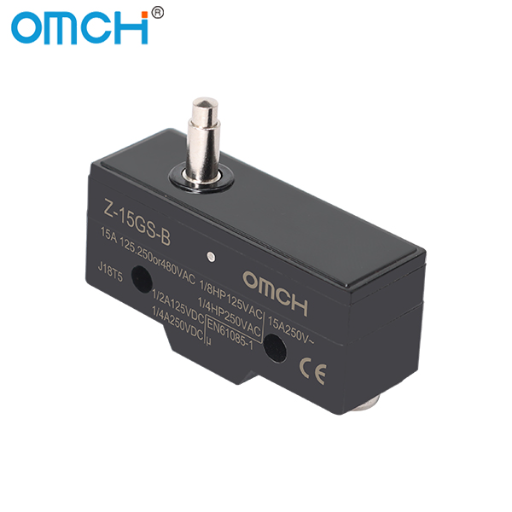
Pin Plunger Micro Switches
Pin plungers are the most basic design in micro-switch functionality. They have a short actuator that is in the shape of a button, and such requires the actuation force to be applied in a straight direction along the y-axis of the micro-switch. There are no lever terminals to create a mechanical advantage to the switch, which causes a high operating force to be required, although there is very little distance in pre-travel.
For highly accurate designs, this configuration is the best option available. They are also best used when the movement of the target object is very limited, and in a straight line that is orthogonal to the button that the switch contains. In CNC machinery, for example, they act as consistent stoppers or an end switch for axis limits. Another example is the safety interlock in a microwave oven or verifying the closing of doors in an industrial enclosure.
Hinge Lever and Leaf Lever Switches
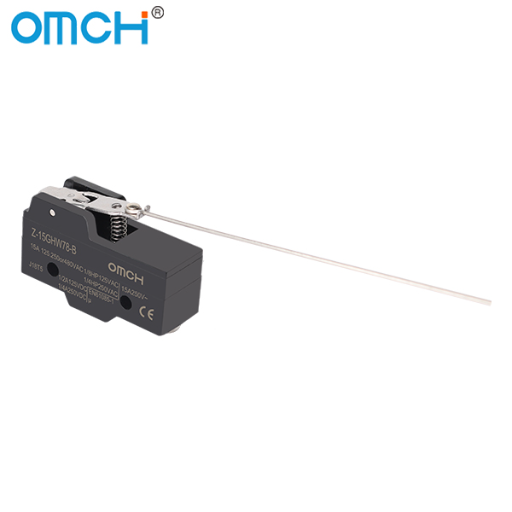
If the use case for the switch needs a lower operating force, or if the trajectory of the target object is not perfectly perpendicular to that of the switch, then a lever system is utilized. A rigid metal lever or a leaf lever is hinged on one end of the cover of the panel mount switch, meaning that a mechanical advantage (named leverage) is then created, thus lowering the force that is required to actuate the internal plungers to be significantly lower.
These types of micro switches are useful in environments where there is minimal torque. An example of this is medical devices or vending machines, which can also include smart appliances that utilize such sensors. In vending machines there needs to be a sensor that is unable to block the path of the product, yet needs to be able to trigger the sensor when a light product passes through. Another example is in the mechanisms that allow printers to feed paper. A hinge lever switch that is able to sense the presence of paper without causing a jam is activated by the resistance of a single sheet of paper.
Roller Lever Micro Switches
A roller lever micro switch is designed with a roller at the end of the lever that is made from either stainless steel or a type of strong plastic, providing a greater stroke. This design converts sliding friction to rolling friction and is purely functional.
This type of micro switch is the standard for dynamic industrial applications where the target object moves laterally across the switch, such as cylinder drives or a conveyor belt item. Using a standard plunger in these applications would be problematic as the lateral shear forces could cause rapid destruction of the mechanism. Roller lever switches are common in automation equipment, especially in packaging, where they act as different components to sense the position of transported items.

Classification by Circuit Configuration
The circuit configuration is what determines how the switch control the flow of electricity. This is critical for the control circuits of various devices.
SPDT (Single Pole Double Throw)
The Single Pole Double Throw or SPDT configuration is by far the most flexible and frequent specification. It has 3 terminals, which are Common or COM, Normally Open or NO, and Normally Closed or NC. In the resting state, there is a continuity of connection between COM and NC. When the circuit is actuated, there is a snap action that disconnects the NC and makes a connection with COM and NO.
With this configuration, one electronic component has the ability to perform 2 functions at once, which is breaking one circuit and making another. In the example of a motor control system, when the switch is pressed, it can disconnect power to a drive motor (NC) while at the same time enabling a light indicator in green color which signifies the brake is engaged (NO).
SPST-NO and SPST-NC (Single Pole Single Throw)
Single Pole Single Throw (SPST) switches are less complicated and feature different electrical terminations compared to SPDT.
- SPST-NO (Normally Open): The circuit is open and off until the actuator is pressed. This is the standard configuration for start buttons or to signal a trigger.
- SPST-NC (Normally Closed): The circuit remains complete (on) until the actuator is pressed. This configuration plays a critical role in safety devices. With emergency stop buttons or limit switch applications, the circuit must be closed for an operation to be functional. If the wire gets cut, or the switch opens due to failure, the circuit opens and the machine is halted. This is an industry standard minimum requirement for safety in automation.
Classification by Protection Level (IP Rating)
In the industrial world, failure of components is rarely caused by electrical fatigue alone, and it is commonly due to harsh environments. The Ingress Protection (IP) rating system provides a measure of this resistance.
Standard / Dust-Proof Switches (IP40)
Standard micro switches, fairly common, with a rating around IP40, are made for “clean” environments. They are able to protect against the entry of solid objects larger than 1mm (like wires or fingers), and they do not offer any protection against liquids or fine dust in a sealed environment. The micro switch features a common pin designed to streamline its operation.
These are more than economically efficient for closed consumer electronics, office peripherals, or home appliances, where the switch is placed in an enclosure with a protective shield. However, employing an IP40 switch in a factory floor environment leads to rapid failure, as conductive dust can enter the mechanism and cause short circuits, or insulating dust can coat the contacts and prevent conduction.
Sealed / Waterproof Switches (IP67)
For industrial automation, IP67 switches are the requisite standard. These components undergo epoxy potting around the terminals, rubber gaskets joining the housing, and internal diaphragms protecting the plunger.
An IP67 rating means that the switch is dust-tight and can endure temporary immersion in water. This is critical for various applications like CNC machining centers, where the switch is subject to coolant spray, food processing plants that undergo high-pressure wash-downs and outdoor equipment like EV charging stations and railway signaling systems. These switches are manufactured by companies like OMCH and have high insulation resistance (≥100MΩ) even in damp conditions.
How to Select: Industrial vs. Appliance Grade
The distinction between an “appliance grade” switch and an “industrial grade” switch is substantial, involving differences in materials, tolerances, and certified endurance. Misapplying an appliance switch in an industrial setting results in premature failure and costly downtime.
The following table summarizes the key selection criteria:
| Feature | Appliance Grade (Consumer) | Industrial Grade |
| Mechanical Life | 10k – 50k Cycles | ≥ 10,000,000 Cycles |
| Sealing | Basic / Unsealed | IP65 / IP67 Waterproof |
| Impact Resistance | Low (Plastic housing) | High (Often reinforced/metal) |
| Contact Material | Standard Silver | Silver Alloy / Gold Plated |
- Cycle Life and Durability
The most important economic consideration is the”cost per cycle.” For example, the TZ-8168 series of industrial limit switches is designed for a mechanical life of more than 10,000,000 operations. In high-frequency automation, such as in a packaging machine that runs 30 cycles per minute, a standard switch that is rated for 50,000 cycles “burns out” in less than 30 hours of running time. Industrial grade switches are designed and built, as the new standards for the industry, using a superior alloy for spring components and more durable housing to endure high cycles to eliminate fatigue.
- Environmental Protection (Sealing)
Outdoor use, oil mist, and dust (fine wood and textile dust) require a sealed switch. Industrial switches use a variety of sealing selection technologies to avoid the “breathing” effect, where a switch’s temperature cycling causes it to inhale moist air. Such failures can lead to insulation failure or the internal components corroding.
- Contact Material and Load Handling
The contact metallurgy is determined by the electrical load. For power circuits (e.g., controls direct motor to 5A), Silver Alloy contacts are needed to withstand the heat of an arc. In contrast, logic level circuits (PLC -> 24VDC/5mA), these contacts are not recommended as arc discharge will form oxides. In these low-voltage cases, the industry standard is to use Gold-plated contacts or bifurcated crossbar contacts that meet signal integrity specifications.
- Precision and Repeatability
In automation, the switch is the sensing element. Repeatability is one of the metrics – how consistent is the switching point over time. When it’s an industrial switch, that time differential on Movement is called the differential Movement Tolerance, and it must be tighter. If a switch is meant to signal a robotic arm to stop, then stopping a 0.5mm (or more) variance in the switching point would result in time to an unplanned mechanical collision. Industrial switch designs are performed with the assurance that, over the lifespan of the component, the Operating Force (OF) and Release Force (RF) will stay within the same range.
Conclusion
Selecting micro switches always comes down to weighing the costs of the electronic component against the potential risk of the final product failing in the field. While snap-action systems have become the norm, the idiosyncrasies of actuator type, circuit, logic, and enclosure seals give rise to a complex selection matrix. For commercial purposes, it soon becomes no longer an option to ignore the specs that govern the mechanical and environmental influences, particularly those that highlight the largest overtravel specifications of the switches. The selection of industrial grade components with the high cycle life of switches is a fundamental way to reduce the risk of a complete system failure.
Since 1986, OMCH has developed into a leading supplier of electronic component solutions in the industrial automation sector, prioritizing stability and certification over simple commodity production. We offer a comprehensive portfolio ranging from pin plungers to hinge roller lever, enabling one-stop sourcing for diverse engineering needs. Designed for harsh environments, our switches deliver consistent electrical longevity with robust IP65/IP67 protection ratings. Every unit holds CE, CCC, and RoHS certifications and fully complies with IEC standards, ensuring uncompromising reliability for global applications.
If you require detailed datasheets, specific load parameters, or guidance on integrating different micro switch types into your automation equipment, we invite you to review the OMCH catalog or contact our engineering support team for a precise consultation.


 English
  Arabic
  Turkish
  Russian
  Spanish
  French
  Indonesian
  Portuguese