



Qu'est-ce que la série LRS de Meanwell ?
Si vous avez déjà ouvert une armoire de commande industrielle, une imprimante 3D ou un écran LED, vous en avez très certainement déjà vu un : un boîtier métallique fin, de couleur argent et noir, muni de bornes à vis à une extrémité et d’une LED verte allumée à l’autre. Ce boîtier transforme le courant alternatif provenant de votre prise murale en courant continu propre et stable — et dans le domaine des alimentations à découpage encapsulées, la série LRS de Meanwell est celle que vous êtes le plus susceptible de rencontrer.
LRS signifie Commutateur fiable à profil bas, et cette série s'est imposée comme la gamme d'alimentations fermées la plus vendue de Meanwell. Elle couvre une plage de puissance allant de 35 watts à 1 200 watts, fournit des tensions continues à sortie unique comprises entre 3,3 V et 48 V, le tout dans un boîtier métallique standard d'une hauteur de 1U (30 mm) qui s'intègre parfaitement dans les baies d'équipement exiguës. Depuis son lancement en tant que successeur de l’ancienne série RS, la gamme LRS est devenue le choix par défaut pour les armoires d’automatisation, les installations d’éclairage LED, les bancs d’essai et les machines à commande numérique (CNC) dans des dizaines de secteurs d’activité.
Qu'est-ce qu'une alimentation à découpage en boîtier fermé ? Et quel est le rôle de LRS dans ce domaine ?
Tout équipement électronique branché sur une prise murale a besoin d’un dispositif capable de convertir le courant alternatif (CA) haute tension provenant du réseau en courant continu (CC) basse tension, qui alimente les circuits imprimés, les moteurs et les capteurs. Une alimentation à découpage effectue cette conversion grâce à une commutation à haute fréquence, ce qui explique pourquoi elle peut être nettement plus petite et plus légère que les anciennes alimentations linéaires à transformateur utilisées il y a plusieurs décennies.
Un ci-joint Grâce à ce système d'alimentation, l'ensemble est logé dans un boîtier métallique perforé. Cela le distingue des trois autres formats courants dans le domaine de l'alimentation industrielle :
- Cadre ouvert Ces composants ne disposent pas de boîtier — il s’agit simplement d’un circuit imprimé nu, utilisé lorsque le châssis de l’équipement lui-même assure la protection nécessaire.
- rail DIN Ces accessoires se fixent directement sur les rails de 35 mm à l'intérieur des armoires électriques.
- Adaptateurs externes se trouve à l'extérieur de l'appareil, comme un chargeur d'ordinateur portable.
La série LRS fait partie de la catégorie des modèles fermés et est spécialement conçue pour intégré Applications — il suffit de le visser dans le châssis de votre équipement, de raccorder l’entrée au secteur et la sortie à votre charge, et il y reste pendant des années. Avec son profil de 30 mm, il occupe exactement 1U de hauteur de rack, ce qui explique pourquoi il est si répandu dans les racks d’équipement de 19 pouces et les armoires d’automatisation compactes.
Pourquoi la série LRS a remplacé la série RS comme série de référence
Si vous utilisez depuis un certain temps déjà les alimentations Meanwell, vous vous souvenez peut-être de la série RS, qui a précédé directement la série LRS. Meanwell a présenté la série LRS comme une mise à niveau « drop-in », et les chiffres le confirment sur tous les aspects importants :
| Fonctionnalité | Série RS (ancienne) | Série LRS (actuelle) |
|---|---|---|
| Plage de puissance | 15 W – 150 W | 35 W – 1 200 W |
| Consommation électrique à vide | >0,5 W | < 0,2 W – 0,75 W (selon le modèle) |
| Efficacité | ~82–86% (valeur typique) | 82–94% (varie selon le modèle et la tension) |
| Hauteur | Profil de l'atelier | 30 mm (1U) sur la majeure partie de la gamme |
| Prix | Coût par watt plus élevé | 10–20% : puissance inférieure à celle du RS à puissance équivalente |
| Résistance aux pics de tension d'entrée | Standard | 300 V CA pendant 5 secondes |
La gamme RS est de fait retirée de la vente pour les nouveaux modèles. Si vous définissez les spécifications d'un nouveau projet ou si vous remplacez un appareil RS vieillissant, la gamme LRS constitue la solution de remplacement directe : vous bénéficierez d'un meilleur rendement, d'une consommation en veille réduite et d'un encombrement moindre, le tout à un prix plus avantageux.
Aperçu de la gamme de modèles LRS
La gamme LRS comprend dix niveaux de puissance. La première chose à noter est la ligne de démarcation très nette à 200 watts : tous les modèles jusqu'au LRS-200 inclus sont sans ventilateur (refroidi par convection à l'air libre), tandis que tous les modèles à partir du LRS-350 utilisent un ventilateur à courant continu intégré. Ce simple choix de conception a des répercussions considérables sur le niveau sonore, l'entretien et l'adéquation à différents environnements — nous y reviendrons dans le guide de sélection.
| Modèle | Puissance nominale | Dimensions (L×W×H mm) | Refroidissement | Tension d'entrée | Tensions de sortie |
|---|---|---|---|---|---|
| LRS-35 | 35W | 99 × 82 × 30 | Convection (silencieuse) | 85–264 V CA (plage complète) | 5, 12, 15, 24, 36, 48 V |
| LRS-50 | 50W | 99 × 82 × 30 | Convection (silencieuse) | 85–264 V CA (plage complète) | 3,3, 5, 12, 15, 24, 36, 48 V |
| LRS-75 | 75W | 99 × 97 × 30 | Convection (silencieuse) | 85–264 V CA (plage complète) | 5, 12, 15, 24, 36, 48 V |
| LRS-100 | 100W | 129 × 97 × 30 | Convection (silencieuse) | 85–264 V CA (plage complète) | 3,3, 5, 12, 15, 24, 36, 48 V |
| LRS-150 | 150W | 159 × 97 × 30 | Convection (silencieuse) | 115/230 V CA (commutateur) | 12, 15, 24, 36, 48 V |
| LRS-150F | 150W | 159 × 97 × 30 | Convection (silencieuse) | 85–264 V CA (plage complète) | 5, 12, 15, 24, 36, 48 V |
| LRS-200 | 200W | 215 × 115 × 30 | Convection (silencieuse) | 115/230 V CA (commutateur) | 3,3, 4,2, 5, 12, 15, 24, 36, 48 V |
| LRS-350 | 350W | 215 × 115 × 30 | Fan de DC | 115/230 V CA (commutateur) | 3,3, 4,2, 5, 12, 15, 24, 36, 48 V |
| LRS-450 | 450 W | 225 × 124 × 35 | Fan de DC | 115/230 V CA (commutateur) | 5, 12, 15, 24, 36, 48 V |
| LRS-600 | 600 W | - | Fan de DC | 115/230 V CA (commutateur) | 5, 12, 15, 24, 36, 48 V |
| LRS-1200 | Mille deux cents watts | 225 × 124 × 41 | Fan de DC | 180 à 305 V CA | 12, 24, 36, 48 V |
Il y a deux points à souligner dans cette sélection. Premièrement, le LRS-150F — le suffixe “ F ” indique une entrée CA à plage complète (85–264 V CA), ce qui signifie qu’il fonctionne partout dans le monde sans qu’il soit nécessaire de changer de commutateur de tension. Le modèle LRS-150 standard nécessite de sélectionner manuellement 115 V ou 230 V avant la mise sous tension. Deuxièmement, le LRS-N2 La sous-série (du LRS-100N2 au LRS-600N2) ajoute Puissance de crête du 200% pendant 5 secondes maximum — une caractéristique essentielle si votre charge comprend des moteurs, des batteries de condensateurs ou tout autre élément générant un courant d'appel élevé au démarrage. Sans N2, vous devriez surdimensionner l'alimentation d'un facteur deux rien que pour assurer son fonctionnement pendant les premières secondes.
Les tensions les plus couramment disponibles, toutes puissances confondues, sont les suivantes : 24 V et 12 V. Si vous êtes un distributeur en train de constituer vos stocks, ces deux tensions couvriront 80%+ de la demande des clients. (Meanwell, 2026)
Comment choisir le bon modèle de LRS
Quatre étapes vous permettent de passer de “ J'ai besoin d'un bloc d'alimentation ” à une référence précise. Les voici, dans l'ordre.
Étapes 1 et 2 — Déterminez la tension, puis calculez la puissance
Commençons par la tension. Ce point n'est pas négociable. Un équipement de 12 V ne fonctionnera pas sur une alimentation de 24 V, et brancher une carte de commande de 5 V sur une sortie de 12 V la détruira instantanément. Adaptez la tension à votre charge :
| Tension de sortie | Applications typiques |
|---|---|
| 5V | Microcontrôleurs (Arduino, grappes de Raspberry Pi), circuits logiques, systèmes de commande TTL |
| 12V | Bandes LED, caméras de vidéosurveillance, ventilateurs, petits moteurs, cartes électroniques pour imprimantes 3D |
| 15 V | Amplificateurs audio, capteurs industriels anciens, certains servomoteurs |
| 24V | Systèmes PLC, plateaux chauffants pour imprimantes 3D de grande taille, capteurs industriels, électrovannes, cartes de relais |
| 36V | Lignes LED longue distance, infrastructure PoE, pilotes de moteurs pas à pas CNC spécialisés |
| 48V | Équipements de télécommunications, PoE haute puissance, accessoires de recharge pour véhicules électriques, installations de bandes LED de grande longueur |
Calculez ensuite la puissance en watts — en prévoyant une marge. Additionnez l'intensité absorbée par chaque appareil sur le rail CC, multipliez ce total par la tension, puis multipliez le résultat par 1,25 :
Puissance requise = (Courant total en ampères × Tension de sortie) × 1,25
Cette marge de sécurité de 25% n'est pas facultative. Faire fonctionner une alimentation à 100% de sa puissance nominale réduit la durée de vie des condensateurs, augmente l'ondulation et augmente le risque de déclenchement des protections contre les surcharges lors des journées chaudes. Tout ingénieur expérimenté prévoit cette marge de sécurité.
Exemple détaillé : Vous alimentez une installation LED de 24 V consommant au total 10 A. 24 × 10 × 1,25 = 300 W. Le modèle LRS le plus proche supérieur à 300 W est le LRS-350-24 (puissance nominale de 350 W, 24 V, jusqu'à 14,6 A).
Étape 3 — Adaptez la méthode de refroidissement à votre environnement
C'est là que la limite des 200 W devient votre critère de décision le plus pertinent.
Silencieux (sans ventilateur) — des modèles LRS-35 à LRS-200. Ces modèles dissipent la chaleur grâce à leur boîtier métallique et aux perforations de celui-ci. Aucune pièce mobile, aucun bruit, aucune aspiration de poussière. Ils sont parfaits pour les équipements de laboratoire, les boîtiers d'appareils médicaux, les machines installées à proximité de bureaux, ainsi que pour toute installation où le bruit d'un ventilateur serait inacceptable ou où la poussière et les particules en suspension dans l'air risqueraient d'obstruer rapidement un ventilateur. Les LRS-200 Il s'agit du modèle sans ventilateur offrant la puissance la plus élevée de la gamme. Si vous recherchez un fonctionnement silencieux au-delà de 200 W, vous devrez vous tourner vers une autre gamme de Meanwell (UHP) ou vers une autre marque.
Actif (refroidissement par ventilateur) — LRS-350 et modèles supérieurs. À partir de 350 W, le refroidissement passif ne permet plus de maintenir les températures de jonction dans des limites de sécurité au sein d’un boîtier de 30 mm. La solution proposée par Meanwell consiste en un ventilateur CC intégré. Cela fonctionne, mais ce ventilateur est la principale source de plaintes des utilisateurs pour l’ensemble de la gamme LRS. Dans les environnements calmes, son bruit est perceptible. Dans les ateliers poussiéreux, il devient un élément nécessitant un entretien régulier : les ventilateurs encrassés réduisent le débit d’air, font augmenter les températures internes et raccourcissent la durée de vie des condensateurs. Si vous utilisez des modèles LRS-350 ou supérieurs dans des environnements poussiéreux, prévoyez un budget pour un nettoyage périodique ou envisagez des alternatives étanches et sans ventilateur.
Règle empirique pratique : Si vous avez besoin d'une puissance de 300 W et que le silence est un critère important, deux unités LRS-150 alimentant des sections distinctes de votre installation peuvent constituer une meilleure solution qu'un seul LRS-350 — au prix d'un câblage supplémentaire et d'un peu plus d'espace dans le tableau électrique.
Étape 4 — Vérification des certifications et de la tension d'entrée
Les deux dernières vérifications sont celles qui risquent le plus de poser problème dans le cadre des marchés publics internationaux.
Commutateur de tension d'entrée. La plupart des modèles LRS (LRS-150, LRS-200, LRS-350, LRS-450, LRS-600) sont équipés d’un commutateur manuel 115 V/230 V sur le côté du boîtier. Le réglage d'usine par défaut varie selon les lots de production. Si un appareil réglé sur 115 V est branché sur un réseau électrique de 230 V, il sera immédiatement détruit — il ne s'agit pas d'un risque théorique ; cela arrive régulièrement. Avant d'expédier l'appareil à un client ou de le mettre sous tension, vérifiez visuellement la position du commutateur à glissière rouge. Le LRS-150F et les modèles LRS-35/50/75/100, plus petits, acceptent une tension d'entrée à large plage (85–264 V CA) et ne disposent pas de commutateur — ce qui constitue un avantage logistique non négligeable si votre équipement est expédié vers plusieurs régions.
Certifications. Chaque marché exige des marquages spécifiques. LRS dispose des certifications UL 60950-1 (et de la norme équivalente CEI/EN 62368-1), CE (CEM + LVD), CCC, BSMI et EAC — mais toutes ces certifications ne s'appliquent pas nécessairement à chaque modèle ou à chaque variante de tension de sortie. Si votre marché cible est la Russie ou l’Union douanière eurasienne, vérifiez que le modèle concerné est bien couvert par la certification EAC. S’il s’agit de l’Amérique du Nord, vérifiez que le numéro de dossier UL correspond exactement à la variante concernée. Ne partez pas du principe que, parce qu’une série est “ certifiée CE ”, toutes les références de cette série portent ce marquage : vérifiez toujours la fiche technique pour vous assurer que la combinaison de puissance et de tension correspond bien à celle dont vous avez besoin.
LRS par rapport aux autres séries Meanwell — À quoi sert-elle ?
Meanwell propose plus d'une douzaine de gammes d'alimentations électriques, et on peut facilement se demander si la gamme LRS est réellement celle qui convient à votre application. Voici un tableau de référence rapide pour vous aider à faire votre choix :
| Votre priorité | Meilleure série | Pourquoi |
|---|---|---|
| Priorité au budget, usage industriel général | LRS | Meilleur rapport coût/watt, disponibilité maximale, couvre 99% des besoins en tension continue standard |
| Rendement maximal, fonctionnement totalement silencieux à tous les niveaux de puissance | UHP | Rendement 95%, conception hermétique sans ventilateur jusqu’à 2 500 W — mais nettement plus chère |
| Montage sur rail DIN dans une armoire électrique | Docteur / Docteur en philosophie | Se fixe directement sur un rail DIN de 35 mm ; sa faible largeur permet de gagner de la place sur le panneau |
| Éclairage LED pour l'extérieur ou les lieux humides | HLG | Indice de protection IP65/IP67, option de sortie à courant constant, boîtier métallique encapsulé |
| Instrumentation de précision, fonctionnement continu 24 heures sur 24, 7 jours sur 7 | RSP | PFC active, ondulation réduite, détection de tension à distance, marges de déclassement des composants plus élevées |
Le LRS est un véritable cheval de bataille. Il n'est ni le plus efficace, ni le plus silencieux, ni le plus riche en fonctionnalités — mais c'est le plus rentable pour un large éventail d'applications. Considérez-le comme la Toyota Corolla de la puissance industrielle : pas très excitant, mais il démarre à chaque fois et fonctionne pendant des années.
Ce qu'il faut savoir avant d'acheter un LRS
LRS est un produit vraiment de qualité, mais aucun produit n'est parfait. Voici les limites qui comptent dans la pratique — celles qui ressortent de l'expérience sur le terrain, et pas seulement des notes de bas de page des fiches techniques.
Pas de correction active du facteur de puissance (PFC). Les modèles LRS présentent des facteurs de puissance compris entre 0,5 et 0,7 à des charges typiques, ce qui signifie qu’ils prélèvent sur le réseau un courant apparent supérieur à la puissance active qu’ils fournissent. Pour un seul appareil installé sur un établi, cela n’a aucune importance. En revanche, dans une armoire électrique contenant vingt LRS-350, le courant réactif cumulé peut déclencher les disjoncteurs et exercer une contrainte inutile sur le câblage en amont. Si votre installation comporte plus d’une poignée d’unités sur un même circuit, ou si la réglementation électrique locale impose la conformité à la norme EN 61000-3-2 (limites de courant harmonique), vous devez plutôt opter pour une série équipée d’un correcteur de facteur de puissance (PFC), telle que la gamme RSP.
Le risque de contrefaçon est bien réel — et il ne cesse de croître. En raison de sa popularité et de sa conception relativement simple, la gamme LRS est devenue l’une des gammes d’alimentations les plus contrefaites du marché. Les modèles LRS authentiques utilisent des condensateurs électrolytiques de marque japonaise conçus pour fonctionner à 105 °C et offrent une ondulation de sortie généralement inférieure à 100 mV crête à crête. Les contrefaçons, que l'on trouve couramment sur des annonces non vérifiées d'AliExpress et d'eBay, utilisent à la place des condensateurs génériques de 85 °C et produisent systématiquement une ondulation supérieure à 400 mV crête à crête — soit quatre fois la valeur spécifiée pour les modèles authentiques. Plusieurs témoignages sur des forums font état de contrefaçons ayant pris feu dès la première mise sous tension. La seule protection fiable : acheter auprès du réseau de distributeurs agréés de Meanwell, et non auprès des annonces en ligne les moins chères. (Meanwell, 2026)
Le bruit du ventilateur est la principale source de plaintes des utilisateurs du #1. Comme indiqué dans la section consacrée au refroidissement, les modèles LRS-350 et supérieurs sont équipés d’un ventilateur à courant continu qui devient audible lorsqu’ils sont soumis à une charge. Il ne s’agit pas d’un défaut — c’est un compromis technique visant à intégrer une puissance de 350 W ou plus dans un boîtier de 30 mm — mais cela surprend souvent les acheteurs novices. Si vous recherchez une solution pour un environnement intérieur silencieux, optez pour le modèle LRS-200 sans ventilateur ou tournez-vous vers la série UHP.
Il n'est pas possible de monter des unités LRS en parallèle pour obtenir un courant plus élevé. Contrairement à certaines séries haut de gamme, les blocs d'alimentation LRS ne sont pas conçus pour fonctionner en parallèle direct. Le fait de connecter deux unités LRS-350-24 en sortie à sortie pour obtenir 48 V ou doubler le courant provoquera une interférence entre les deux unités, ce qui entraînera une instabilité ou des dommages. Si vous avez besoin d’une redondance en parallèle ou d’un partage de courant, vous devez utiliser des diodes « OR » externes ou un module actif de partage de courant — ou encore une autre alimentation électrique conçue avec une fonction de fonctionnement en parallèle intégrée.
Au-delà du LRS : des alternatives intéressantes à envisager
LRS est un excellent produit, mais ce n'est pas la seule option. Si vous êtes distributeur ou grossiste de composants industriels, vos clients finiront par vous demander : “ Quelles sont les autres solutions disponibles à un meilleur prix ? ” C'est en étant capable de répondre à cette question en proposant une alternative certifiée, provenant directement de l'usine — une alternative que vous avez soigneusement sélectionnée et que vous stockez en toute confiance — que vous transformerez une commande ponctuelle en un compte client régulier.
Les critères à prendre en compte pour choisir une alternative au LRS
Si vous envisagez d'acheter un bloc d'alimentation en boîtier d'une marque autre que Meanwell, ces cinq points à vérifier vous permettront de distinguer les alternatives valables des choix désastreux motivés par une recherche de prix bas :
Où trouver des alternatives de qualité
Le marché mondial des blocs d'alimentation fermés présente un centre de gravité géographique bien connu : Yueqing, dans la province du Zhejiang, en Chine. Il s'agit du même pôle industriel qui a vu naître Chint (CHINT) et Delixi, deux des plus grands fabricants mondiaux d'équipements électriques basse tension. L'écosystème de cette région, composé de fournisseurs de composants, d'ingénieurs expérimentés et d'infrastructures d'essais, s'est développé au fil de quatre décennies. Il soutient aujourd'hui des dizaines de fabricants dont les alimentations à découpage encapsulées rivalisent directement avec la gamme LRS en termes de caractéristiques techniques, tout en offrant des avantages significatifs en termes de coûts.
Dans cet écosystème, s’approvisionner directement auprès d’un fabricant — plutôt que par l’intermédiaire d’une société de négoce ou d’un distributeur étranger — permet généralement de réaliser une économie de 15 à 30% sur le coût unitaire en cas d’achat en volume. Vous bénéficiez également de services proposés directement par l’usine, que les sociétés de négoce ne peuvent pas offrir : étalonnage personnalisé de la tension de sortie, étiquetage à l’effigie de votre marque, configurations de connecteurs adaptées et assistance technique directe de la part des ingénieurs qui ont conçu l’alimentation.
L'essentiel est de trouver un fabricant dont la gamme de produits correspond à la plage de puissance principale de LRS (35 W à 350 W), dont les certifications sont documentées et à jour, et qui est présent sur le marché depuis suffisamment longtemps pour avoir fait ses preuves. Un fournisseur fort de plus de 30 ans d’expérience dans la fabrication, disposant de sa propre usine et proposant un catalogue comprenant des alimentations électriques ainsi que des composants d’automatisation complémentaires (disjoncteurs de distribution, relais, capteurs, contrôleurs) devient un point d’approvisionnement unique. Cela se traduit par moins de problèmes logistiques et une gestion des fournisseurs simplifiée.
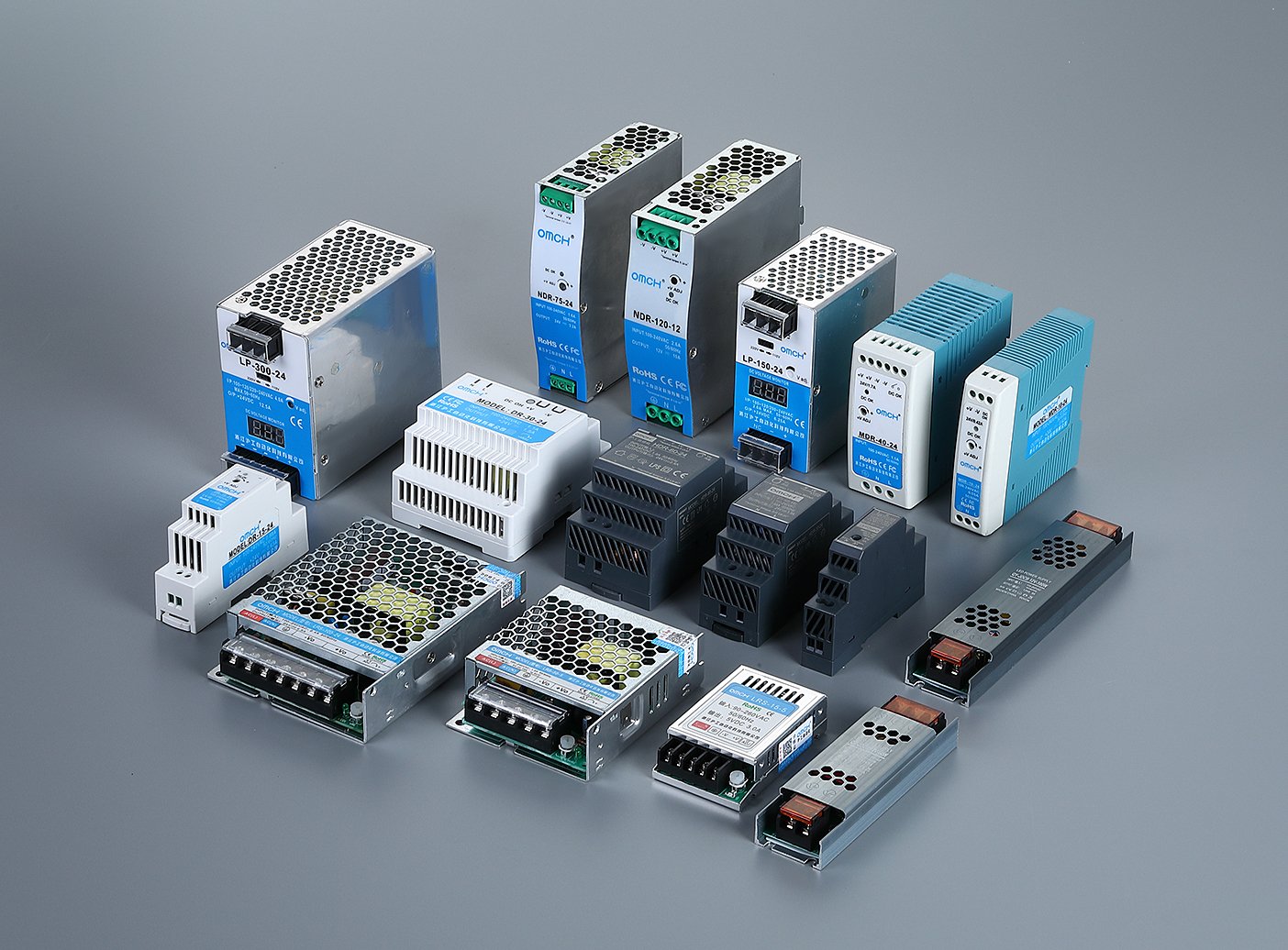
Si vous distribuez des alimentations électriques industrielles, OMCH est un fabricant qu’il vaut la peine d’ajouter à votre gamme de produits. Sa gamme d’alimentations à découpage comprend des modèles en boîtier, sur rail DIN et des pilotes LED, d’une puissance allant de 15 W à 480 W — soit exactement la plage de puissance que vos clients recherchent — et bénéficiant des certifications CE, CCC et ROHS. Tarifs directs d’usine, fabrication en interne (depuis 1986) et aucune marge d’intermédiaire. Consultez le catalogue complet sur omch.com/switch-mode-power-supply.
Références
- Meanwell. “ Catalogue des alimentations électriques industrielles — Type en boîtier (série LRS) ”. 2026. https://www.meanwell.com/catalog/product/files/basic-html/page5.html
- Meanwell. “ Réseau de distributeurs agréés ”. 2026. https://www.meanwell.com/distributors.aspx
- OMCH. “ Alimentation à découpage ”.” https://www.omch.com/switch-mode-power-supply/
- OMCH. “ Page d’accueil. ” https://www.omch.com/
- OMCH. “ Contact ”.” https://www.omch.com/contact/


 English
  Arabic
  Turkish
  Russian
  Spanish
  French
  Indonesian
  Portuguese
  Thai
Thai  Vietnamese