




Industrial automation is all about precision, and the decision of whether your system spends its currency on an absolute encoder or an incremental encoder determines the efficiency of that spend. Whether you are designing for complex motion control applications or simple speed monitoring, understanding the specific types of encoders is crucial. Finding the good fit between an absolute encoder vs incremental technology often comes down to balancing cost against safety reasons and performance needs.
This guide covers a wide range of applications to help you decide which type of encoder belongs in your motion control system.
Incremental Encoders: Principles and The Homing Necessity
You need to know how the incremental encoder works in order to know the choice you are about to make. It is the industry workhorse, which is characterized by simplicity in hardware.
The process is based on the disc of an incremental encoder—typically a clear disc with a set of opaque lines or holes. A light source is passed through these slots as the disc turns, and a photo-detector produces a continuous stream of electrical pulses. This output signal is usually arranged in three channels: Signal A, Signal B, and Signal Z (the index signal).

These signals appear as square waves. The frequency of these pulses determines the speed of the system, and the number of pulses relates to the distance. By comparing the phase difference between Signal A and Signal B, the system determines the direction of movement (e.g., when A leads B, the shaft is turning clockwise). The controller counts these pulses to determine the position of the shaft.
But the resolution of an incremental encoder comes with a specific operational burden: the notion of “homing.”
An incremental system is essentially measuring relative position. It is only aware that it has moved. The volatile memory holding the pulse count is erased when power is switched off to the system. When the controller is restarted, it reads a position of zero, no matter what the actual position of the mechanical arm or shaft is.
To function, the machine must perform a homing sequence to find a reference point. It must physically move the axis until it triggers a sensor to establish a reference position. This is the defining trait of incremental encoders.
Absolute Encoders: Unique Codes and Communication Protocols
The absolute rotary encoder is a solution to the issue of position loss because it alters the language of measurement. It does not give a stream of the same pulses. Instead, it assigns a unique code to every position within its rotation.
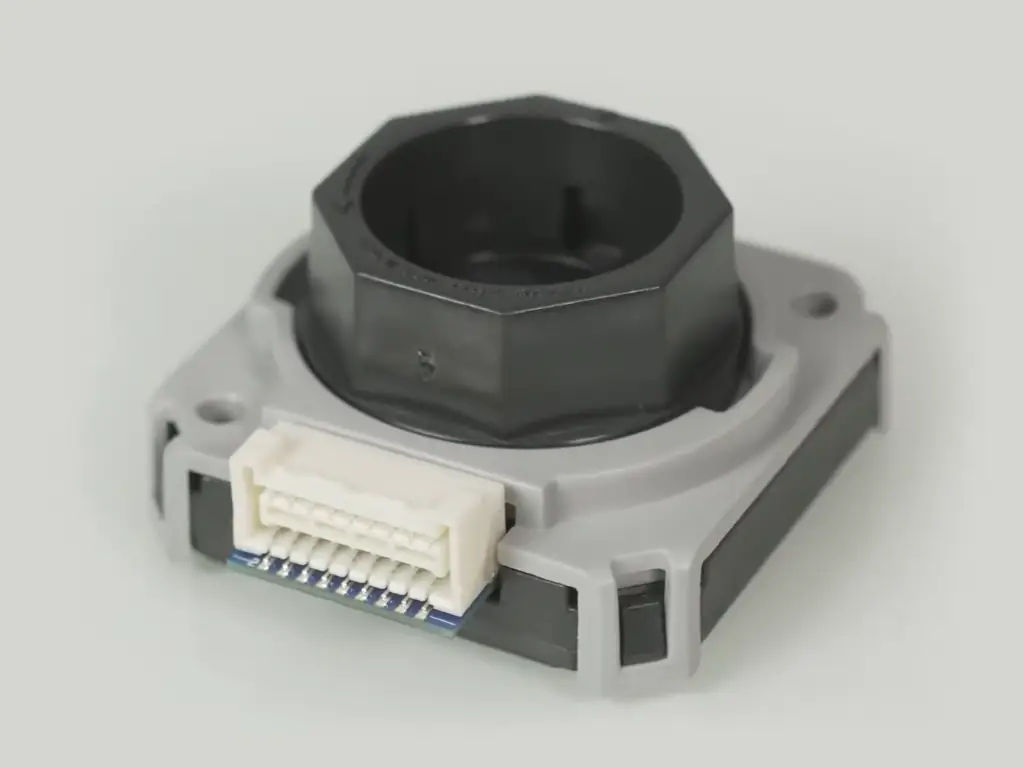
The optical disc of an absolute encoder is much more complicated than an incremental one. It has several concentric strips of opaque and transparent parts. When the light goes through these tracks, it creates a parallel digital word a particular pattern of ones and zeros.
This implies that there is a unique code at each particular angle of the shaft. The controller does not need to count previous movements to know the position of an object; it simply reads the current position.
This absolute system extends into two distinct categories:
- Single-turn Absolute Encoder: These encoders provide a unique code for every position within 360 degrees of rotation. If the shaft completes a full circle, the value resets. This is sufficient for robotic arms or valves that operate within a limited arc.
- Multi-turn Absolute Encoder: These instruments record the position information in 360 degrees as well as the number of full rotations. The encoder stores the number of revolutions via internal gearing or battery-backed memory. This is necessary in linear applications that are actuated by lead screws, where the overall travel distance is more than one full rotation of the motor shaft.
With absolute encoders, you move from relative uncertainty to absolute position. The device provides specific positions and position data immediately.
Critical Performance Differences: Incremental vs. Absolute
When we move beyond the datasheet, the theoretical differences in the incremental encoder vs absolute comparison manifest as critical performance factors. We must evaluate them based on three specific engineering realities: startup behavior, signal stability (or noise immunity), and speed of processing.
Startup Behavior and Position Memory
The first operational difference is the most immediate: startup behavior.
Using an incremental encoder, the system starts up blind. As explained, the machine goes into a non-productive state because it lacks position memory. It is not able to resume its work, it has to orient itself. This homing need is not just an inconvenience in large-scale operations, like in the case of gantry cranes, automated warehousing systems, or heavy printing presses; it is a serious operational risk. When a power failure happens when a robotic arm is deep into a car chassis on an assembly line, homing is not possible without the risk of a collision. The arm should be aware of where it should safely pull out.
The absolute encoder provides position memory and instantaneous preparedness. Since the position is determined by the physical pattern on the disc, the data is provided milliseconds following the restoration of power. No movement is necessary. The encoder is asked by the controller and the precise coordinate is provided. This Position Memory feature essentially changes the safety measure of the machine. It allows for “hot restarts.” This is not a luxury in critical infrastructure, like medical scanning equipment or elevator control systems, but a safety requirement. A surgical robot cannot be asked to recalibrate its zero point when a patient is on the table.
Signal Stability in High-Noise Environments
The electrical environment in industries is hostile. They contain variable frequency drives (VFDs), heavy welding equipment and high-voltage switchgear. These gadgets cause a lot of electromagnetic interference (EMI). It is here that the idea of robustness will be the determining factor in your absolute vs incremental encoder choice.

Incremental encoders are susceptible to EMI. When a noise spike is caused by a nearby welder and it causes a false voltage in the signal cable, the controller can interpret the noise spike as a pulse. On the other hand, a legitimate pulse may be suppressed by strong interference.
The risk in this case is Cumulative Error. When the controller fails to receive one pulse in thousands, the position recorded is not the same as the actual position. The controller is unaware of the fact that it missed a beat. It goes on counting the wrong number. These minor mistakes accumulate over hours of work. A robot welder may one day be welding 2mm out of target, resulting in a whole batch of scrap product. The mistake continues until the machine is switched off and re-homed.
Absolute encoders have Self-Correction. They are not based on a running tally. They send a digital word of the present position.
Take an example of a case when the data transmission is corrupted by electrical noise for over 10 milliseconds. The controller can get invalid data during that short window. But when the noise has stopped, the following data packet of the absolute encoder is the new correct position code depending on the shaft angle at the moment. The mistake is not compounded. The system self-heals instantly. In high-reliability applications where signal integrity is paramount, such robust data validation makes the absolute encoder better.
Speed Limits and Data Processing Latency
Although absolute encoders are superior in reliability, the physics of data processing impose various limitations in terms of speed in comparison to incremental systems.
Pulse Frequency limits incremental encoders. The higher the speed of the shaft, the more frequent the pulses. At some point you hit a physical limit where the electronics cannot turn on and off quickly enough, or the capacitance of the cable turns the square waves into an illegible mess. But, in their range, incremental signals are virtually instantaneous.
Absolute encoders are constrained by Latency and Baud Rate. Since the encoder needs to read the pattern, encode it to a digital protocol (such as SSI or EtherCAT), and send that data packet to the controller, it has a small calculation delay. Even in ultra-high-speed applications, this latency, even in microseconds, has to be considered in the control loop.
Moreover, the communication cycle time determines the refresh rate of the position data. When you need real-time velocity feedback of an extremely dynamic servo motor, you need to make sure that the communication rate of the absolute encoder is higher than the control loop of your drive. This gap has been bridged by modern absolute encoders, although in simple, raw speed monitoring the direct pulse of an incremental encoder is still a valid, low-latency solution.
Interface Standards: Connectivity and Controller Integration
Choosing the encoder hardware is not the whole battle, you need to make sure that it is compatible with your controller. The complexity of integrating the two technologies is very different.
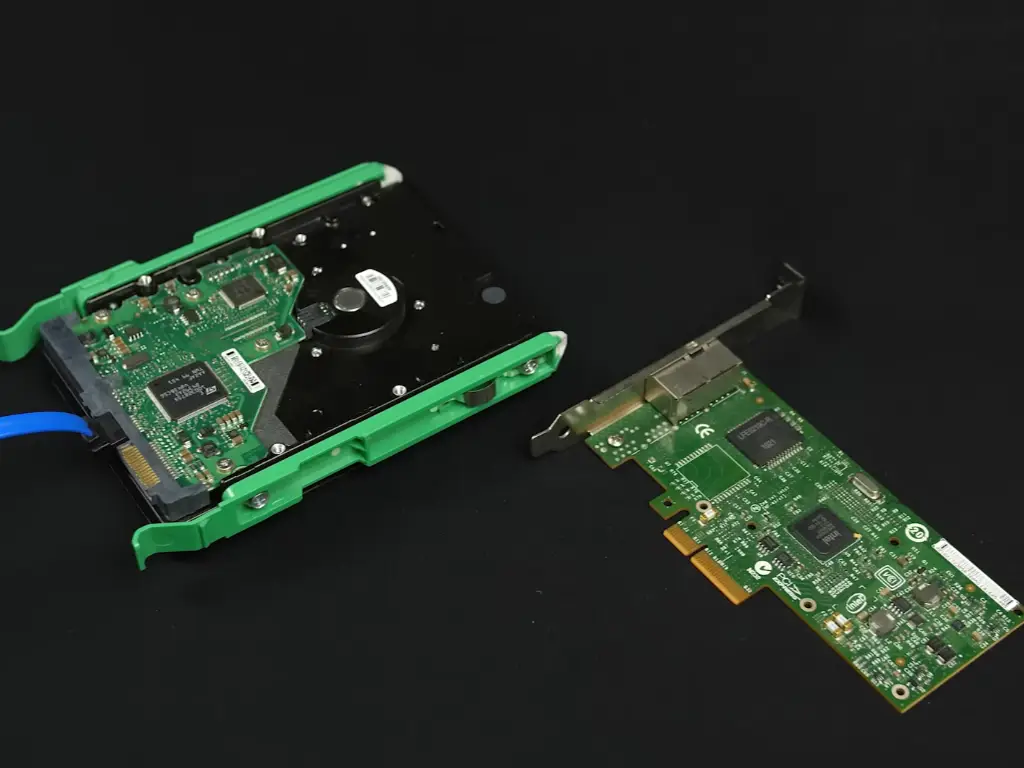
The incremental encoder is hard wired to connect. You usually have three output wires (A, B, Z) and their inverses, power and ground. You need a High-Speed Counter (HSC) module on the controller side. The internal processor of the PLC is required to process the logic, and it has to be programmed to read the quadrature pulses. The wiring is standard, but it is up to your controller CPU to count.
Absolute encoders are smart network nodes. They need certain communication protocols. This is where it cannot be compromised with your current architecture.
- Serial Interfaces (SSI/BiSS): Synchronous Serial Interface (SSI) is the point-to-point connection standard. It is also efficient and uses fewer wires and transmits position data in sync with a clock pulse sent by the controller. This is bidirectionally evolved into BiSS, which supports higher data rates.
- Fieldbus and Ethernet (Modbus, EtherCAT, PROFINET): The modern absolute encoders are frequently directly linked to the industrial network. A typical example is an EtherCAT encoder which simply fits into the Ethernet port of a drive or PLC. This enables the controller to not only get position data, but also diagnostic data such as temperature alerts or vibration alerts.
Cost Analysis: Upfront Price vs. Long-term Value
It is an objective fact: the purchase price of an absolute encoder is higher than that of an incremental encoder. The complex optical disc and the onboard processing chips cost more to manufacture. However, smart engineering decisions are never made based on sticker price alone. They are based on the Total Cost of Ownership (TCO).
It is an objective fact: the price of an absolute encoder is higher than an incremental encoder. The complicated optical disc and the processing chips on board are more expensive to produce. Nevertheless, sticker price is never used to make smart engineering decisions. They are founded on the Total Cost of Ownership (TCO).
When you decide to save money on the component by selecting an incremental encoder, you are in fact just moving the expense to other parts of the system. You will need to buy limit switches. You have to pay to have those switches mounted and wired. The PLC programming time to write the homing routine must be paid.
Most importantly, you need to consider the cost of downtime. Assuming that a machine requires 15 minutes to re-home each shift change or power outage, and that the machine is producing $1000 of product per hour, the cheaper incremental encoder is costing you 250 a day in lost productivity.
The actual financial implications are as follows:
| Cost Factor | Incremental Encoder Solution | Absolute Encoder Solution |
| Component Price | Low | Moderate to High |
| Auxiliary Hardware | Requires limit switches, brackets, cabling | None required |
| Installation Labor | High (wiring switches + encoder) | Low (encoder only) |
| Programming | Complex (Homing logic required) | Simple (Read variable directly) |
| Maintenance | High (Mechanical switches wear out) | Low (Solid state operation) |
| Downtime Risk | High (Homing time + switch failure) | Low (Immediate startup) |
The absolute encoder can also pay back in a few months in complex, multi-axis systems, where the hardware and labor to initialize position is removed.
Industry Applications: Choosing Based on Scenario
Technology is defined, yet the usage determines the decision. Not all shafts require an absolute address. Smart engineering is concerned with the appropriate amount of technology for the problem without over-engineering or under-specifying.
The following is a reference guide to the encoder type that is most likely to match a typical industrial situation when considering absolute vs incremental encoder solutions:
| Recommended Encoder | Industry / Application | The Engineering Logic |
| Absolute Encoder | Robotic Arms (Multi-Axis) | Safety Critical. A robot in a confined space cannot safely “home” itself blindly. It requires immediate, absolute position data to calculate safe paths and prevent collisions upon startup. |
| CNC Machining Centers | Tool changers and rotary tables require absolute precision. A loss of position here leads to crashed tools and ruined workpieces. Homing takes too long and is too risky. | |
| Elevators & Medical Devices | Safety Critical. MRI tables and elevators must operate with absolute certainty. Uncommanded movement for “homing” is unacceptable in clinical or passenger environments. | |
| Wind Turbines | Pitch control systems must know the blade angle immediately—even after power loss—to feather the blades safely against strong winds. | |
| Incremental Encoder | Conveyors & Logistics | The primary goal is speed synchronization. The exact linear position of the belt is rarely relevant, making the incremental encoder the efficient, cost-effective standard. |
| HVAC (Fans & Pumps) | The Variable Frequency Drive (VFD) only needs feedback to maintain RPM. The absolute angle of the fan blade is irrelevant to the process. | |
| Cut-to-Length Machines | The machine counts pulses to a set point, cuts, and resets. This relative counting loop is perfectly served by incremental technology. |
Final Verdict: Optimizing Your Automation System
The selection between absolute and incremental encoders is not a battle of “better vs. worse.” It is a calculation of “fit vs. friction.”
If your application involves continuous velocity control, simple counting, or budget-constrained machinery where homing is a minor inconvenience, the Incremental Encoder remains a reliable and cost-effective standard.
However, if your system demands immediate startup, operates in high-noise electrical environments, coordinates multiple axes, or poses a safety risk if position is lost, the Absolute Encoder is not just an upgrade—it is a necessity. The higher initial investment is returned through simplified mechanical design, reduced programming effort, and the elimination of downtime.
Your Selection Checklist:
- Safety: Does unexpected movement during the homing pose a risk? (If yes -> Absolute)
- Downtime: Is the time spent homing the machine costing you production revenue? (If yes -> Absolute)
- Environment: Is the installation near VFDs, welders, or high-voltage lines? (If yes -> Absolute for noise immunity)
- Function: Is the primary need Speed Control (Incremental) or Position Control (Absolute)?
At OMCH, we don’t just assemble sensors; we engineer certainty. Having more than 38 years of manufacturing experience, we offer a full range of encoders that are customized to meet the needs of the world. More importantly, our encoders have a universal compatibility design, which is compatible with mainstream industry protocols to provide a smooth handshake with a variety of controller interfaces. We support this flexibility with uncompromising quality standards. We have a strict production that is based on the ISO 9001 management system, and all units are in line with the CE, CCC, and ROHS certifications. This dependability is not by chance, it is the consequence of our stringent four-step inspection procedure, starting with the accuracy of raw material testing, and culminating in a compulsory 100 per cent full-load aging test.
Don’t let position uncertainty compromise your machine’s performance. Contact an OMCH engineer today, and let us help you select the precise feedback solution your automation system deserves.


 English
  Arabic
  Turkish
  Russian
  Spanish
  French
  Indonesian
  Portuguese