



Everything in modern industry and in our daily life is filled with electrical energy. But a more careful examination will show that the wall outlets are Alternating Current (AC), providing ac power, and nearly all of our electronic equipment and electronic devices, including smartphones, phone chargers, and even highly sophisticated industrial robots, uses Direct Current (DC) internally.
It is namely the main task of the Power Supply Unit (PSU) to transform the turbulent fluctuation of the ac input into the stable dc output. This paper will guide you through the technical analysis of all the technicalities of this conversion process within an electronic circuit.
Understanding the Fundamentals of AC and DC Currents
Before diving deep into the conversion process, we must first understand the essential differences between Alternating Current (AC) and Direct Current (DC).
Alternating Current (AC):
The characteristic of AC is that the direction and the amplitude of the current changes with time periodically through an ac cycle. It is expressed in a physical image as a normal ac waveform. The rationale behind the use of ac power in long-distance transmission by the power grid is that it can boost the ac voltage with transformers with a very high efficiency, thereby reducing the amount of heat loss in transmission. The world typically uses a frequency of 50Hz or 60Hz hertz, or 100 to 120 times per second, of household electric current.
Direct Current (DC):
DC is a current flow as opposed to AC; the current is in one direction only. The DC voltage is fixed and this is how normal operation of semiconductor components, integrated circuits and microprocessors operate.
Why convert?
Most electronic components process signals or store information by controlling the unidirectional movement of electrons. If connected directly to input ac voltage, the constant reversal of polarity would instantly destroy fragile logic gate circuits. Therefore, AC to DC conversion is not only a technical necessity but also an effective means for equipment safety.
Step 1: Voltage Transformation for Safety and Efficiency
The first step of conversion is usually step-down. The voltage of the civil power grid (110V/220V) is too high for most electronic products.
How a Transformer Works
A transformer utilizes Faraday’s Law of Induction. It consists of an iron core and two coils (primary coil and secondary coil) wound around it.
- When AC passes through the primary coil, it creates a constantly changing magnetic field.
- This magnetic field couples to the secondary coil through the iron core, thereby inducing a new AC current.
- By adjusting the turns ratio of the primary and secondary coils, we can precisely reduce the high voltage of 220V to 12V, 24V, or other safe voltages.
Key Value
This step achieves electrical isolation. This means the high-voltage grid at the input end and the device circuit at the output end are not directly connected physically, which greatly improves the safety of operators and equipment.
Step 2: Bridge Rectification And The Use of Diodes.
The current after stepping down is still AC; although the voltage is lower, the direction is still constantly changing. Rectification is to compel the current to flow in a single direction to create DC power.
Diodes: The “One-Way Valves” of a Circuit
The Diode is the main element of rectification. A diode has unidirectional conductivity: current can easily flow through its forward direction but is blocked in the reverse direction.
Bridge Rectifier
In order not to waste the negative half-cycle signal of the AC, engineers usually use four diodes to form a “bridge rectifier circuit.”
- During the positive half-cycle: Two diodes on the diagonal conduct, and the current enters the load.
- During the negative half-cycle: The other two diodes on the diagonal conduct, forcing the reversed current to still enter the load in the same direction.
Result: When the sine wave which was oscillating above and below the horizontal axis is rectified, it turns into pulsating dc voltage that is completely above the horizontal axis. The direction is unified, but its voltage continues to jump wildly between zero and the peak value.
Step 3: Smoothing the Ripple with Capacitive Filtering
Pulsating DC cannot still be used in precision equipment. Suppose your light bulb flicked 100 times a second; that would not be acceptable. Filtering is required to even out these ripples.
Capacitors: Miniature Reservoirs
The Capacitor acts as an energy storage device here.
- Charging phase: When the pulsating voltage after rectification rises, the capacitor absorbs energy and becomes fully charged.
- Discharging phase: When the pulsating voltage drops toward the zero point, the capacitor releases the stored electrical energy to supplement the load.
Ripple Voltage
The output voltage after filtering does not go back to zero, but still there will be slight fluctuations, which are referred to as ripples. The bigger the capacitor the better the filtering effect tends to be and the closer the output curve to a straight line.
Step 4: Precision Voltage Regulation for Sensitive Electronics
Even with filtering, the output voltage may still shift due to grid fluctuations or load changes (such as you suddenly running a large program causing the current to increase). Regulation is the final gate to ensure the long life of the equipment.
The Logic of a Voltage Regulator
A voltage regulator acts like an automatic valve. It monitors the output voltage in real-time; if it finds the voltage has risen slightly, it increases internal impedance to consume the excess energy, and vice versa. This ensures that no matter how the input changes, the output terminal always maintains a constant voltage (such as a precise 5.00V).
The OMCH Advantage: Industrial-Grade Reliability in Power Conversion
The AC to DC conversion environment is much more hostile in process control systems and renewable energy systems than in the household environment. OMCH is very aware of the pain points of industrial sites.
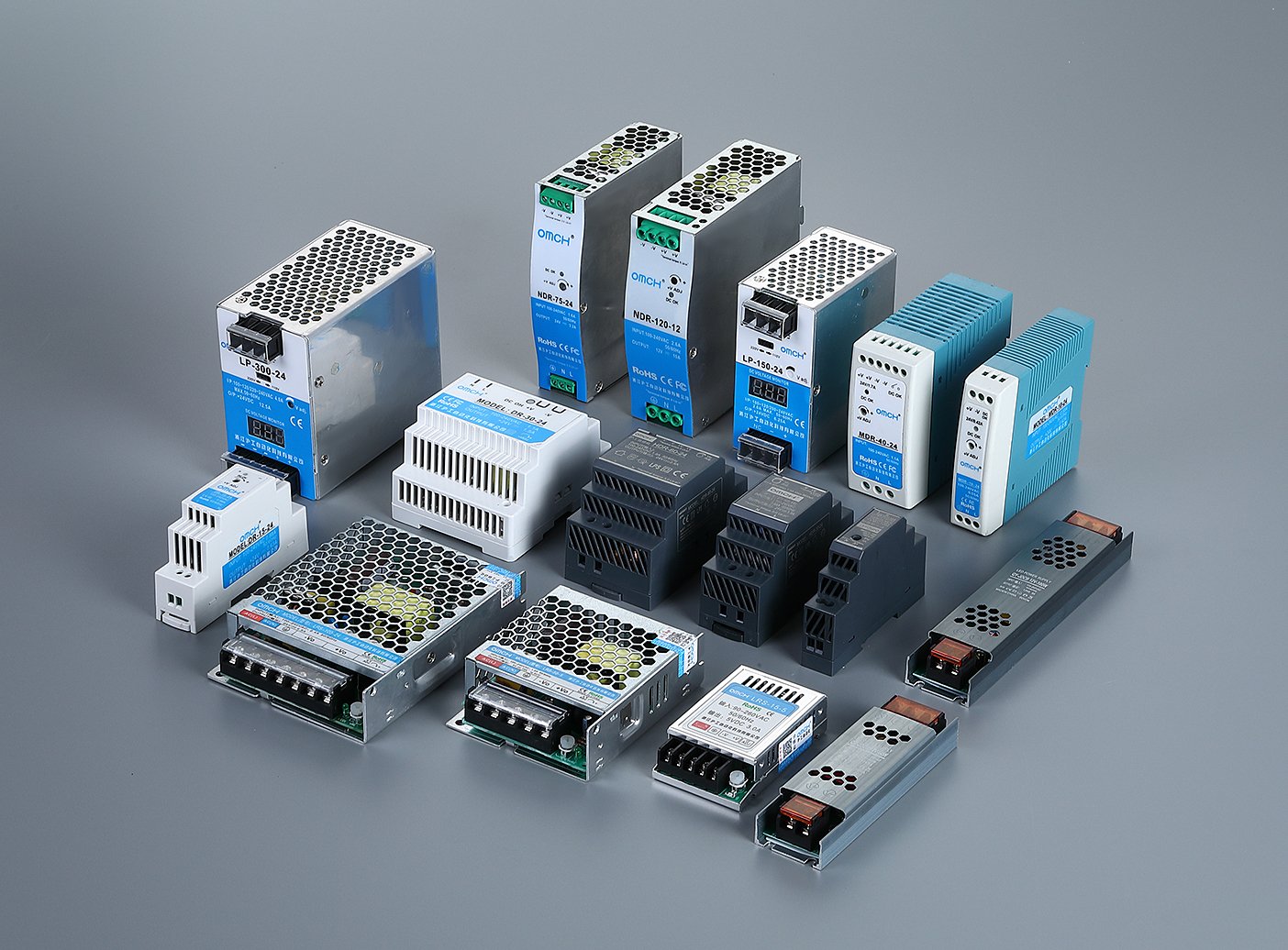
Normal civilian power adapters typically only go as far as to be usable in a room-temperature environment, whereas industrial-grade Switching Mode Power Supplies (SMPS) of OMCH are made to be challenged:
- Extreme Anti-Interference Ability (EMI/EMC): Factories are full of electromagnetic interference from large motors. OMCH products pass strict IEC standards and CCC, CE certifications, ensuring that the output voltage remains pure even in high electromagnetic noise environments, without falsely triggering sensors.
- Broad Temperature Adaptability: From cold northern warehouses to high-temperature injection molding workshops, OMCH power supplies can still run stably at full load under extreme ambient temperatures.
- Superior Protection Mechanisms: In-built overload protection, overvoltage protection and short-circuit protection. Once a fault is detected in the backend circuit the OMCH power supply will automatically switch to protection mode to prevent the destruction of expensive controllers (PLCs) or sensors worth hundreds of thousands.
- Full Category Coverage: We have 7 professional production lines and over 3,000 models. OMCH is able to provide a one-stop solution be it DIN rail power supplies, waterproof power supplies or adapters.
Having the confidence of more than 72,000 customers in more than 100 countries around the world, what OMCH offers is not merely a power supply, but the assurance of the never-ending industrial production lines.
Linear vs. Switching Power Supplies: Which Should You Choose?
When choosing a power supply, it is crucial to understand the two mainstream technologies:
| Feature | Linear Power Supply | Switching Power Supply (SMPS) |
| Working Principle | Consumes excess voltage through heat dissipation | Controls energy transmission through high-frequency switching |
| Efficiency | Lower (usually 30%-60%) | Extremely High (usually 80%-95%+) |
| Size & Weight | Bulky (requires a large transformer) | Lightweight (high-frequency operation allows miniaturization) |
| Heat Generation | Large (requires huge heat sinks) | Small (extremely low energy loss) |
| Application Scenarios | Ultra-high precision audio equipment, lab power supplies | Industrial automation, computer power supplies, LED drivers |
Conclusion: Switching Mode Power Supplies (SMPS) are the new mainstream in the modern industry, and this is the main direction of R&D of OMCH. It is very efficient, resulting in reduced energy wastage and increased equipment life.
Common Troubleshooting Tips for Industrial Power Converters
Even high-quality power supplies may fail due to environmental factors. Here are common troubleshooting tips for industrial sites:
- Capacitor Aging:
- Phenomenon: Output ripple becomes larger, and the device restarts frequently.
- Reason: High ambient temperature causes the electrolyte to dry up.
- Prevention: Regularly check if the top of the capacitor has bulges and ensure the cabinet is well-ventilated.
- Rectifier Failure:
- Phenomenon: The fuse at the input end blows instantly.
- Reason: Instantaneous high voltage shock (surge) from the power grid.
- Prevention: Install an OMCH surge protector at the front end and leave a certain voltage margin during selection.
- Overheating Caused by Loose Wiring:
- Phenomenon: The terminal block is carbonized or discolored.
- Reason: Factory machine vibration causes screws to loosen.
- Advice: Regularly perform infrared thermal imaging inspections to ensure all connection points are tight.
Conclusion
The conversion of Alternating Current into Direct Current is a miniature of the ideal use of physical laws by the human race. To the industrial user who wants to achieve excellence, the knowledge of these principles does not only assist in the selection but also enhances the stability of the system.
Do you need a reliable and stable power supply for your new project? OMCH offers 24/7 fast-response technical support, and our professional team is willing to give you full services, including selection to after-sales.


 English
  Arabic
  Turkish
  Russian
  Spanish
  French
  Indonesian
  Portuguese
  Thai
Thai  Vietnamese