




What Is a DIN Rail Power Supply
A DIN rail power supply is an AC-to-DC converter designed to snap onto a standardized 35mm metal rail inside industrial control cabinets. It is the default way to deliver stable DC power to automation equipment. If you have ever opened an electrical control panel and noticed a compact metal box with wires going in one side and out the other — mounted alongside circuit breakers and relays on the same metal strip — you were looking at one.
To understand it fully, we need to unpack both parts of the name.
The DIN Rail Standard — Where the Name Comes From
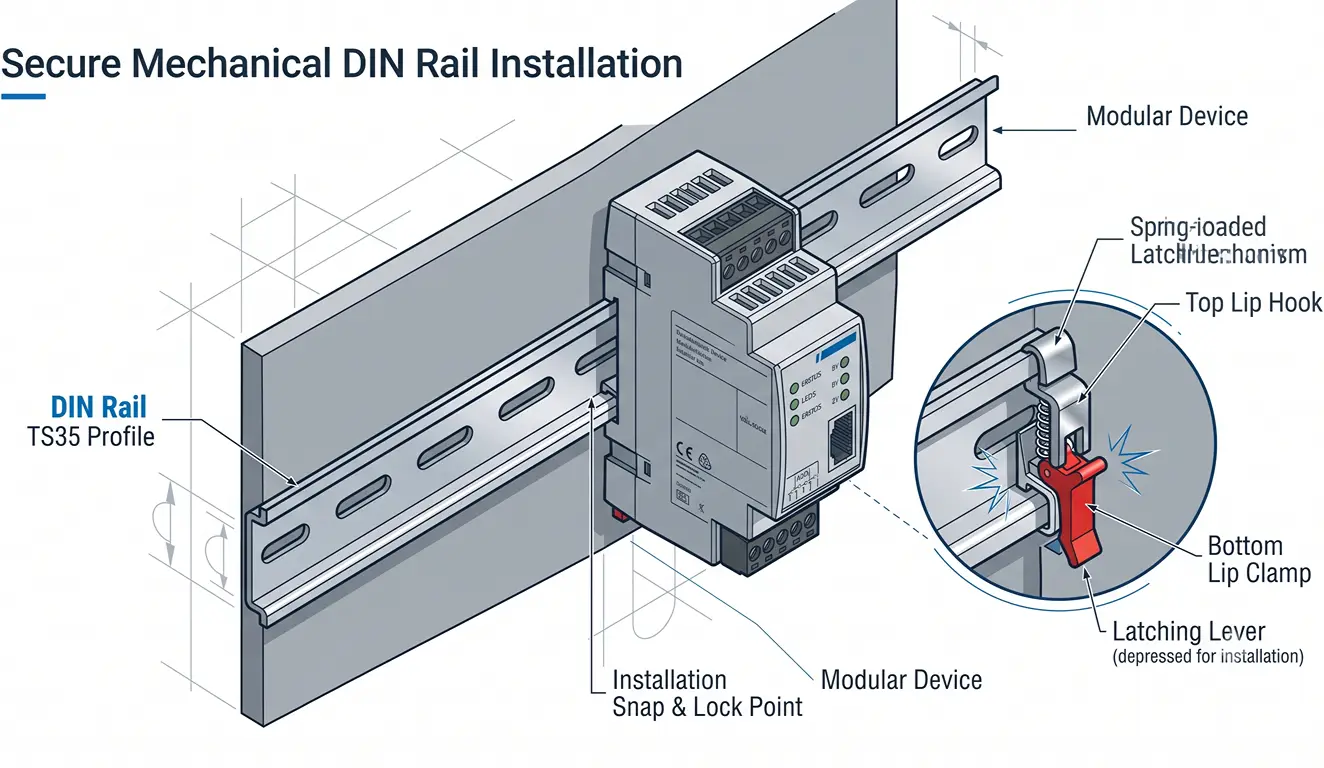
DIN stands for Deutsches Institut für Normung, the German Institute for Standardization, founded in 1917. The mounting rail we use today is defined by the international standard IEC/EN 60715, which specifies a 35mm-wide metal strip with a distinctive “top hat” cross-section. This shape (often called TS35 in North America) allows compatible devices to hook onto the upper edge and snap down with a spring-loaded clip at the bottom. No tools, no screws, no drilling.
Why 35mm? Because standardization creates interoperability. A circuit breaker from one brand, a relay from another, and a power supply from a third all clip onto the same rail inside the same cabinet. Think of a DIN rail as the USB port of the electrical enclosure world: a universal physical interface that eliminates custom brackets and adapters.
DIN rails come in two depth profiles under the standard: TS35×7.5 (shallow, for lightweight devices like terminal blocks and small relays) and TS35×15 (deep, for heavier components like power supplies and motor controllers). Most DIN rail power supplies mount on the deeper 15mm profile.
The Power Supply Unit Itself
The power supply half of the equation does one straightforward job: it takes the alternating current (AC) from your mains electricity and converts it into the direct current (DC) that industrial electronics need to operate.
Why does this conversion matter? Your factory’s wall power is AC — voltage that swings back and forth 50 or 60 times per second. But a PLC, an HMI touchscreen, or a bank of sensors all need smooth, stable DC voltage, typically 24V DC, to function reliably. Feeding AC directly into these devices would destroy them. The DIN rail power supply sits between the mains and your equipment, bridging that gap.
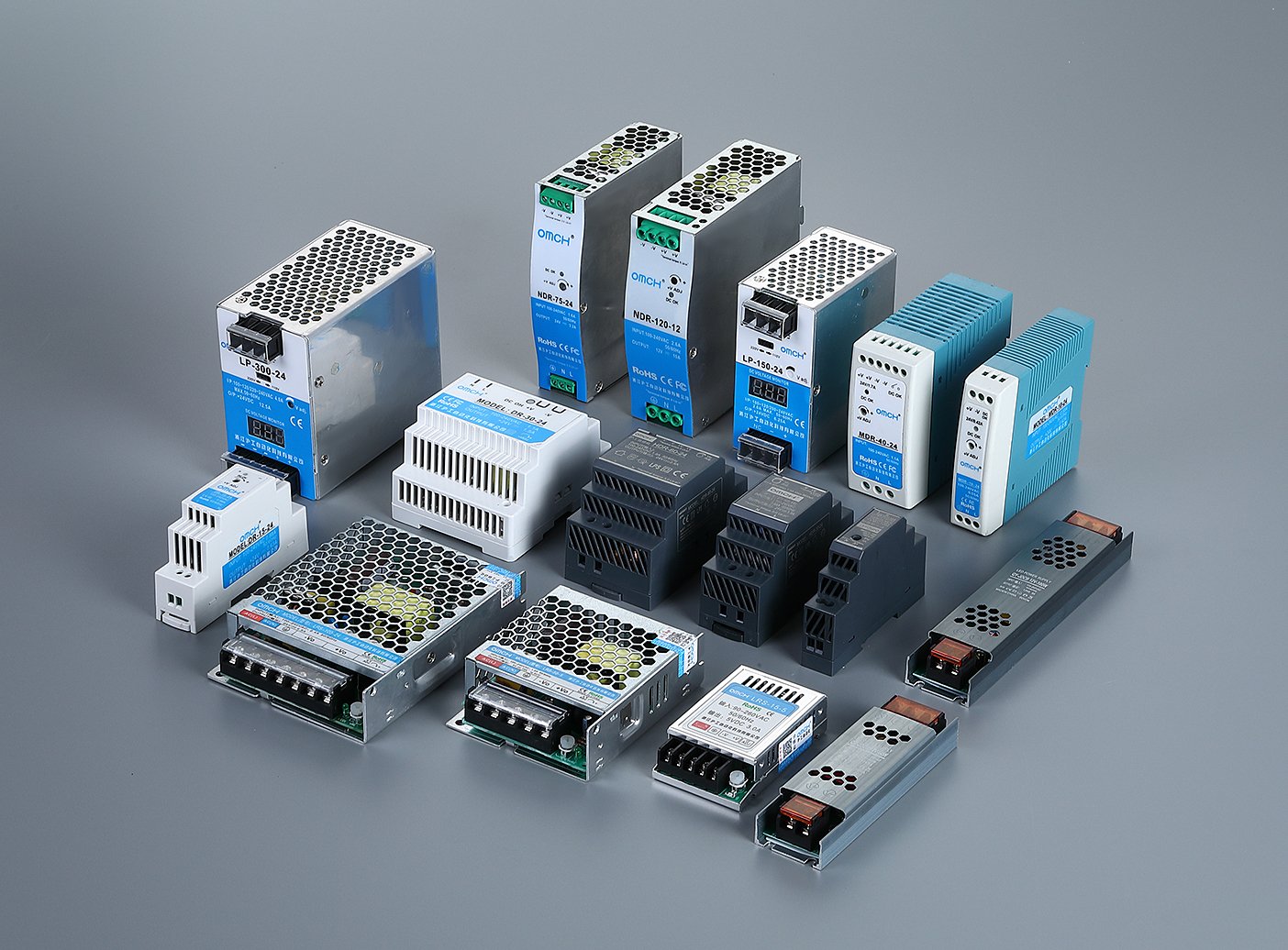
Physically, these units are compact metal or plastic enclosures. They range from the width of two fingers (18mm for a 15W unit) to about the width of your hand (110mm for a 480W unit). On the front you will find input terminals (marked L, N, and PE for earth), output terminals (V+ and V-), a green LED indicating “DC OK,” and often a small potentiometer for fine-tuning the output voltage.
Key Characteristics at a Glance
Three design decisions define every DIN rail power supply:
Snap-on mounting. The back of the unit has a mechanical latch that mates with the TS35 rail. Installation takes seconds: hook the top, pivot down, hear the click. Removal is just as fast. Pull the latch with a screwdriver and lift off. This modularity means a failed unit can be swapped in under a minute, minimizing production downtime.
Convection cooling. Almost all DIN rail power supplies are fanless. This surprises people. Shouldn’t electronics that handle hundreds of watts need active cooling? The answer lies in the environment. Industrial control cabinets are often sealed to NEMA 12 standards to keep out dust, oil mist, and moisture. A fan would merely recirculate hot air and become the first component to fail. Instead, these power supplies use their aluminum housing as a heatsink, relying on natural convection: hot air rises, cool air enters from below, and the cycle sustains itself without a single moving part.
Built-in protection. Short circuit, overload, overvoltage, and over-temperature. These four protections are standard in any industrial-grade unit. If a sensor wire gets pinched and shorts to ground, the power supply detects it, shuts down the output within microseconds, and auto-recovers once the fault clears. This protects both the power supply itself and every device downstream of it.
How a DIN Rail Power Supply Works
Every DIN rail power supply does one job: take unpredictable AC mains power and turn it into clean, predictable DC power that sensitive industrial electronics can rely on. Here is how that conversion happens, and why the cooling approach matters as much as the electronics.
From AC Input to DC Output — The Conversion Chain
The conversion happens in three stages, all packed into that compact metal case.
Stage 1: Rectification and filtering. The incoming AC voltage can be anywhere from 85V (Japanese mains) to 264V (British mains) for a universal-input unit. It first passes through an EMI filter to block electrical noise from entering or leaving the power supply. Then a bridge rectifier converts the AC sine wave into a pulsating DC waveform. Large input capacitors smooth out the ripples, producing a rough DC voltage of about 170V to 370V, depending on the input.
Stage 2: Switch-mode conversion. This is where the magic, and the efficiency, lives. The rough DC is chopped at a high frequency, typically 50kHz to 500kHz, by a switching transistor. This high-frequency AC passes through a small ferrite transformer that steps the voltage down to the target level. Because the transformer operates at 50,000+ cycles per second rather than the mains 50/60Hz, it can be dramatically smaller and lighter. The chopping itself is the efficiency secret: the switching transistor is either fully on (near-zero voltage drop) or fully off (near-zero current flow). Very little power is wasted as heat. This is how modern units achieve 87% to 96% efficiency (RECOM, 2025).
Stage 3: Output regulation and filtering. The stepped-down voltage is rectified again, then passes through output filtering capacitors and inductors to remove the high-frequency switching noise. A feedback circuit continuously monitors the output voltage and adjusts the switching duty cycle in real time to maintain regulation, typically within ±1% of the setpoint. The final result is clean DC with ripple typically below 50mV peak-to-peak on a 24V output.
Why No Fan? — The Convection Cooling Advantage
As Bruce Desmond of Phoenix Contact noted in a widely cited analysis of industrial-grade power supplies (Electronic Design, 2004), at least 80% of industrial-grade applications use cabinets without ventilation. In a sealed NEMA 12 enclosure, a fan is worse than useless. It stirs hot air around and eventually seizes from dust and vibration.
Convection cooling solves this by design. The power supply is mounted vertically with the terminals facing downward. As internal components generate heat, the aluminum housing transfers it to the surrounding air, which rises naturally. This draws cooler air in from the bottom, creating a passive but continuous cooling cycle. The absence of a fan eliminates the single most common failure point in industrial electronics, contributing to MTBF (mean time between failures) ratings of over 500,000 hours (per IEC 61709) in quality units.
The trade-off is that spacing matters. A power supply needs at least 50mm of open space above and below it for the convection current to establish. Block that space, and the unit will overheat and begin derating — protecting itself by reducing output power. We will cover this more in the installation section.
Key Specifications Explained
Once you move beyond the basics, a DIN rail power supply is defined by a handful of key parameters. Understanding these makes the difference between skimming a datasheet and actually reading one.
Input voltage range. “Universal input” means 85–264V AC, single-phase. It is compatible with every mains voltage from Japanese 100V to British 230V, with no manual switching required. For higher-power applications (typically 480W and above), three-phase input (320–575V AC) is common. Some specialized units also accept DC input (430–815V DC) for solar and battery storage applications.
Output voltage and current. 24V DC is the industry standard for a reason. It is low enough to be touch-safe under SELV (Safety Extra-Low Voltage) regulations — below the 50V hazardous threshold defined by both OSHA and IEC standards — yet high enough to reliably power solenoid valves, relay coils, and sensors over long cable runs. 12V and 48V outputs exist for niche applications (automotive, telecom), but if you do not have a specific reason to choose otherwise, 24V is the default.
Power rating. Wattage is simply voltage multiplied by current: a 24V, 10A unit is a 240W unit. The critical rule is to size with a 20–30% margin above your calculated total load. This headroom accounts for startup inrush currents, load fluctuations, future expansion, and temperature derating.
Efficiency. A 5% efficiency difference is not academic. Testing by PULS has shown that a 5% lower efficiency translates to roughly a 10–16°C higher internal temperature inside a sealed enclosure. That is enough to potentially halve the lifespan of electrolytic capacitors. For units above 75W sold in the EU, active power factor correction (PFC >0.9) is required by EN 61000-3-2. The universal input capability is a byproduct of the PFC circuit design.
Hold-up time. This is the number of milliseconds the power supply can maintain its output after the input power is lost, typically ≥20ms for industrial units. Twenty milliseconds is one complete cycle of 50Hz AC. In practical terms, this means the power supply can ride through a momentary voltage sag or a single missing mains cycle without the PLC rebooting and the production line stopping.
Ripple and noise. Measured in millivolts peak-to-peak (mVpp), this tells you how clean the DC output is. For a 24V output, anything below 50mVpp is considered good industrial grade. Excessive ripple can cause erratic sensor readings and communication errors on industrial networks.
Protection features. Short-circuit protection (hiccup-mode auto-restart), overload protection (constant-current limiting), overvoltage protection (output clamp), and over-temperature protection (thermal shutdown) are standard. If a unit lacks any of these four, it is not industrial grade.
Where DIN Rail Power Supplies Are Used
If your work touches any of the following, there is almost certainly a DIN rail power supply running quietly in the background.
| Application | What It Powers | Why a DIN Rail PSU? |
|---|---|---|
| Factory automation | PLCs, HMIs, I/O modules, sensors | Standardized 24V backbone for the entire control system |
| Process control | Transmitters, flow meters, analyzers | Clean, stable DC for measurement accuracy |
| Packaging & material handling | Conveyor controllers, sorters, barcode scanners | Modular, easy to expand as lines grow |
| Building management | Fire alarms, HVAC controllers, access control | Compact, fits inside standard electrical panels |
| Renewable energy | Monitoring gateways, communication equipment | DC input options for direct battery/solar connection |
| Infrastructure | Traffic signals, pump station controls, water treatment | Reliability in unattended outdoor enclosures |
Open any industrial control cabinet, and the power supply is almost always in the upper-left corner. That is the starting point of the DC distribution. Every other device on that rail depends on it. When it fails, everything downstream goes dark. That is why selection matters.
How to Choose the Right DIN Rail Power Supply
Choosing a DIN rail power supply is not complicated once you break it into three sequential decisions. Think of it as a checklist. Each step eliminates wrong options until only the right one remains.
Step 1 — Calculate Your Power Budget
This is the step most first-time specifiers get wrong, and the mistake is almost always the same: underestimating the total load.
Start by listing every device that will draw DC power from this supply: the PLC, the HMI, each sensor, each relay coil, each indicator light. Look up the power consumption of each. Most will be listed in watts. For devices listed in amps at 24V, multiply by 24 to get watts. Sum everything, then multiply by 1.2 to 1.3 (a 20–30% safety margin).
Here is a real example. A small conveyor control cabinet might contain a PLC (30W), an HMI panel (15W), 12 photoelectric sensors at 1W each (12W), 8 relay coils at 2W each (16W), and a network switch (10W). Total: 83W. With a 25% margin: 104W. You would select a 120W unit, the next standard size up.
Also check for devices with high inrush current, such as motors and solenoid valves. These can briefly draw 150% to 300% of their rated current at startup. If your power supply offers a “power boost” capability (like 150% for 3–5 seconds), it can handle these surges without tripping. If not, you need to size for the peak, not the average.
Step 2 — Match Input and Output to Your System
On the output side, 24V DC covers the vast majority of industrial needs. Choose 12V only if you are working with automotive-spec equipment. Choose 48V for telecom, PoE infrastructure, or when you need to deliver power over very long cable runs (higher voltage = lower current = less voltage drop).
On the input side, a single-phase universal input (85–264V AC) handles nearly everything below 480W. It works worldwide and eliminates the risk of someone flipping a 110V/220V selector switch to the wrong position — because there is no switch. For systems drawing 480W or more, a three-phase input (320–575V AC) is typical, especially when the factory already has three-phase power distributed to the machine.
| Single-Phase | Three-Phase | |
|---|---|---|
| Input range | 85–264V AC | 320–575V AC |
| Typical power range | 10W–480W | 480W–960W+ |
| Best for | Most control panels | Large machines, heavy automation |
Step 3 — Verify Environment, Certifications, and Features
The same 240W power supply that runs perfectly at full load in a 25°C air-conditioned room may only deliver 180W in a 55°C sealed cabinet. Every datasheet includes a derating curve: a graph showing how much output power drops as ambient temperature rises. Typically, full power is available up to 50°C or 60°C, then decreases by 2–3% per additional degree. If your cabinet sits in an un-air-conditioned factory in summer, you need to account for this.
Certifications are your proof that the unit has been independently tested. For the North American market, UL 508 (Industrial Control Equipment) is the minimum requirement. For hazardous locations with flammable gases or dust, look for ATEX or UL HazLoc Class I Division 2 certification. In the EU, CE marking backed by a Declaration of Conformity is mandatory. CCC is required for the Chinese market.
Beyond the basics, a few features are worth seeking out. A DC OK relay contact lets you wire a remote alarm if the power supply fails. Parallel/redundancy capability lets you connect two units through a redundancy module for N+1 configurations in critical systems. Conformal coating on the circuit boards protects against humidity and corrosive atmospheres in chemical plants, food processing facilities, and outdoor installations.
DIN Rail vs. Other Power Supply Form Factors
Not every box that outputs DC voltage is the same. Here is where the DIN rail form factor fits among its relatives.
| Form Factor | Mounting | Cooling | Best For |
|---|---|---|---|
| DIN Rail PSU | Snaps onto TS35 rail | Convection | Control cabinets, modular automation panels |
| Enclosed / Panel Mount | Screws to a sub-panel | Often fan-cooled | Standalone machines, general industrial |
| Open Frame | Screws into host equipment chassis | Varies | OEMs embedding power into their own products |
| Wall Adapter / LED Driver | Plug or inline | Convection (small) | Consumer electronics, LED lighting |
The key distinction: if your equipment lives inside a control cabinet alongside other DIN-mounted components, choose a DIN rail power supply. It shares the same rail, the same form factor, and the same maintenance workflow as everything else in the panel. If your device is a standalone machine with its own enclosure and no other DIN rail components, an enclosed panel-mount supply may be more appropriate.
A common point of confusion: an LED driver is not a DIN rail power supply, even if some LED drivers do mount on DIN rails. LED drivers are constant-current sources designed for a specific load characteristic. DIN rail power supplies are constant-voltage sources designed to power a variety of industrial loads. Using one in place of the other will, at best, not work. At worst, it will damage your equipment.
Getting Started with Installation
The physical installation of a DIN rail power supply is straightforward, but a few principles separate a reliable panel from a troubleshooting headache six months later.
Mounting. Hook the top edge of the power supply onto the rail, pivot it downward until the bottom latch clicks, and give it a gentle tug to confirm it is locked. That is it. To remove it, insert a flathead screwdriver into the latch release slot and lift.
Spacing. This is the one rule that gets ignored most often and costs the most in the long run. Leave at least 50mm of open space above and below the power supply for convection airflow, and 10–15mm on each side (25mm for units above 240W). Stacking devices too tightly is like putting a blanket over the power supply. It will run hot, derate early, and age its capacitors prematurely.
Wiring. Input side: connect L (line), N (neutral), and PE (protective earth) to the input terminals. Always install a circuit breaker or fuse upstream of the power supply. Output side: V+ and V- feed your DC distribution. Use ferrules (crimp-on wire end sleeves) on all stranded wire connections. Bare stranded wire stuffed into a screw terminal will loosen over time from thermal cycling and vibration. Tighten terminals to the manufacturer’s torque specification, typically 0.5–1.2 Nm.
Grounding. The PE terminal must connect to the panel’s grounding busbar with a dedicated green/yellow conductor. Never rely on the DIN rail alone for the earth connection. The rail is a mechanical support, not a guaranteed electrical path.
Commissioning. Power up the unit with no load first and verify the output voltage with a multimeter. Check that the DC OK LED is green. Then apply load gradually — 25%, 50%, 75%, 100% — monitoring the output voltage and the unit’s case temperature at each step. If anything drifts, you have caught it before it becomes a field failure.
If you are at the stage of comparing specific models, OMCH offers a range of DIN rail power supplies from 75W to 480W in their NDR series — all with CE, CCC, and RoHS certification, universal AC input, and convection-cooled design. Whether you are building a single control panel or outfitting a production line, having your power supply, circuit breakers, relays, and sensors all available from one source can simplify procurement and ensure compatibility.
References
- IEC. “IEC 60715: Dimensions of low-voltage switchgear and controlgear — Standardized mounting on rails for mechanical support of electrical devices.” Wikipedia: DIN Rail
- Morrison, David. “DIN Rail Power Supplies Move Beyond the Factory Floor.” Electronic Design, August 2004. Full article
- RECOM. “Choosing the Right DIN Rail Power Supply for Your Application.” 2025. Selection guide
- PowerVolt Group. “Why 24V is the Standard Voltage in Industrial Control Panels.” Blog post
- OMCH. Switch Mode Power Supply product page. https://www.omch.com/switch-mode-power-supply/
- OMCH. Homepage. https://www.omch.com/


 English
  Arabic
  Turkish
  Russian
  Spanish
  French
  Indonesian
  Portuguese
  Thai
Thai  Vietnamese